What KPIs should food service operators track for guest experience?
Operational KPIs tell you whether a food service operation ran; guest-experience KPIs tell you how it felt to the people eating. This guide covers eight guest-experience KPIs worth tracking, what each one signals and how to turn them into action.

The guest experience KPIs worth tracking include food quality, speed and wait time, cleanliness, service and friendliness, atmosphere, participation, overall satisfaction and feedback response volume. Together they turn the dining experience from a subjective impression into something you can measure and improve.
A common trap is to measure food service KPIs, such as meals produced, cost per cover and waste, and assume they describe the guest experience. While those numbers tell you whether the operation ran efficiently, they do not indicate whether guests enjoyed their meal. Guest experience KPIs measure the outcome: how people actually felt, and if they will return. This guide breaks down the eight KPIs that matter, what each one signals and how to act on it.
Operational KPIs vs. Guest experience KPIs
It helps to be clear about the two families of metrics. Operational KPIs, including covers served, food cost percentage, labor cost, plate waste and service-level agreement (SLA) compliance, measure how well the operation runs. Guest experience KPIs measure how the dining experience feels to the people eating at your facility. Both matter, and they are best read together, since a strong operational report and a lukewarm lunchtime can occur at the same site on the same day. For the underlying distinction, see our guide on food service versus food experience. The eight below are guest experience KPIs worth tracking.
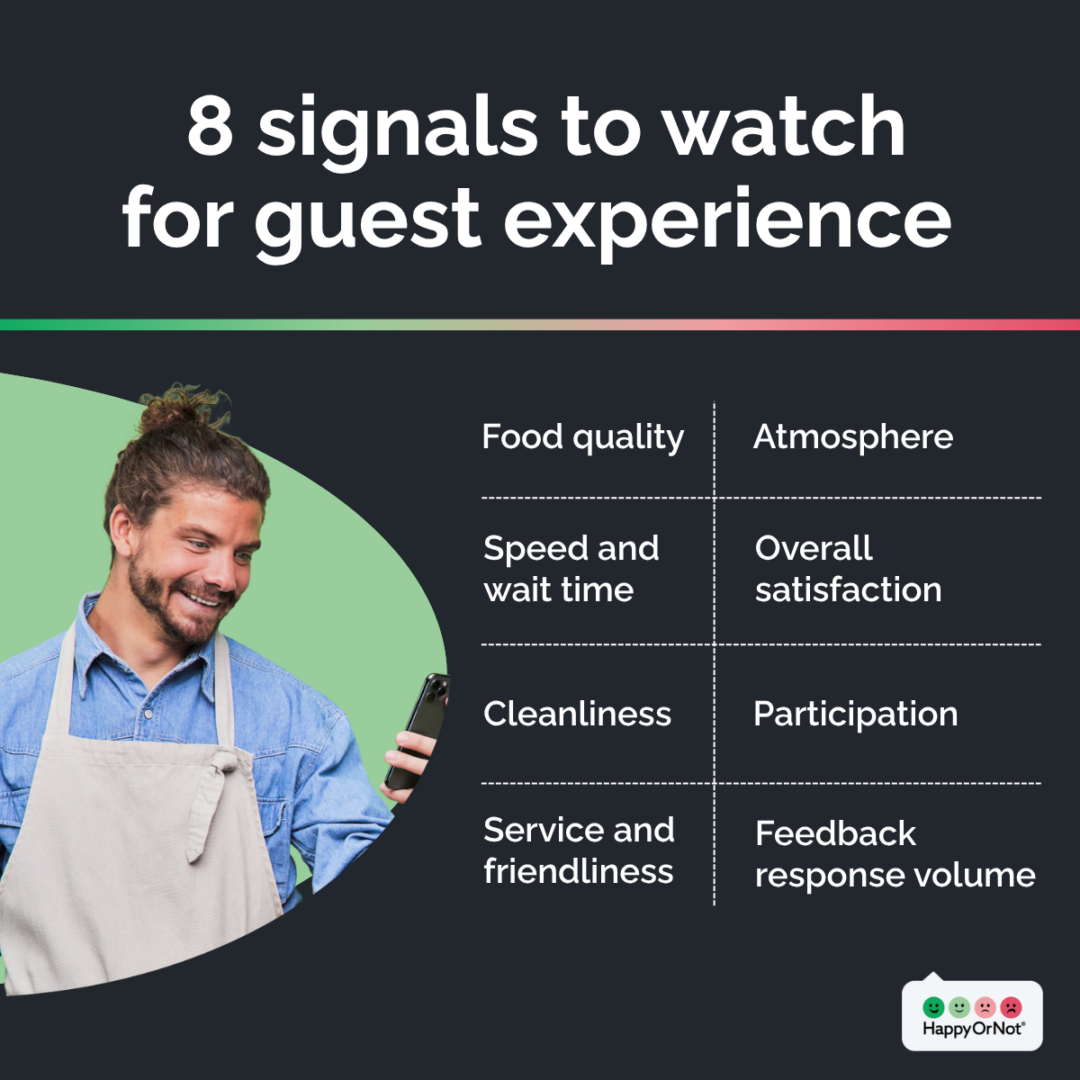
8 guest experience KPIs food service operators can track
1. Food quality
- What it measures: satisfaction with taste, temperature, freshness and consistency, the foundation of the whole experience.
- Why it matters: no other measure fully compensates for food that disappoints.
- How to act: capture dish-level feedback so you can see which items land well and which drag the average down. The City of Järvenpää tracks satisfaction per dish, which gives the team clear direction on what to keep and what to change.
2. Speed and wait time
- What it measures: guest satisfaction with how long service takes, especially at peak.
- Why it matters: at lunch or dinner rush, speed is often the biggest single driver of how a visit feels.
- How to act: track satisfaction by time of day to see when the queue is costing you, then match staffing to the peak.
3. Cleanliness
- What it measures: guest perception of hygiene across the serving area, seating and trays
- Why it matters: cleanliness is a baseline expectation, largely invisible when right and quickly noticed when wrong.
- How to act: a sudden dip at a specific site and hour is often the earliest signal that something needs attention now, rather than at the next audit.
4. Service and friendliness
- What it measures: the warmth, helpfulness and knowledge of the frontline team.
- Why it matters: human moments tend to be what guests remember longest, and a strong team can lift an ordinary menu.
- How to act: use positive feedback to recognize team members and recurring issues to guide coaching. Teams often find that visible results help motivate staff to keep raising the standard.
5. Atmosphere
- What it measures: comfort, noise, seating and the overall feel of the dining space.
- Why it matters: atmosphere shapes whether a space is somewhere people want to linger or somewhere they endure.
- How to act: pair sentiment with observation to find quick wins, such as seating layout, noise or flow, that lift the room.
6. Participation
- What it measures: how many eligible diners choose to eat with you.
- Why it matters: in managed dining, participation is often the ultimate outcome, and frequently the commercial one. As a nutrition leader at Capistrano Unified School District put it, “if they don’t eat with us, we don’t get paid.”
- How to act: watch participation alongside satisfaction, since a satisfaction dip often precedes a participation drop, which gives you time to intervene.
7. Overall satisfaction
- What it measures: a single, headline satisfaction score for the dining experience.
- Why it matters: one consistent number helps you track a site over time and compare across locations.
- How to act: HappyOrNot summarizes this with the Happy Index, a transparent 0 to 100 score derived from the four-button scale with no hidden weighting, which ISS has described as a simple, easy-to-understand measure across its restaurants.
8. Feedback response volume
- What it measures: how many feedback responses you are collecting.
- Why it matters: every other KPI is only as reliable as the volume behind it, since more responses make patterns clearer and dilute the odd outlier.
- How to act: treat response volume as a measure in its own right, and work to raise it. Displaying results and acting on them visibly tends to encourage more people to take part.
How to turn KPIs into action
A KPI you only report tends to sit unused; a KPI you act on is what drives change. A simple operational cadence helps:
Daily. Glance at dips and comments and assign quick fixes to named owners.
Weekly. Review recurring drivers, compare sites and decide one improvement to make.
Monthly. Check that improvements held, then share what worked across locations.
Capturing these KPIs in real time, as microfeedback tied to time and place, is what makes daily action possible. For the how, see our guide on how to measure food experience; for comparing KPIs across a portfolio, see how to benchmark dining experience across multiple sites.
Track the measures that move the dining experience
HappyOrNot turns guest-experience feedback into a live, transparent score your teams can act on day to day. Explore HappyOrNot Analytics or our food service solutions.