Real-time customer feedback: How microfeedback transforms customer experience
Traditional surveys arrive too late to drive change. Discover how real-time microfeedback gives frontline teams immediate, contextual customer insights, enabling faster decisions, continuous improvement, and measurable customer experience impact.
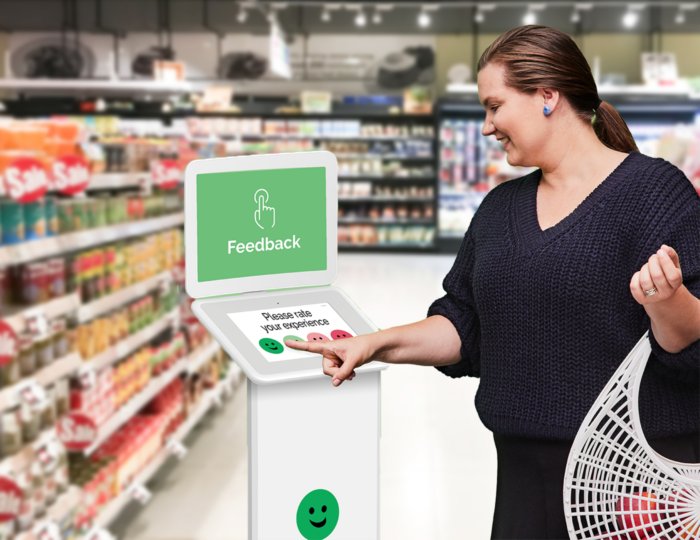
Traditional feedback often lands too late to matter. A survey link arrives days after the visit, a report gets reviewed weeks later, and the frontline has already moved on to the next rush, the next shift, the next fire drill. Response rates are also a structural problem, especially for email-based surveys, which have shown declining participation over time.
Microfeedback is a different system. It captures a steady stream of in-the-moment signals, ties them to time and place and gives location teams the visibility to act while the experience still has a chance to change.
If you run operations, use this page as a playbook for speed to action. The goal is not “more data.” The goal is faster, clearer decisions that improve customer experience where it happens.
Quick start
- Put feedback where the experience happens, not in the inbox.
- Review signals on an operational cadence (daily or weekly), not monthly.
- Assign ownership by location and touchpoint.
- Close the loop with visible actions and recognition.
What is real-time customer feedback?
Real-time customer feedback is input captured during or immediately after an experience, while details are still fresh and the context is still true. That timing matters because retrospective feedback is vulnerable to memory gaps and distortions, especially once time passes and other experiences blend in.
In operational terms, real-time feedback becomes useful when it includes:
- A fast signal (what happened)
- Context (where and when it happened)
- Visibility (who sees it quickly)
- A path to action (what changes today, this week)
Why traditional feedback methods fall short
Most feedback programs still lean on methods that were built for analysis, not frontline execution.
Common limits you feel in operations
- Delay breaks relevance. If you learn about a long queue weeks later, the moment is gone and the conditions have changed.
- Low engagement skews the picture. Email survey response rates vary widely and have trended downward, which makes it harder to rely on them as a consistent operational signal.
- You miss walkaways. Digital-only asks tend to reach people who have finished the journey. The people who left early are often the most useful signal.
- Recall problems creep in. The longer the gap, the less reliable the details, because memory is not a perfect recording of events.
Traditional surveys can still serve a purpose for deeper research, however, they do not match the cadence of day-to-day operations.
What is microfeedback?
Microfeedback is a short, low-friction way to capture real-time customer feedback at the point of experience, usually in seconds. Think: One quick sentiment signal, exactly where the moment happened, and optional context when a customer wants to say why.
Microfeedback works because it behaves like a signal system, not a questionnaire:
- It captures the experience while it is happening.
- It fits high-flow environments where people will not stop for long forms.
- It is simple enough to collect consistently across locations and shifts.
- It creates a feedback loop that operators can run every day.
Microfeedback vs. traditional surveys
Microfeedback is not “better research.” It is better operations.
Traditional surveys often optimize for depth and segmentation, but trade away speed and volume.
Microfeedback optimizes for speed, volume and actionability, then adds depth only where needed.
The practical difference
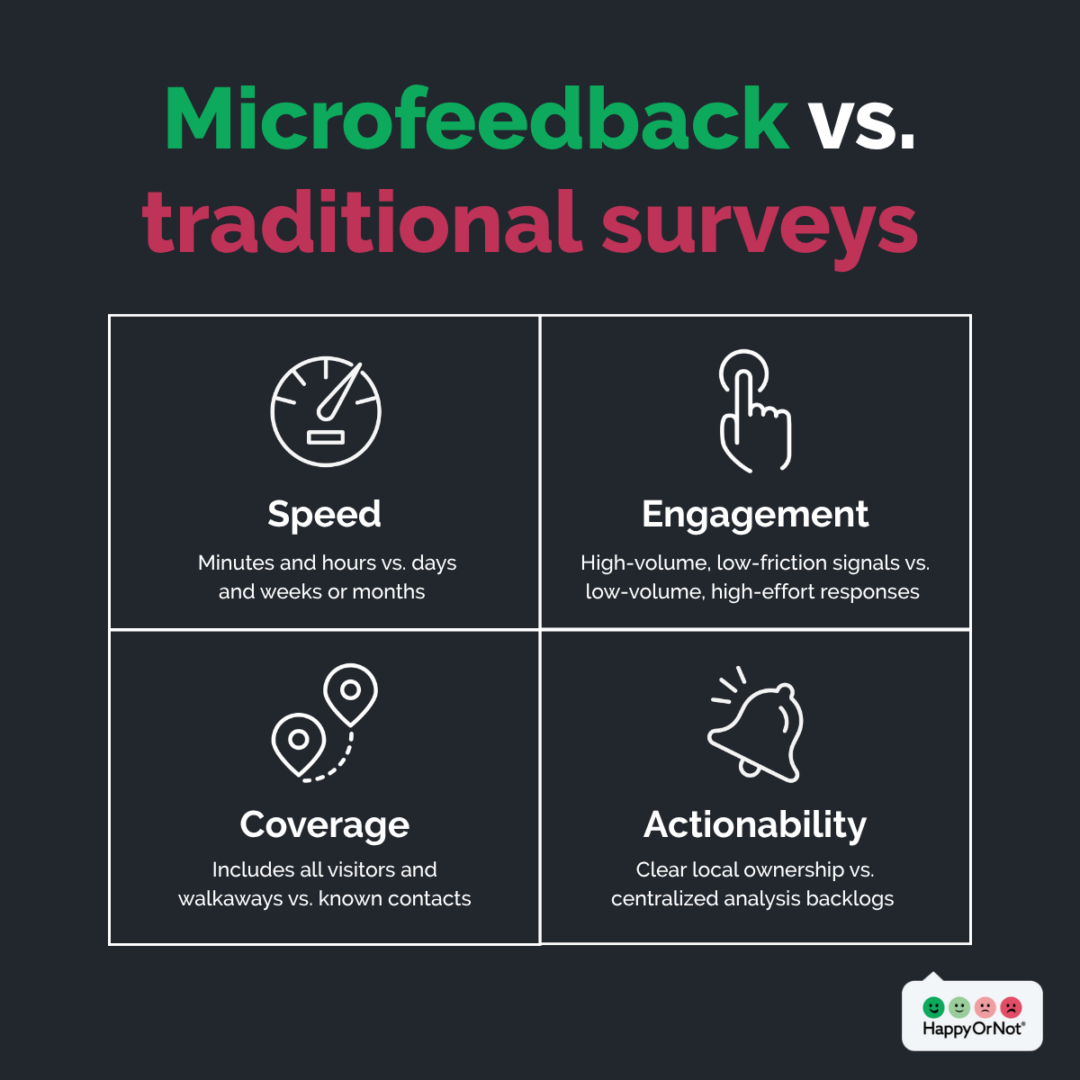
- Speed: Minutes and hours vs. days and weeks or months
- Engagement: High-volume, low-friction signals vs. low-volume, higher-effort responses
- Coverage: Includes in-location customers and walkaways vs. mostly reachable, known contacts
- Actionability: Clear local ownership vs. centralized analysis backlogs
If the question is “what should we fix before tomorrow,” microfeedback wins.
How real-time feedback works in practice
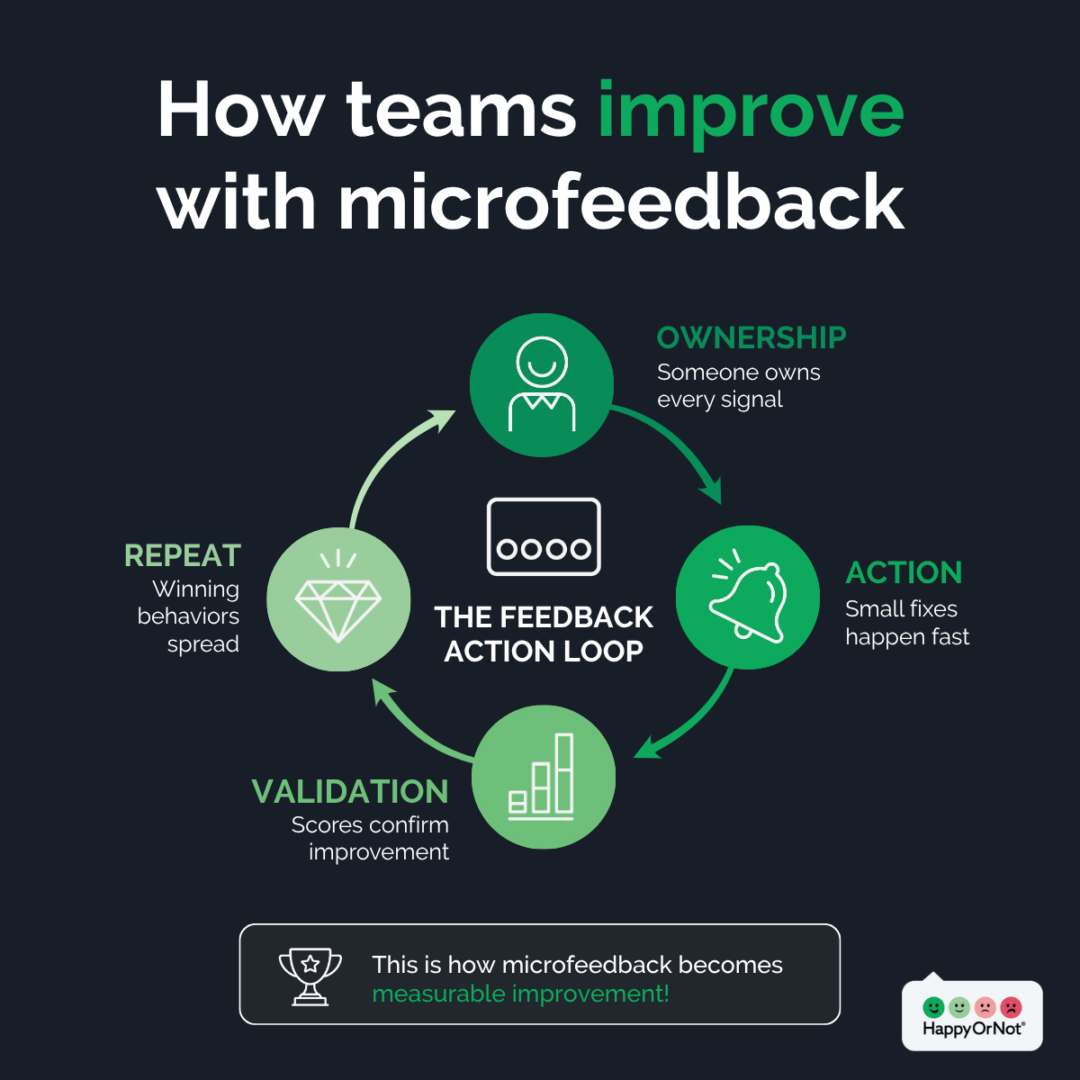
Real-time feedback becomes operational when you run it as a loop with clear ownership.
The loop operators can run
- Capture signals at key touchpoints (entry, service, queue, exit).
- Connect feedback to time and place so patterns are obvious.
- Review on a daily or weekly cadence that matches operations.
- Act with one or two fixes tied to owners, not committees.
- Close the loop by showing what changed and recognizing the team.
A simple operating rhythm
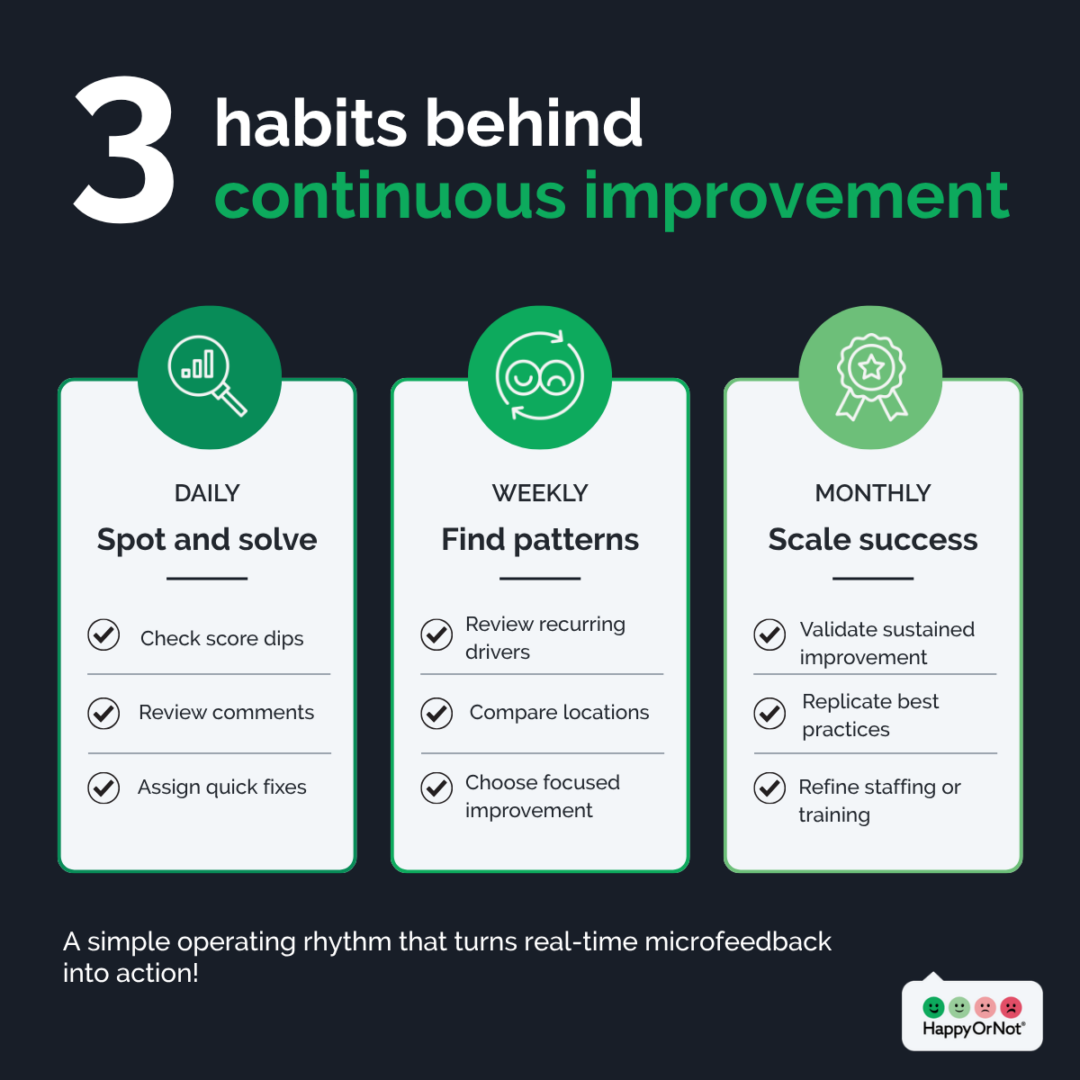
- Daily: Glance at dips, check comments, assign quick fixes.
- Weekly: Review recurring drivers, compare locations, decide one structural improvement.
- Monthly: Validate sustained lift, replicate best practices, adjust staffing or training.
Real-world use cases
Microfeedback is most powerful in environments where the experience changes by time window, location and staffing.
Retail
Use microfeedback to spot where experience drops (checkout, availability, service), then adjust staffing, coaching or process while the store is still trading.
Hospitality
Track service quality by moment of truth (arrival, cleanliness, wait time) and fix recurring friction before it becomes review-site damage.
Transport and other high-traffic environments
High footfall amplifies small failures. Microfeedback highlights hotspots fast so teams can deploy cleaning, wayfinding, staffing or escalation before dissatisfaction compounds.
How teams turn feedback into action
The difference between “lip service” and impact is not the tool. It is the operating system around it.
Make ownership unavoidable
- Assign an owner for each location or zone.
- Keep visibility simple enough that the frontline actually uses it.
- Tie actions to the same cadence leaders already run (standups, weekly ops reviews).
Coach and recognize, not blame
- Use signals to spot where teams need support.
- Use positive comments to reinforce what is working.
- Share wins publicly so teams trust the system.
Keep actions small, consistent and visible
Microfeedback drives customer experience improvement through accumulation: Small fixes that land fast, repeated often, and are validated in the score.
Key takeaway
Real-time customer feedback only creates ROI when it reaches the people who can act, in a timeframe that matches how operations run. Microfeedback delivers that by turning customer input into fast, contextual signals that drive same-day improvements.
Want to turn microfeedback into a daily operating rhythm across locations? Explore how HappyOrNot supports real-time visibility, clear ownership and fast action through simple feedback collection tools.