
Turn customer feedback analysis into clearer answers
Customer feedback can quickly become difficult to interpret when important changes are spread across charts, time periods and customer comments. HappyOrNot simplifies customer feedback analysis, making it easier for operational teams to find the signal and understand the story behind performance.
See what matters first with AI-powered Insights
Insights gives teams a clearer starting point for customer feedback analysis. Instead of beginning with dashboards, charts and filters, teams see a monthly narrative view of important changes and observations in performance. When something deserves a closer look, teams can move directly into the underlying comments, comparisons and deeper Analytics.
- See important changes and observations each month without manually comparing multiple charts
- Understand monthly performance in context
- Bring quantitative feedback and customer comments together
- Drill into deeper Analytics when something needs investigation



Analyze the open feedback you choose
Open Feedback Summary uses AI for customer sentiment analysis, summarizing, the customer comments you choose to analyze, helping you quickly understand what customers are saying without reading every response. Explore feedback across different timeframes, days or demographics to answer specific questions and understand the feedback most relevant to you.
- Summarize large volumes of open feedback in seconds
- Identify key strengths and areas for improvement
- Analyze feedback across the timeframe, day or demographic you choose
- Investigate specific questions using the feedback most relevant to you
Focus your analysis with Themes and Categories
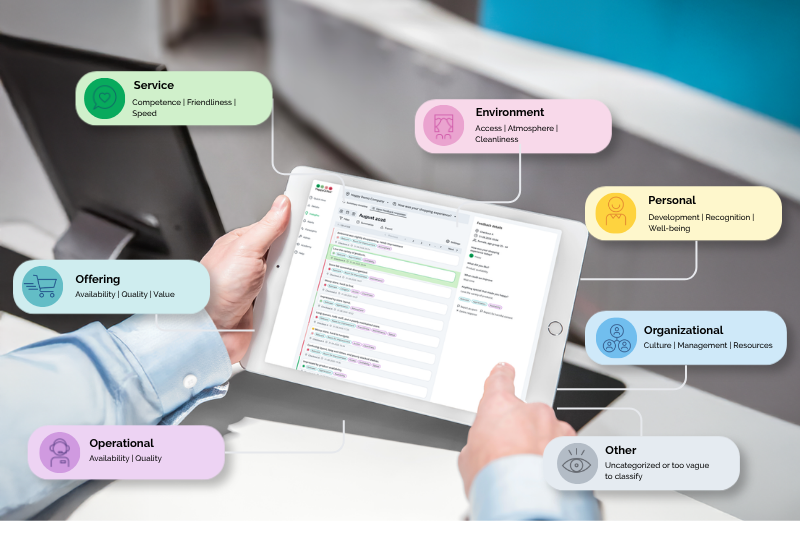
Themes and Categories add structure to open feedback, helping teams focus on the feedback most relevant to their analysis. Available within both Insights and Open Feedback Summary, they provide complementary ways to explore feedback by topic or filter for specific comments relevant to your investigation.
Themes: See what customers are talking about
Groups open feedback by topic and sub-topic, making recurring themes such as speed, friendliness and cleanliness easier to identify and explore.
Categories: Find relevant feedback faster
Classifies open feedback so teams can filter and find the comments most relevant to what they are investigating.
 “With HappyOrNot’s AI-enhanced open feedback, we instantly see what’s working and what’s not across our food departments globally. The easy-to-read, categorized summaries of our customers’ comments make our decisions on menus and service improvements quicker and easier, and give us valuable input for client meetings and staff recognition.”
Tracey Coetzee, Global Food Manager, ISS
What sets HappyOrNot’s AI apart?
HappyOrNot’s AI is built specifically for customer feedback analysis. Integrated into our customer feedback management software, it combines AI with our experience in microfeedback and real-time customer feedback to turn high volumes of customer signals into clear, relevant insight for operational teams.
- Built for customer feedback: Purpose-built for customer feedback analysis, rather than relying solely on generic AI capabilities.
- Backed by feedback expertise: Informed by our experience collecting and analyzing more than 2 billion customer feedback responses.
- Understands context: Connects customer sentiment and feedback with the operational context behind the experience.
- Works across languages: Analyzes feedback across languages and presents results in the user’s chosen Analytics language.

Spend less time analyzing feedback and more time improving
HappyOrNot’s AI-powered feedback analytics software reduces the work required to interpret customer feedback, helping teams move faster from analysis to informed operational decisions.

See what changed

Understand the context
Bring quantitative feedback, sentiment and customer comments together to build a clearer picture of what is affecting operational performance.

Focus attention faster
Identify the locations, experiences or issues that deserve a closer look so teams know where to investigate first.

Make informed decisions
Give teams a clearer and more consistent understanding of performance to support operational decision-making.
How AI customer feedback analytics works
HappyOrNot combines continuous real-time customer feedback with AI-powered analysis so teams can move from individual responses to a clearer view of operational performance. The capabilities work together within the HappyOrNot customer feedback platform, from feedback collection through analysis and deeper investigation.
- Capture feedback: Collect real-time microfeedback across physical and digital touchpoints, including a retail feedback system or feedback kiosk.
- Understand monthly performance: Use Insights to surface and explain important monthly changes and observations.
- Analyze open feedback: Use Open Feedback Summary to understand what customers are saying in the feedback you choose to analyze.
- Explore deeper: Drill into comments, comparisons and HappyOrNot Analytics when further investigation is needed.

