Themes: turn open feedback into clear operational priorities
HappyOrNot Themes uses AI to structure open feedback into consistent themes, helping operational teams spot recurring issues, compare patterns and identify where attention and action are needed most.
Open feedback can tell you what a score alone cannot. A customer might tell you that checkout was slow, the employee helping them was friendly, and the product they wanted was unavailable. Each comment adds valuable context to the microfeedback signal, helping teams understand not only how people felt about an experience, but what shaped it.
The challenge comes when hundreds or thousands of those comments start arriving across different locations and experience points. Reading them individually does not scale. Recurring issues can become buried in the volume, different teams may interpret similar comments differently, and determining where attention is needed first becomes increasingly difficult.
HappyOrNot Themes changes that by using AI to turn open feedback into consistent, structured operational signals.
What is HappyOrNot Themes?
Themes uses HappyOrNot AI to automatically organize open feedback into predefined main themes and sub-themes.
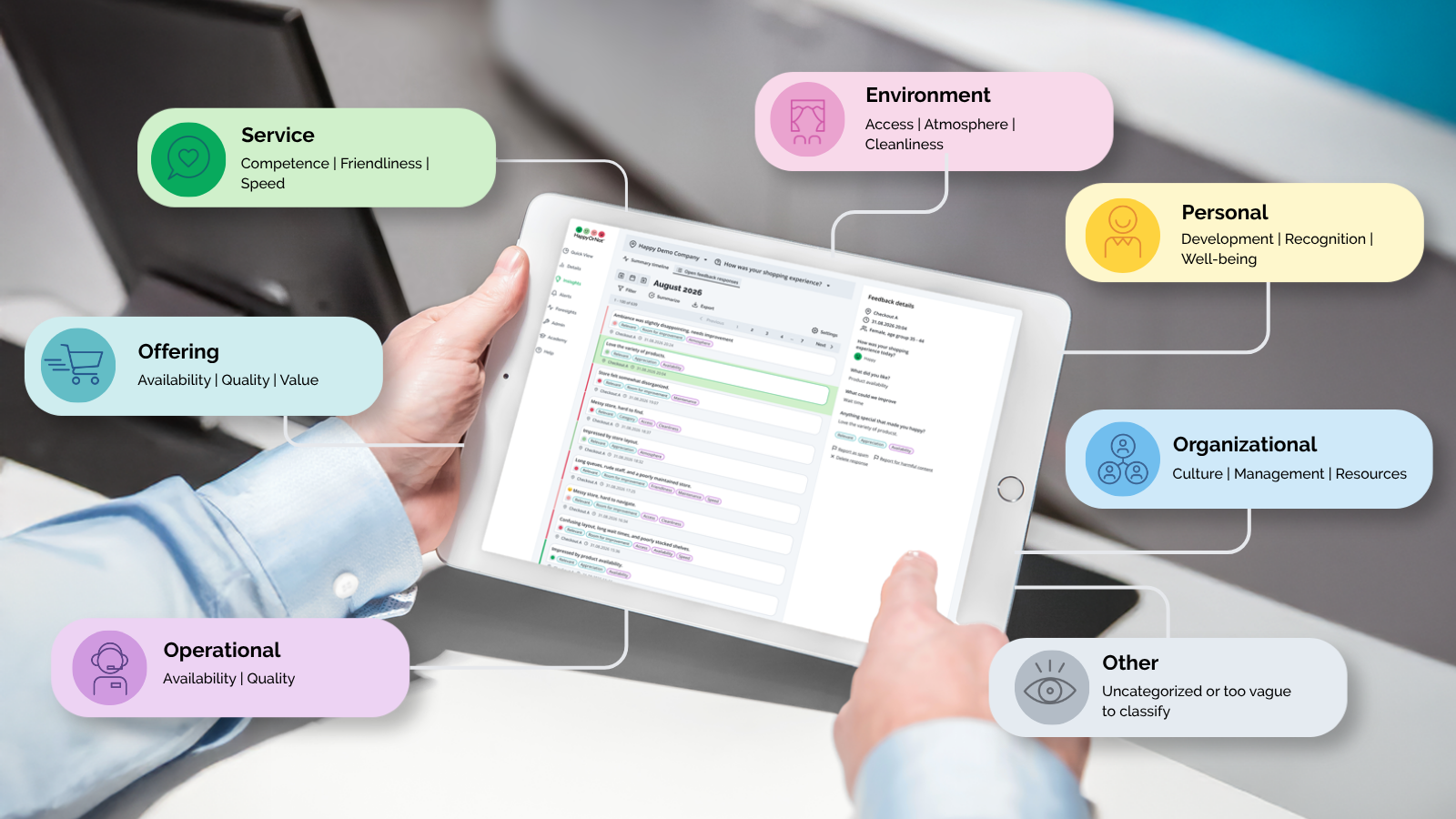
For Customer Experience feedback, for example, a comment might relate to Service, with a more specific sub-theme such as Speed or Friendliness. Feedback about the physical experience might fall under Environment, with sub-themes including Cleanliness, Maintenance or Atmosphere.
And because real experiences are rarely about just one thing, a single comment can be assigned to multiple themes.
Consider a customer who says: “The checkout took forever, but the employee was really friendly and helpful.” Rather than forcing that comment into one category, Themes can recognize the different topics contained within it. That gives teams a more complete picture of what people are actually talking about.
Why does categorizing open feedback matter?
For operational teams, the value isn’t categorization itself -it’s what consistent categorization makes possible. Imagine a retail operations team receiving open feedback from hundreds of stores. An individual complaint about checkout speed is useful. But when similar comments repeatedly appear across particular stores or time periods, they become an operational signal worth investigating. Themes helps make those patterns easier to see.
Instead of manually reading and sorting every comment, managers can explore feedback around consistent operational topics and understand which issues or strengths are appearing repeatedly. That means less time organizing feedback and more time deciding what to do about it.
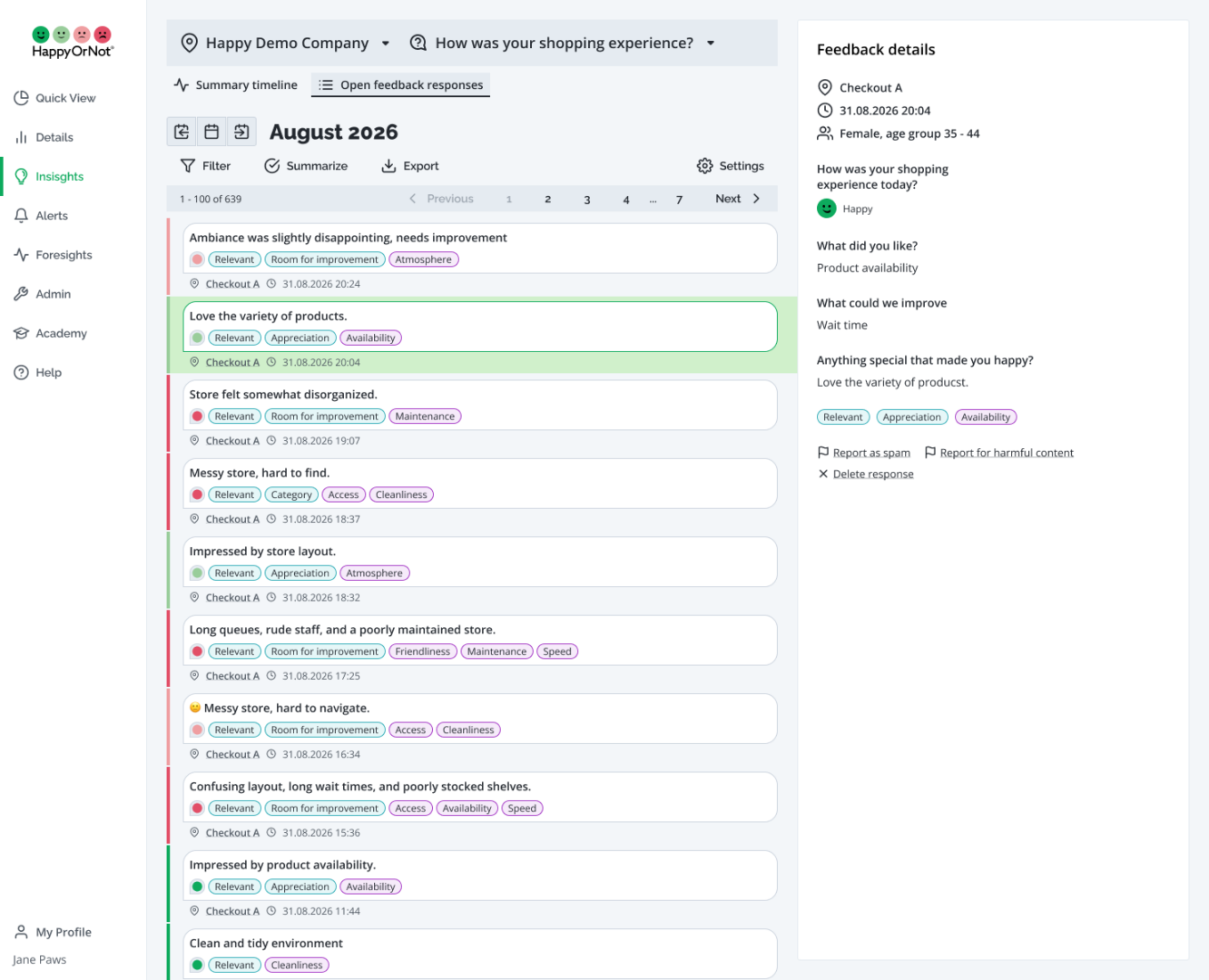
From individual comments to operational patterns
Consistency becomes especially important in multi-location operations. Without a shared structure, one manager might interpret a comment as being about “staffing,” another as “queues,” and another as “service.” That makes comparison difficult even when teams are experiencing similar problems.
Themes applies the same predefined taxonomy across feedback, locations and time periods. This creates a common language for understanding what people are saying and makes it easier to:
- identify recurring operational issues and strengths across large volumes of comments
- understand which topics appear most often in positive and negative feedback
- compare patterns across locations and operational contexts
- determine which issues warrant investigation or action first
- track themes over time to understand whether issues persist, improve or emerge
The result is a clearer path from what people say to what operations should pay attention to.
Built for the reality of operational feedback
Themes is not a standalone AI text-analysis tool. The thematic structure becomes part of the wider HappyOrNot microfeedback signal and is available across the workflows where teams already use open feedback, including Analytics, Insights, exports, API and Zapier.
That distinction matters. A comment about checkout speed becomes more valuable when teams can explore it in the context of where and when the experience happened, compare similar feedback across locations, and follow how that issue changes over time.
Open feedback becomes another structured layer of operational intelligence rather than a separate collection of comments waiting to be analyzed.
A consistent language for Customer and Employee Experience
Themes also recognizes that customer and employee feedback describe different operational realities. HappyOrNot therefore uses dedicated predefined taxonomies for Customer Experience (CX) and Employee Experience (EX) feedback.
Customer Experience Themes cover areas such as Environment, Offering and Service, while Employee Experience Themes organize feedback around Operational, Organizational and Personal topics.
Within those main themes, more specific sub-themes provide the detail teams need to investigate what is actually happening. This balance between consistency and detail is intentional: broad enough to make feedback comparable, but specific enough to help teams understand where attention is required.
Turning microfeedback into tangible impact
Microfeedback works because it captures sentiment quickly, in context and close to the moment of experience. But as organizations collect richer open feedback across more touchpoints, extracting value from that context has to scale too. Themes helps close that gap.
It removes much of the manual effort involved in interpreting large volumes of comments and gives teams a consistent way to identify recurring issues, compare patterns and establish priorities.
For frontline and regional managers, that can mean getting to the important question faster: What needs our attention? And for operations leaders managing performance across locations, it creates a shared view of the issues and strengths emerging across the business.
Because collecting more feedback is only valuable when teams can understand what it is telling them and use it to improve.
To learn more about the full suite of HappyOrNot’s AI-powered analytics capabilities, visit our AI Feedback Analytics page.