How Harborstone Credit Union uses member feedback to improve branches
Discover how Harborstone Credit Union uses real-time microfeedback across 30 branches to recognize exceptional service, strengthen member loyalty, and turn everyday branch experiences into measurable improvements and actionable insights.
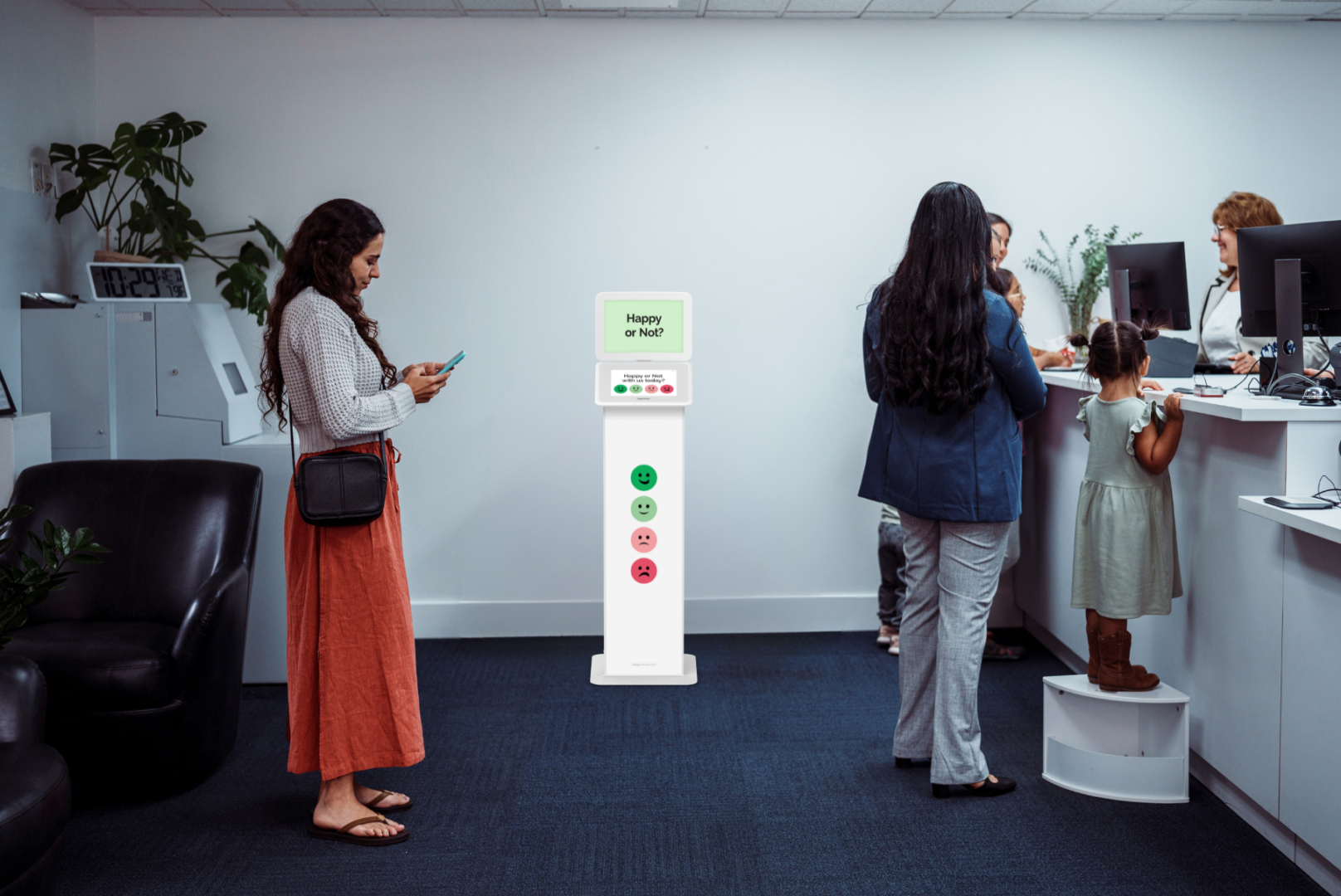
In a recent LinkedIn Live conversation, HappyOrNot’s Scott Erickson sat down with Tim Hoefel, Chief Experience Officer, and Bon Valera, Vice President of Retail, from Harborstone Credit Union in Western Washington. The conversation focused on something every community financial institution wrestles with: How to understand what members experience at the branch and, as importantly, how to turn that understanding into action while the moment is still fresh.
Their answer was to add real-time feedback, captured as microfeedback right at the branch exit, alongside the metrics they already tracked. Here is how a $3 billion credit union with 30 branches and 125,000 members built that into daily operations, and what they learned in the first few months.
A relationship-focused credit union in a competitive market
Harborstone started in 1955 as McCord Federal Credit Union, serving airmen and their families. Seventy years later, it has grown to roughly 30 branches stretching from Olympia to the Canadian border at Bellingham, more than 125,000 members, and over 450 team members. Its busiest branches see between 500 and 1,000 members a day.
The market is crowded. As Hoefel put it, from the credit union’s headquarters “we could probably hit a golf ball to about 15 different competitors.” Winning a new member takes serious marketing investment and community presence; keeping one for the long haul takes something else entirely. Harborstone has members who have banked with them for 30 and 40 years, and an internal ambition Valera summed up simply: To be “the friendliest credit union ever.”
That ambition is the backdrop for everything that follows. When the goal is relationships measured in decades, you cannot afford to learn about a poor branch experience weeks after it happened.
Why NPS alone left a gap
Harborstone did not have a strong member feedback mechanism until a couple of years ago, when it launched Net Promoter Score (NPS). NPS gave the credit union something it had been missing: A structured way to benchmark loyalty and survey the entire membership across channels.
But there was a gap. As Hoefel described it, some of that information “is a little bit stale by the time we get it. The opportunity to help the member sometimes has passed.” NPS was strong for the broad, strategic view, yet it could not tell a branch manager how a member felt walking out the door this afternoon. The credit union’s board specifically wanted to hear from members directly and immediately about how they were being served inside the branches.
The goal was never to replace NPS, but to supplement it with something faster, pair benchmarking with immediacy and get, in Tim’s words, “a more robust, well-rounded view of how our members perceive our service.”
How microfeedback runs across 30 branches
Harborstone deployed Smiley Touch™ kiosks at the exit of all 30 branches. The idea was deliberately simple: As soon as a member leaves the teller line or banker’s desk, they get a chance to answer one question: How did we do today? with a tap on a Smiley face that runs from very happy to very sad.
Two design choices made it work. First, placement. The kiosks sit right by the front door, where they are impossible to miss, which Valera’s team treated as both a feedback point and a daily cue for staff. As Hoefel described it, the kiosk by the door is “a great everyday reminder to our team that we need to be always focused on the service that we’re delivering, because our members will give us that feedback right on their way out.”
Second, simplicity. “When you see a happy face all the way to a very sad face, it’s easy to understand for our members,” Valera noted. No login, no app, no long form: a universal Smiley interface that any member can use in a second on their way out.
A rollout that was operational the next day
The physical deployment was painless. Thirty kiosks arrived, took minimal assembly, charged overnight so no outlets were needed, and the branches were “basically operational the next day,” according to Tim. After a week or two of testing, Harborstone went live on the first of February and has been collecting ever since.
The real work, as both leaders stressed, was the communication around the rollout, not the hardware. Valera’s team made sure everyone understood what the program was, why it mattered and what was in it for members and staff alike before the kiosks went out. Crucially, Harborstone built feedback into its incentive plan, making participation “more of a carrot vs. a stick.”
As a result, instead of resistance, branch teams were genuinely excited to see the kiosks arrive. As Hoefel observed, when an organization already has a strong commitment to service, “it’s easy to get behind a program that gets more feedback from our members so we can get better at what we do.”
The volume surprise: 2,000+ responses a month
Tim’s biggest concern going in was simple: Would members actually respond often enough to make the program worthwhile? The answer settled that quickly. Harborstone now collects more than 2,000 responses every single month – a level of participation that turns scattered anecdotes into a continuous, always-on signal.
This is where microfeedback earns its keep. A survey program might gather a few hundred responses skewed toward the most motivated respondents. High-volume microfeedback at the point of experience captures a far broader cross-section of members, frequently enough to reveal patterns by branch and even by time of day, including, as Valera noted, spotting the hours when a branch might need more staffing or its “best selves” to show up.
The biggest surprise: how much of the feedback is positive
The clearest theme from the conversation was one the team did not fully expect. Three and a half months in, the most striking trend was not complaints: It was praise, and praise that named names.
“A lot of the comments, when you run through it, are very specific, highlighting an individual and thanking them for a very specific service that they delivered,” Hoefel shared. That turned the program into a recognition engine. Harborstone now includes microfeedback in its monthly all-call for the entire member experience team (around 230 people) where it highlights branches that scored a perfect 100 and reads out specific member comments naming individual employees in front of their peers.
There is a common myth that businesses deploy feedback tools mainly to extract the negative when there is just as much value in surfacing the positive. When frontline staff are delivering exceptional service, recognizing it reinforces the behavior and generates a stronger loop that motivates even better service going forward. For a credit union whose stated goal is to be the friendliest around, that recognition loop is not a nice-to-have – it is the strategy, made visible.
How NPS and microfeedback work together
Harborstone is clear that this is not an either/or. The two tools answer different questions, and the credit union uses each for what it does best:
- NPS covers the broad, strategic view: It surveys the entire membership across the contact center, digital channels, new account opening and new membership, not just branch visits.
- Microfeedback covers the branch, in the moment: It captures how a member felt right after a specific transaction, location by location, the same day.
Together, Hoefel said, they “paint a pretty robust picture of how our members are feeling, both right after a transaction as well as right after the other ways they interact with Harborstone.” The branch-level immediacy of microfeedback has also validated what NPS suggested: Harborstone is performing in the top 5% of its industry, and the daily signal confirms the credit union is doing the right things.
Why asking, on its own, strengthens loyalty
One of the more subtle benefits the team described had nothing to do with the data itself. The simple act of asking signals that the credit union cares. “Every time they pass that [Smiley kiosk] on the way out, they know they have an opportunity to share with us where we did well or where we didn’t,” Hoefel said. “It shows that Harborstone cares about what they think.”
There is a second effect, too. When a member stops to type something like “Gabby at my Camp branch was absolutely amazing,” they are doing more than giving feedback; they are reminding themselves why they bank there in the first place. As Hoefel put it, the kiosk becomes “another touch point for them to self-reflect on why they do business with us.” In a market with 15 competitors within golf ball range, that quiet reinforcement matters.
What the Harborstone team learned
For credit unions and community banks considering a similar move, the advice from Hoefel and Valera was practical and consistent:
- Getting the program is step one; acting on it is step two: As Hoefel put it, “it’s really what you do with the feedback that matters.” The tool collects the signal; the value comes from recognition, coaching and change.
- Use it to recognize, not just to catch problems: Reinforcing excellent service has measurably motivated Harborstone’s teams to push their member service to another level.
- Be intentional and keep it simple: Valera’s guidance: Make sure everyone understands why you are doing it, and keep member experience top of mind in incentives, meetings and calls.
- Communicate before you deploy: The smoothest part of Harborstone’s rollout was the hardware. The part that made it land was explaining the why to frontline teams first.
- Let it be a pulse check on change: When Harborstone made a couple of nervous procedural changes, the feedback channel became a real-time gauge of how members received them, informing whether to hold or revisit.
Why it matters at the branch
Branch banking is built on trust, and trust is built one interaction at a time. Members who feel heard stay; members who feel like a number drift to one of the competitors down the street. A real-time, low-friction microfeedback signal at the branch exit closes the gap between what members experience and what leadership can act on: Surfacing problems before they become churn and surfacing great service before it goes unrecognized.
It is the same operational logic HappyOrNot has seen in very different settings, from employee feedback at Nature’s Way Foods to passenger feedback across airport concessions. The detail changes, but the principle does not. Capture the signal where the experience happens, route it to the person who can act and make the loop short enough that recognition and improvement become a daily habit. As Harborstone is proving, that is how a credit union turns “the friendliest” from an aspiration into something members feel every time they walk out the door.
See real-time microfeedback for branches in action
HappyOrNot helps credit unions and community banks capture in-the-moment member feedback at the branch, and turn it into recognition, coaching and service improvements teams can act on the same day. Explore our real-time branch feedback for credit unions and community banks.