Retail customer experience: how leading retailers stay consistent under pressure
Built on 18.7 million customer feedback responses, the Q2 Retail CX Pulse reveals the latest retail customer experience trends, operational benchmarks, and the execution patterns shaping store performance.
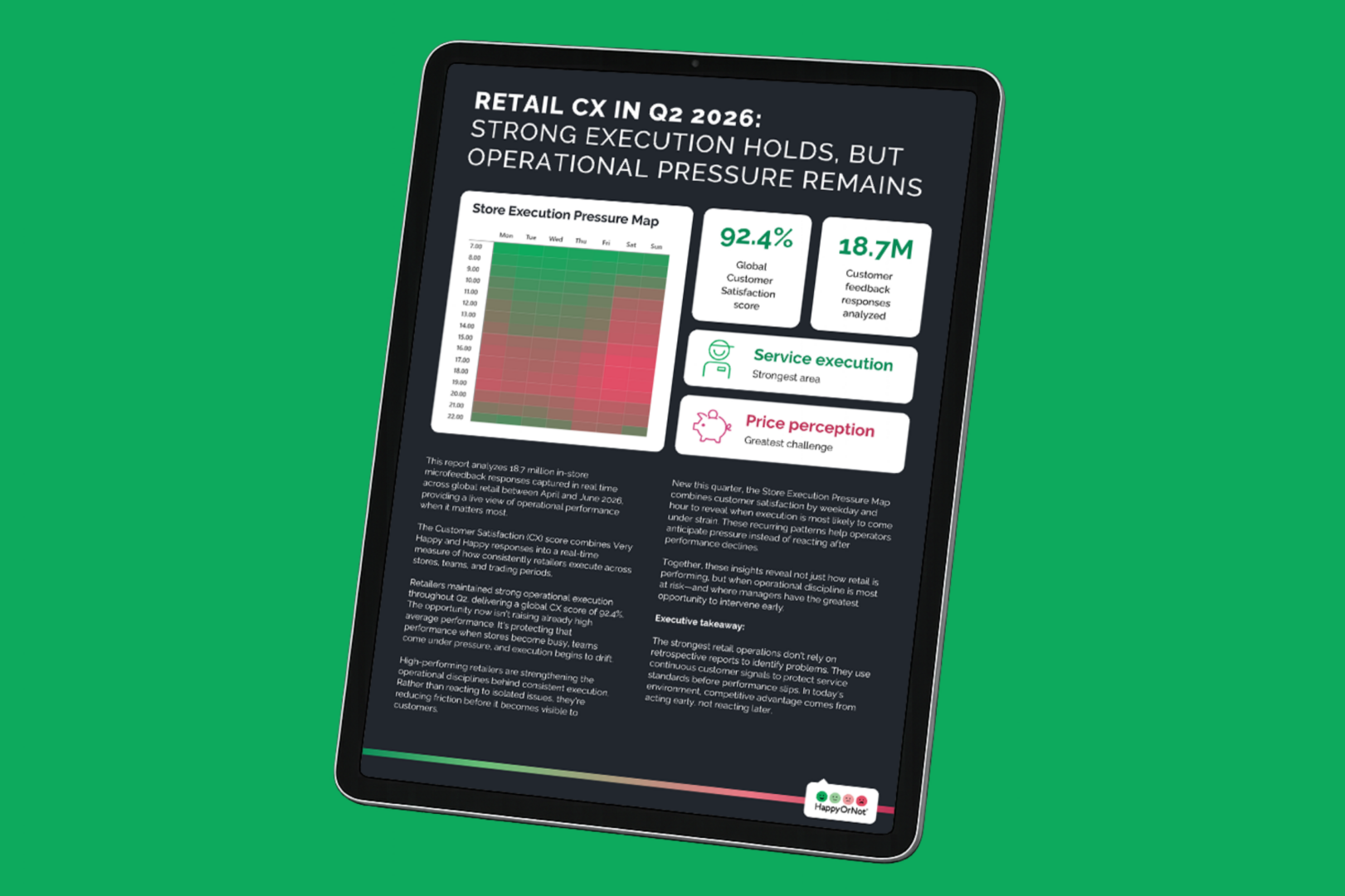
Retail customer experience rarely declines without warning. Instead, it begins to soften during predictable periods when stores become busier, operational complexity increases, and frontline teams are asked to do more with the same resources.
That’s one of the clearest findings from the Q2 2026 Retail CX Pulse. Built on 18.7 million real customer feedback responses collected across global retail locations, the report looks beyond headline satisfaction scores to uncover how retail customer experience is really performing—and where store operations have the greatest opportunity to improve.
Overall customer satisfaction remains strong. But the data also reveals a more important story: the retailers delivering the most consistent customer experiences aren’t simply those with the highest average scores. They’re the ones that maintain consistent execution as operational demands increase.
The highest-performing retailers aren’t operating under easier conditions. They’re executing more consistently through the same challenges everyone faces. Similar findings have emerged from broader retail productivity research, where operational consistency is increasingly recognized as a competitive differentiator.
That distinction matters because customer experience is increasingly becoming an operational challenge rather than a service challenge.
Retail customer experience is built through consistent execution
On its own, that’s encouraging. But headline scores rarely tell the full story.
The distribution of customer sentiment shows that while most shoppers continue to leave satisfied, fewer experiences reach the highest levels of delight. Rather than pointing to widespread service failures, this suggests that small moments of friction continue to shape how customers remember their visit.
For retail operations leaders, that’s an important shift. Improving retail customer experience is no longer simply about raising average satisfaction. It’s about removing the everyday friction that prevents stores from delivering consistently great experiences across every location, every shift, and every trading day.
Consistency—not isolated moments of excellence—is becoming the real measure of operational performance.
What the highest-performing retail operations do differently
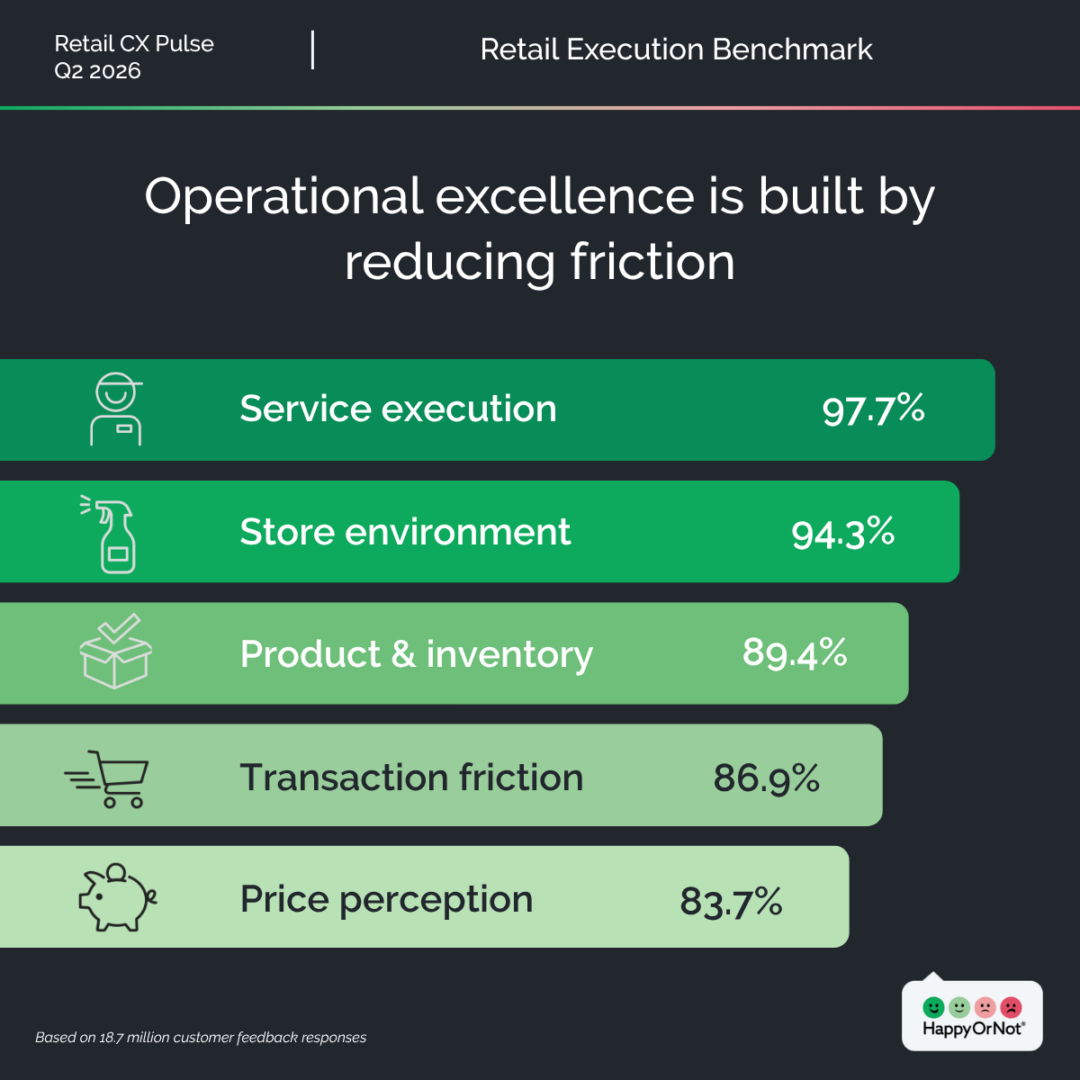
The benchmark shows that the strongest retailers aren’t excelling because every part of the customer journey performs equally well. They’re succeeding because they consistently execute the fundamentals customers notice most. Retailers including Lidl have demonstrated how continuous customer feedback helps identify operational improvements across large store networks.
Service execution remains the industry’s strongest operational area, supported by high performance across staff knowledge, availability, service speed, and friendliness. These are the frontline behaviors that build trust and confidence during every store visit.
Store environment also continues to perform well. Cleanliness, accessibility, and clear navigation create a positive shopping environment before customers even engage with products or employees. This aligns with broader retail research showing that leading retailers increasingly view customer experience and operational efficiency as complementary rather than competing priorities.
As customers move further through the journey, however, complexity increases. Product availability remains relatively strong, but expectations become higher around product selection, product quality, checkout, and price perception. These are often influenced by multiple processes working together rather than a single customer interaction.
Together, the findings reinforce an important reality. Customers don’t judge value through pricing alone. They judge it through the complete shopping experience. Consumer research consistently shows that convenience, consistency, and experience all contribute to how shoppers perceive value.
For retail leaders, the greatest opportunity isn’t fixing what already works well. It’s protecting operational strengths while systematically removing friction from the parts of the journey where execution naturally becomes more difficult.
The challenge, however, isn’t maintaining these standards when stores are quiet. It’s sustaining them when execution pressure begins to build.
The Store Execution Pressure Map reveals when operational pressure builds
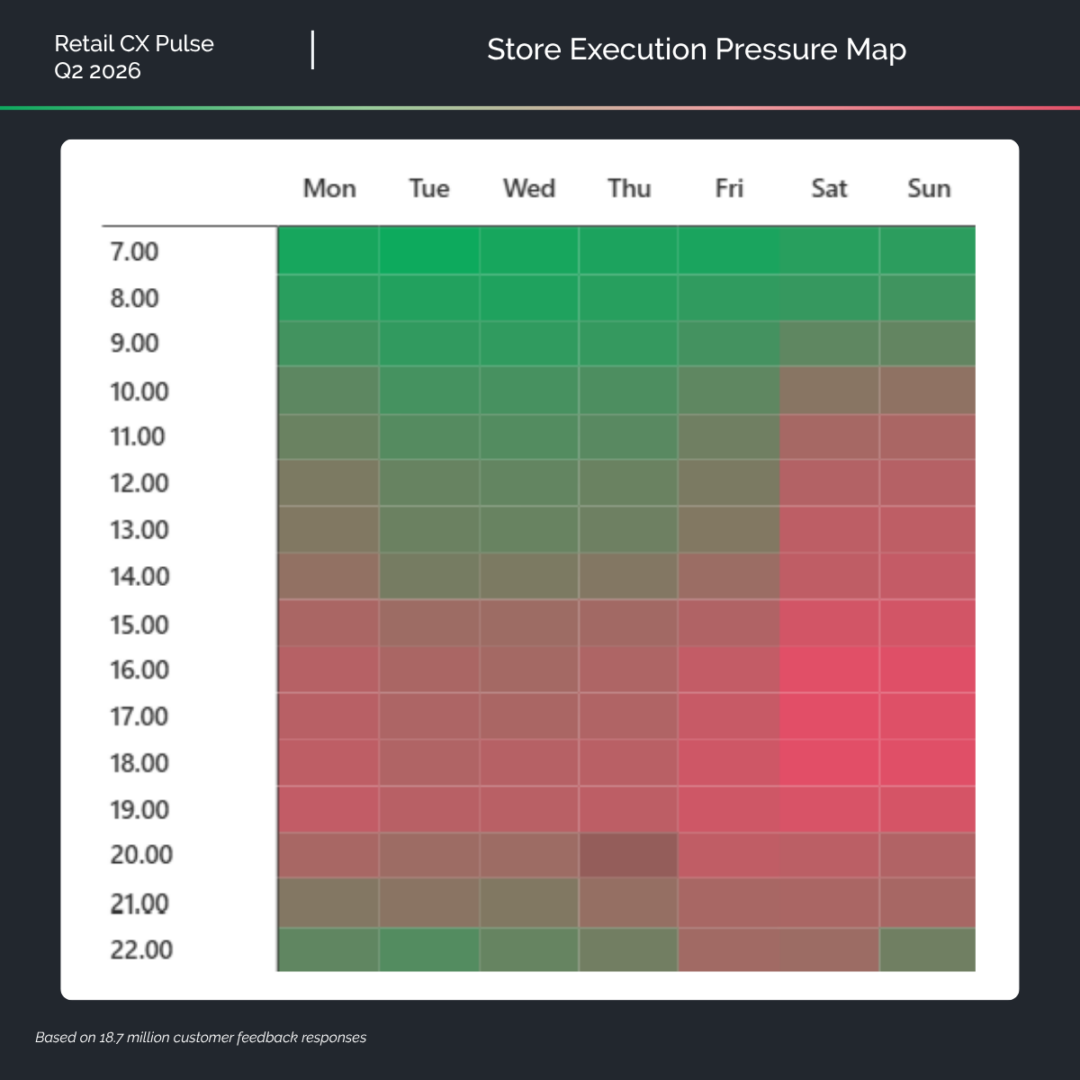
One of the most valuable additions to this quarter’s Retail CX Pulse is the new Store Execution Pressure Map. Rather than analyzing customer satisfaction by weekday or hour independently, it combines both dimensions to reveal recurring patterns throughout the trading week. The findings are remarkably consistent.
Customer satisfaction typically begins from a position of strength before gradually softening as stores become busier and operational demands increase. Weekend trading extends these periods of heightened demand, creating longer windows where maintaining service standards becomes increasingly difficult.
This doesn’t suggest retail operations are failing. It demonstrates that execution pressure follows predictable patterns—and that retailers can prepare for them.
For store operations leaders, that’s a significant shift. Instead of reacting after customer experience begins to decline, they can proactively align staffing, replenishment, floor coverage, checkout readiness, and leadership visibility to the periods when execution is most likely to come under pressure.
That’s the difference between measuring customer experience and managing operational performance.
Why operational patterns matter more than average scores
Average customer satisfaction is valuable for benchmarking. Operational patterns are valuable for improving performance.
A retailer can achieve an excellent overall satisfaction score while still experiencing recurring periods where execution weakens. Those moments are often hidden inside weekly or monthly averages but become immediately visible when customer feedback is analyzed across time, location, and touchpoint.
That’s where meaningful improvement begins. Understanding these patterns allows retailers to focus on coaching, scheduling, staffing, and improvements where they’ll have the greatest impact—not where assumptions suggest they should.
The goal is no longer simply to collect customer feedback. It’s to understand the operational conditions shaping retail customer experience and take action before customers notice the difference.
Three priorities for stronger retail execution
The Q2 findings point to three priorities for retailers looking to strengthen operational performance and deliver more consistent customer experiences.
- Protect frontline execution: Maintain service standards during peak trading periods through coaching, staffing, and visible leadership. Consistency under pressure—not performance during quieter periods—is what separates the strongest retail operations from the average.
- Strengthen value perception: Customers evaluate value through far more than pricing. Clear promotions, product availability, pricing transparency, and a smooth shopping journey all shape how value is perceived.
- Plan ahead using operational patterns: Recurring patterns create opportunities to improve scheduling, replenishment, and store readiness before customer experience begins to soften.
The strongest retail operations don’t simply respond faster. They prepare earlier.
Operational excellence is becoming retail’s competitive advantage
Retail customer experience isn’t defined by a single interaction. It’s shaped by thousands of operational decisions made throughout every trading day.
The Q2 Retail CX Pulse shows that the highest-performing retailers aren’t simply delivering better customer service. They’re operating more consistently during the moments that matter most.
As customer expectations continue to rise, competitive advantage will increasingly belong to retailers that understand not only what customers experience, but when, where, and why those experiences change.
The future of retail customer experience won’t be defined by collecting more feedback. It will be defined by turning customer feedback into better operational decisions.
Download the Q2 Retail CX Pulse
Download the Q2 Retail CX Pulse to benchmark your retail customer experience, understand where execution comes under pressure, and identify the improvements that will have the greatest impact across your stores.