Food service vs. food experience: What’s the difference?
Food service and food experience are often used to mean the same thing, but they describe different halves of the same operation, the first covering what you deliver, the second covering how guests perceive it. This article explains how they relate and why seeing both matters.
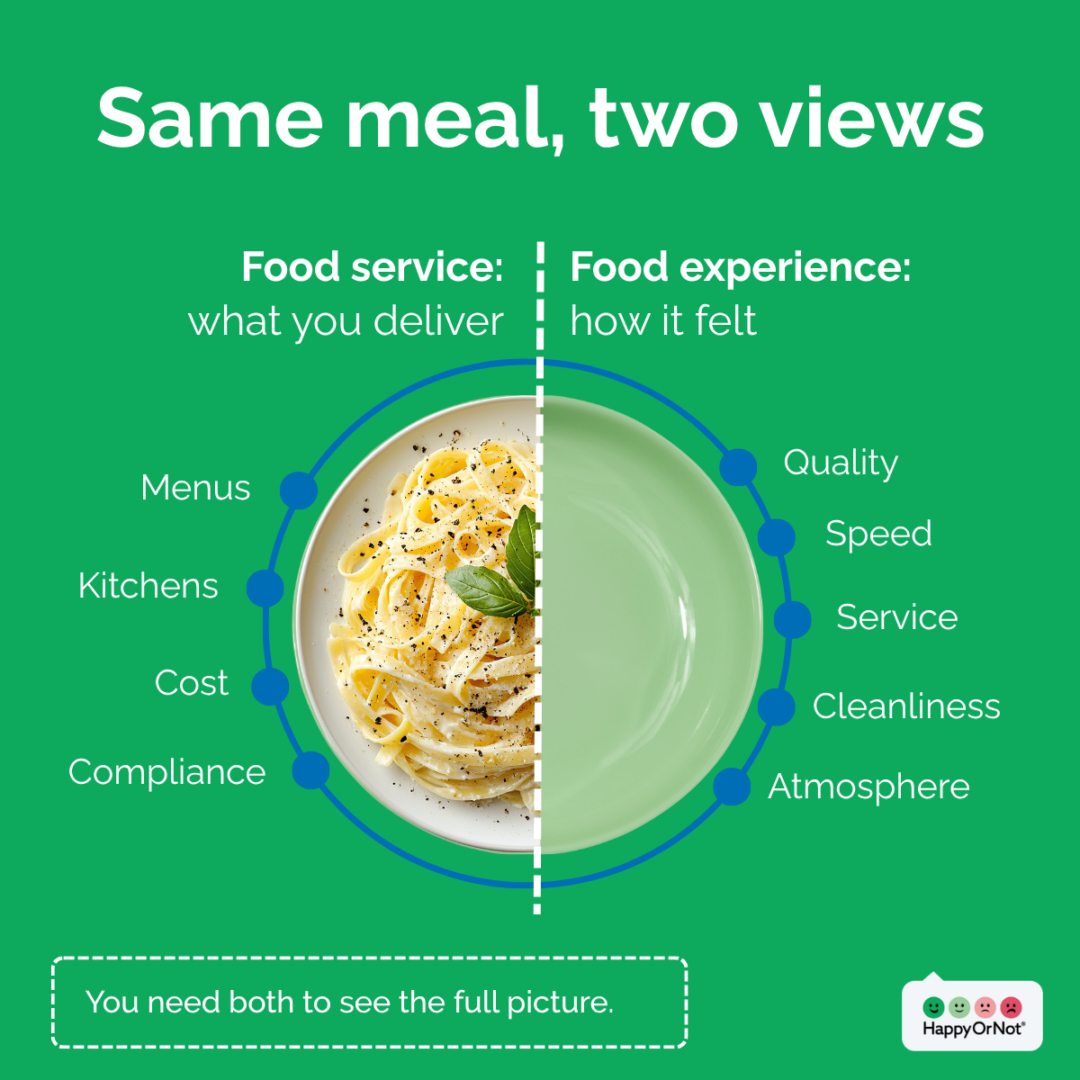
Food service is what an operator delivers and manages: the menus, kitchens, serving lines and logistics that get a meal to a guest. Food experience is how the result is perceived, the way that meal and everything around it made the guest feel. The two are closely connected, because a good experience is largely produced by good service. But they are measured in different ways, and seeing only one leaves a blind spot.
That distinction is easy to overlook, and for food service operators it is worth getting right. You can run food service well, hitting cost targets, safety standards and service levels, and still have guests leave underwhelmed if the queue dragged at peak or the room felt tired. Equally, strong operational delivery is usually what makes a good experience possible in the first place. The point is not that one matters more than the other, but that operators need both a view of how the operation runs and a view of how it feels to guests.
What is food service?
Food service is the operational system that produces and delivers meals. In a managed or contract dining setting, it covers everything an operator does to put food in front of a guest: menu planning and cycles, procurement and food cost, kitchen production, serving and counter operations, staffing and schedules, hygiene and compliance, and the contract terms that govern it all.
It is measured largely in operational and financial terms, such as meals produced, cost per cover, labor efficiency, waste, food safety scores and service-level agreement (SLA) compliance. Those numbers answer the question, “are we delivering the service we agreed to deliver?” They are essential, and getting them right is hard. They also tell you a good deal about the conditions a guest is likely to experience, even if they do not capture sentiment directly.
What is food experience?
Food experience is the impression a guest forms during a meal. It reflects the things they notice and feel: the quality of the food, the choice on offer, the speed of service, the friendliness of the team, the cleanliness of the space and the atmosphere of the room. It answers a different question, “how did the guest feel about their meal today?”
Where food service is measured mainly in outputs, food experience is measured in sentiment, ideally captured close to the moment it happened. It is the result that good food service is there to create, and increasingly it is what operators compete on. In practice, managing it means watching those experience signals alongside the operational ones, since a strong cost or compliance report and a disappointing lunchtime can happen at the same site on the same day.
Food service vs. food experience: a side-by-side comparison
The two are easiest to see side by side. Read them less as opposites than as two views of the same operation, one focused on delivery, the other on how that delivery is perceived.
| Dimension | Food service | Food experience |
| What it is | What the operator delivers and manages | How the guest perceives the result |
| Core question | Are we delivering the service we agreed to? | How did the guest feel about their meal? |
| Focus | Menus, kitchens, cost, compliance | Quality, choice, speed, service, cleanliness, atmosphere |
| Measured by | Meals produced, cost per cover, SLA, waste | Guest satisfaction and sentiment data |
| When it’s measured | Continuously, as the operation runs | Ideally close to the moment of experience |
| Primarily owned by | Operations and kitchen teams | Shared across operational and customer-facing teams |
| Why it matters | Keeps the operation running | Shapes loyalty, participation and renewal discussions |
Can you have good food service but a poor food experience?
It can happen. A site can produce every meal to specification and still leave some guests dissatisfied, perhaps because the queue was slow at the lunch peak, the counter felt chaotic, the same dishes came around too often or the team seemed rushed. Those things do not always show up in a cost report or a compliance audit; they show up in how the meal felt, which is why it helps to measure the experience alongside the operation.
The reverse holds too. A modest menu, served with warmth, speed and genuine attention to what guests want, can produce an experience people happily return to. Solid operations set the floor; the experience on top of them is what guests remember.
Why the distinction matters for operators
A few reasons it is more than semantics:
- Experience data supports renewal conversations. Clients increasingly want evidence of quality, not just confirmation that the spec was met. Continuous experience data is one of several things they weigh at renewal, alongside cost and service levels, and it is one an operator can show with real numbers. More in our guide to using guest feedback in contract renewals and QBRs.
- Experience influences participation. In managed dining, revenue often depends on people choosing to eat. Service they cannot feel will not necessarily bring them back; an experience they enjoyed is more likely to.
- Both can be acted on. Some changes are quick and some are structural, on the operational side and the experience side alike. What matters is being able to see an issue clearly enough to decide how to respond, which is where feedback at the point of experience helps.
How to measure the experience alongside the service
Operators typically have established operational measures for food service. The gap is usually seeing the experience with the same regularity. Before reaching for a tool, it helps to be clear on what you are trying to capture: which touchpoints matter, when guests are able to respond, whether you need a quick sentiment reading or a fuller comment, and how the result will reach the person who can act on it.
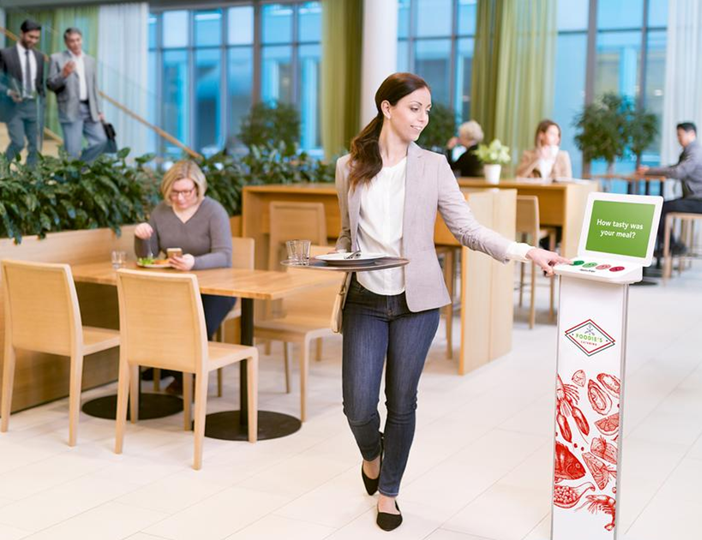
With that settled, real-time feedback is one practical way to fill the gap. Captured as microfeedback, a quick response as a guest leaves the counter can be collected through a range of touchpoints, from a Smiley Terminal or Smiley Touch unit at a busy exit to a Smiley Sign that lets guests respond on their own phones. Those responses land in HappyOrNot Analytics tied to a time and place, so the team can see where and when sentiment shifted, by meal and by site. The signal shows where to look; understanding exactly why usually comes from a follow-up question or an optional comment. Surveys still have a role for deeper, periodic analysis, and the two work well together, particularly as email survey response rates have fallen to around 10 to 15 percent (User Intuition). For the full method, see how to measure food experience in a managed dining environment.
ISS offers one example of measuring the experience and acting on it. After introducing real-time feedback, ISS reported a rise of around 20 percent in customer satisfaction over six months, reviewing results regularly and adjusting its menu in response.
See the experience, not just the operation
HappyOrNot helps food service operators capture how guests feel at the point of service and act on it alongside their operational data. Explore our food service solutions.