What is food experience? The operator’s guide for managed dining
Food experience is the impression a guest takes away from a meal, shaped by the food itself and everything around it. This guide explains what that means in managed dining, breaks down the six things that shape it, and looks at how operators measure it and put that insight to work in practice.
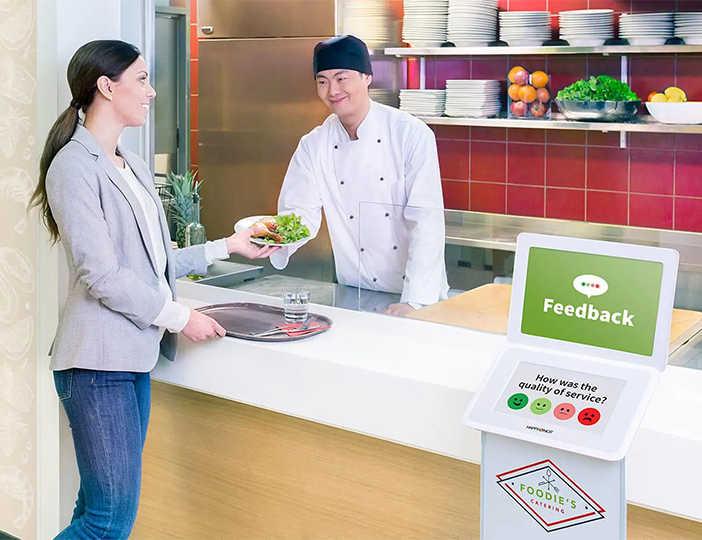
Food experience is the total impression a diner forms across a meal occasion, shaped by food quality, choice, speed of service, staff friendliness, cleanliness and atmosphere.
Two sites can serve the same menu, to the same specification, at the same price, and still send diners away feeling completely differently. One leaves people satisfied and likely to come back tomorrow. The other slowly loses them, one forgettable lunch at a time. That gap between what is served and what is felt is what we mean by food experience, and for the operators who run managed dining, it is where contracts are won and lost.
This guide looks at what food experience means in a managed dining setting, the components that shape it, why it has become a commercial priority for catering operators, and how the best teams measure and improve it day to day.
What is food experience in managed dining?
In managed dining, food experience is the impression a guest forms during a meal at a site run by a catering or food service operator on behalf of a host organization, whether an employer, a university, a care provider or a hospital. It spans the moment a diner walks in to the moment they leave, and it is shaped by far more than the plate in front of them.
It is worth separating two terms that often get used interchangeably. Food service is the delivery model, the menus, kitchens, serving lines and logistics that get a meal to a guest. Food experience is how all of that lands, the way the meal and everything around it made the guest feel. The two are closely linked, and one produces the other, but they are measured in very different ways. We explore that relationship in our guide to food service versus food experience.
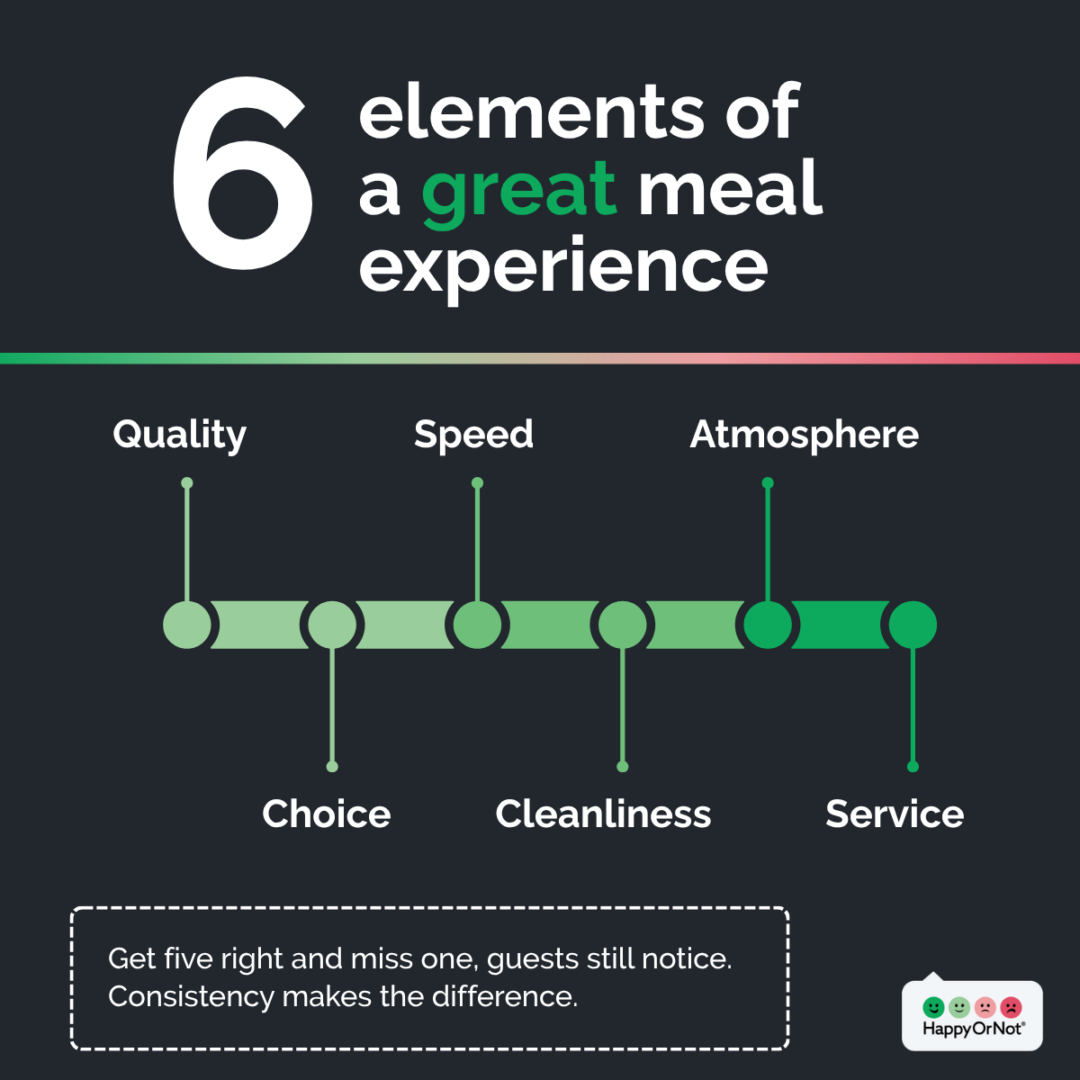
The 6 components of a great food experience
A great food experience is rarely about one thing. It comes from getting six components right, meal after meal, across every site. Let any one of them slip and guests feel it, even when the rest are strong.
1. Food quality
Taste, temperature, freshness and consistency, the foundation everything else is built on. A warm welcome cannot rescue a cold, disappointing plate.
2. Choice and variety
Enough range to suit different diets, preferences and cultures, refreshed often enough that regulars do not tire of the same rotation.
3. Speed and wait times
The time from joining the queue to sitting down with food. At the lunch peak, speed is often the single biggest driver of how a visit feels.
4. Service and friendliness
The warmth, helpfulness and knowledge of the team on the floor, the human moments that guests tend to remember longest.
5. Cleanliness
The visible hygiene of the serving area, the seating and the trays. Cleanliness is a baseline expectation, and its absence is noticed straight away.
6. Atmosphere
The comfort, noise, seating and overall feel of the room, whether it is somewhere people want to linger or somewhere they simply pass through.
These six map neatly onto what operators can actually measure and act on. When satisfaction dips, the cause is usually one of them, and the teams that can see which one, at which site, at which time of day, are the ones positioned to put it right.
Why food experience matters for operators
Food experience is not a soft, hard-to-justify goal. In managed dining it shapes two very practical outcomes: how the operation performs day to day, and how secure the contract is over time.
It protects participation and reduces waste
In most managed dining settings, the operation only works if people choose to eat. When the experience slips, participation tends to follow, as diners bring lunch from home, skip the cafeteria or head off-site. In a subsidized or universal model, that has a direct financial cost. As a nutrition leader at Capistrano Unified School District put it when describing their feedback program, “they may not be paying for the meal, but if they don’t eat with us, we don’t get paid.” Reading demand accurately also helps cut over-production and plate waste, two of the biggest controllable costs in any kitchen. See the Capistrano Unified story for the full example.
It strengthens contract renewals
For contract catering operators, the food experience is a large part of what is being sold, and evidence of its quality helps at renewal. Clients increasingly want proof, not just assurances, at quarterly business reviews (QBRs). A consistent, improving record of guest satisfaction is one of several things a client weighs, alongside cost, compliance and service levels, and it is one of the few an operator can demonstrate with continuous data. We cover this in our guide to using guest feedback in contract renewals and QBRs.
It shapes the host organization’s wider reputation
Dining rarely sits on its own. In a workplace it is part of the employee experience and a visible signal of how an employer treats its people. On campus it shapes student satisfaction and meal-plan retention. In senior living, families often judge the quality of care partly by the quality of the dining room. For the host organization, food is frequently the most regular, most tangible touchpoint it has with the people it serves.
How do you measure food experience?
You cannot improve what you cannot see, and food experience is harder to see than food service. Operational data such as covers served, cost per cover and waste tells you whether the operation ran, and it can hint at how the experience felt, but it does not capture sentiment directly. For that, operators draw on a mix of methods, each with its own strengths and limits.
- Periodic surveys. Good for depth and for understanding the reasons behind a trend, but slow and increasingly easy to ignore. Email survey response rates have fallen from around 20 to 25 percent in 2019 to 10 to 15 percent in 2025 (User Intuition, a customer research firm), and by the time results are analyzed the meal is long past.
- Mystery shopping and audits. Useful for checking standards against a checklist, but subjective, infrequent and low in volume, so a handful of visits can never represent thousands of daily meals.
- Real-time microfeedback. Short, in-the-moment responses captured at the point of experience, which can surface patterns by site, day and meal while the visit is still fresh.
- Other signals. Complaints, online reviews, participation data and conversations with diners all add context and are worth reading alongside the methods above.
Many operators lead with real-time feedback for day-to-day management and use surveys for deeper, periodic analysis. Captured as microfeedback, a quick response as a guest leaves the counter lands in HappyOrNot Analytics tied to a time and place, so a team can look at it the same day rather than the following quarter. For a full walkthrough, see how to measure food experience in a managed dining environment.
From signal to action: the operating loop
Measurement only matters if it changes what happens on the floor. The teams that improve fastest tend to run a simple, repeatable loop, and a short example shows how it works in practice.
Suppose lunchtime scores at one site dip on Thursdays. The signal flags it; connecting that signal to time and place shows the drop clusters between 12:30 and 1 p.m., when a single till is open and the queue backs up. The site lead adds a second server over that window and notes who owns the change. The following week, the team checks whether Thursday lunchtime scores have recovered, and shares the result with the crew. Capture, locate, act, then check: that is the loop most improvements come from.
- Signal. Capture in-the-moment feedback at the key touchpoints, such as the counter, exit or seating area.
- Hotspot. Connect each signal to time and place so patterns stand out, such as which site, meal or hour.
- Fix. Act on one or two changes with a clear owner, on a cadence that suits the operation.
- Proof. Check whether the change moved the score, and let the team see what improved.
ISS, a global facilities and food services provider, used this kind of approach across its dining operations and saw customer satisfaction rise by around 20 percent in the first six months, with daily response rates climbing as guests saw their input acted on.
How operators improve food experience
Measuring the experience is only useful if it changes what happens on the floor. In practice, the operators who improve steadily tend to share four habits, whatever their size or setting.
Prioritize the few things that matter most. Feedback can surface many issues at once, so it helps to focus on the one or two with the biggest effect on the experience, rather than trying to fix everything at once. A recurring lunchtime queue or a consistently low-scoring dish is usually a better place to start than a scattered list of minor points.
Give each issue a clear owner. Improvements stall when no one is responsible for them. Naming a person for each site, station or recurring issue turns a signal into an action, and makes it clear who checks whether the fix worked.
Match the review cadence to the decision. Frontline teams may glance at feedback daily for quick fixes, a site manager may look weekly for patterns, and a regional lead may review monthly or quarterly for longer trends. A simple, regular rhythm keeps improvement part of the routine rather than an occasional project.
Work toward consistency across sites. For operators running more than one location, the goal is not just a good average but a dependable experience everywhere. Comparing sites on the same measure helps surface what the strongest locations do well, so it can be shared with the rest. We cover this in more depth in our guide to benchmarking dining experience across multiple sites.
Explore the food experience library
Explore more guides on managing food experience:
- Food Service vs Food Experience: What’s the Difference? The distinction between what you deliver and how guests perceive it.
- How to Measure Food Experience in a Managed Dining Environment. Methods, metrics and cadence.
- What Is Microfeedback? A Guide for Food Service Operators. The concept behind real-time dining feedback.
- What KPIs Should Food Service Operators Track for Guest Experience? The operational metrics that matter.
- Using Guest Feedback to Prepare for Contract Renewals and QBRs. Turning feedback into evidence for renewal conversations.
- How to Benchmark Dining Experience Across Multiple Sites. Comparing and standardizing performance across a portfolio.
- Catering Operators: How to Capture Real-Time Dining Feedback. The operator’s solution overview.
Turn food experience into something you can measure
HappyOrNot helps food service operators capture guest feedback at the point of service and act on it while it still counts. Explore our food service solutions or see how ISS improved guest satisfaction.