Real Time Alerts: Turning microfeedback into faster operational action
Real Time Alerts transform microfeedback into immediate operational action, helping frontline teams identify issues sooner, collaborate more effectively, and continuously improve customer experiences through timely, context-rich insights.

Customer feedback creates value only when someone can act on it.
That sounds obvious, yet many organizations still rely on reporting cycles that separate customer insight from operational decision-making. By the time feedback reaches the people responsible for improving the experience, the opportunity to intervene has often passed.
For organizations managing hundreds—or even thousands—of customer interactions every day, waiting until tomorrow’s report or next week’s dashboard review is rarely enough. Operations leaders need to know what is happening while the experience is still unfolding.
This is where Real Time Alerts become valuable. Not simply because they notify people faster, but because they help transform microfeedback into quick operational action.
Instead of waiting for issues to emerge long after customers have left, teams receive relevant signals as service is being delivered, meaning they can investigate issues immediately, collaborate around the problem, acknowledge when action has been taken, and continuously improve future performance.
The result is a much shorter path between customer experience and operational improvement.
Why Real Time Alerts need more than speed
Many organizations assume that faster notifications automatically lead to better customer experiences. In reality, speed without context often creates another problem: noise.
Frontline managers already receive notifications from workforce systems, facilities platforms, service desks, messaging applications, and operational dashboards. Adding another stream of generic alerts rarely improves decision-making.
This growing operational complexity reflects broader changes in customer expectations. PwC research on customer experience shows that speed, convenience, knowledgeable help, and friendly service remain among the most important drivers of a positive customer experience, increasing pressure on frontline teams to identify and resolve issues quickly
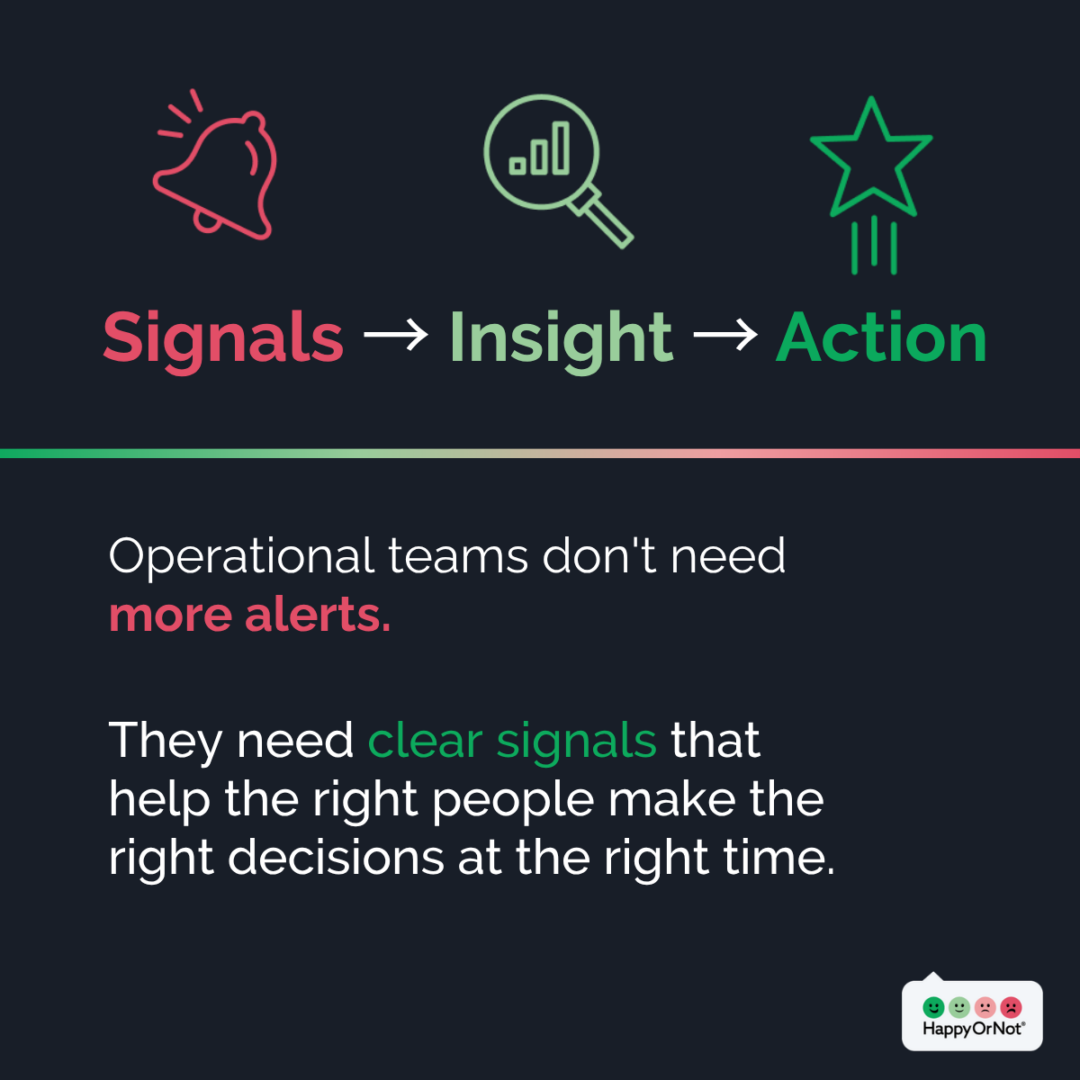
What matters is receiving the right information, at the right time, by the right people. This is why modern operational alerts are evolving beyond simple threshold notifications.
Rather than asking “Has customer satisfaction fallen?” operations teams increasingly need to understand:
- What happened?
- Where did it happen?
- Why are customers responding this way?
- Is this something my team can influence?
- Does it require immediate action?
Only then can alerts become operationally useful instead of operationally distracting. This shift reflects a broader evolution in customer feedback.
Where traditional surveys were designed primarily for analysis, microfeedback is designed for action. Captured at the point of experience, microfeedback provides a continuous stream of real-time signals that enable frontline teams to identify problems while they can still influence the outcome—not days or weeks later. This operational focus sits at the heart of HappyOrNot’s broader vision of turning microfeedback into tangible impact.
How Real Time Alerts turn feedback into operational action
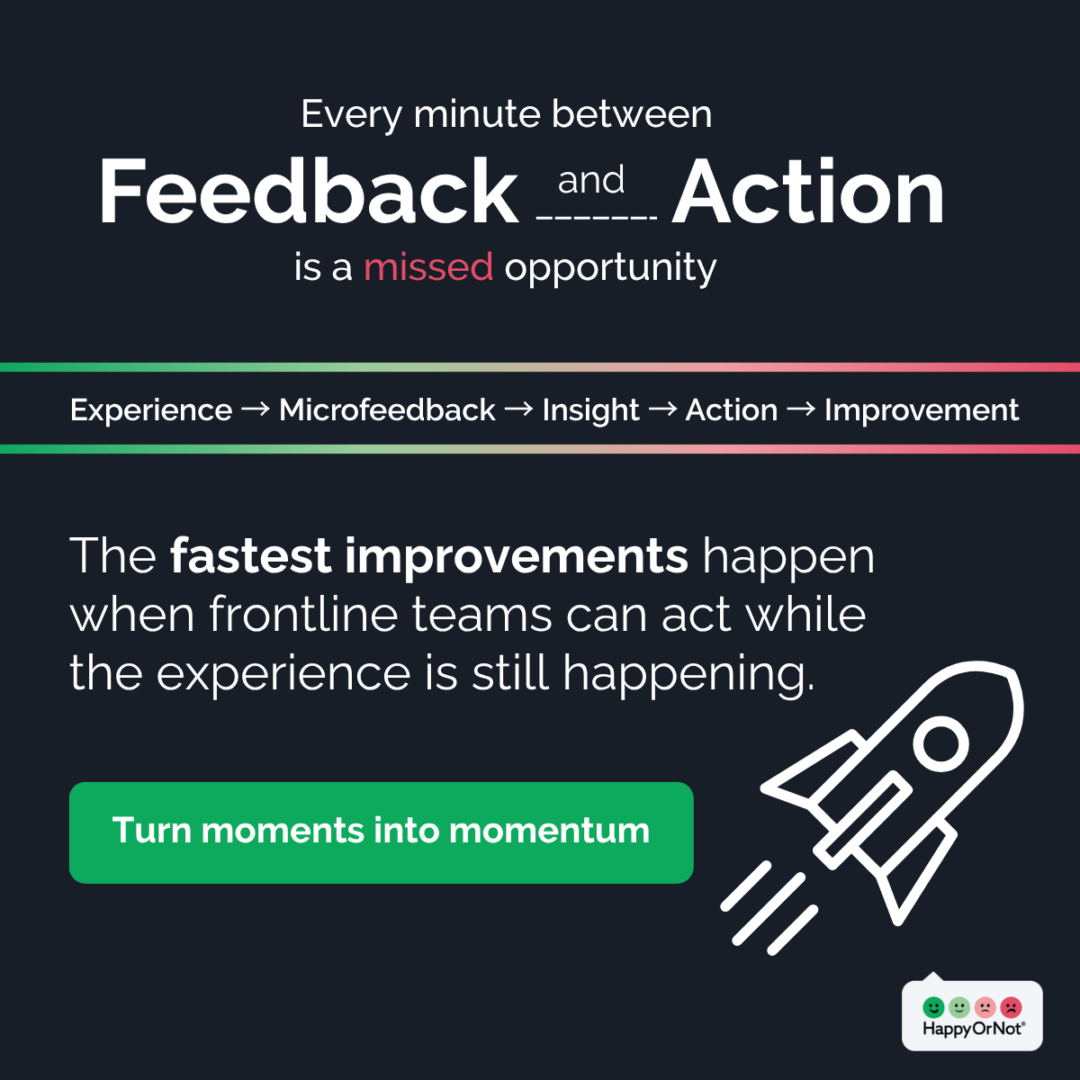
Collecting customer feedback is only the beginning. Organizations generate the greatest value when they choose customer feedback tools that help operational teams act on insights rather than simply report on them. The real value comes from reducing the time between:
Customer experience → Feedback → Insight → Action → Improvement
Every additional step introduces delay. Real Time Alerts help compress that cycle by automatically notifying the people responsible for responding when predefined conditions are met.
Historically, alerts were often triggered simply because customer sentiment crossed a threshold. That remains valuable, but modern operations increasingly require more precision. For example:
- A facilities manager may only need alerts relating to cleanliness.
- A food service manager may only care about waiting times.
- A retail store manager may want immediate visibility into feedback relating to checkout experiences.
- A hospital department leader may prioritize patient comments relating to staff communication.
Each role needs different operational signals. Delivering identical alerts to everyone creates unnecessary noise and reduces adoption, but delivering relevant alerts to the right stakeholders creates ownership.
That distinction becomes increasingly important as organizations scale across multiple locations, teams, and service environments.
How context makes alerts more actionable
One of the most significant developments in Real Time Alerts is not that they have become faster, but that they have become more contextual.
Recent enhancements allow alerts to be triggered using additional operational information beyond overall sentiment.
Organizations can now configure alerts based on specific follow-up responses and categorized open feedback, helping teams focus on issues that genuinely require attention.
Example:
Imagine a restaurant receiving several negative responses. Without additional context, managers know customer sentiment has declined. With richer trigger conditions, they can immediately see that the issue relates specifically to cleanliness—or perhaps service speed—allowing them to respond appropriately.
The accompanying notification also provides more context, helping recipients understand why the alert was generated before they even open their analytics dashboard. This reduces unnecessary investigation and accelerates operational response.
Rather than overwhelming teams with every negative response, alerts become increasingly aligned with operational responsibility and that represents an important shift. Instead of asking people to monitor data continuously, the system surfaces the signals that genuinely matter.
How Real Time Alerts enable better team collaboration
Responding to customer feedback is rarely the responsibility of one individual.
- A facilities issue may involve cleaners.
- A queue problem may require additional staff.
- A catering issue may require kitchen teams.
- A maintenance problem may require an external contractor.
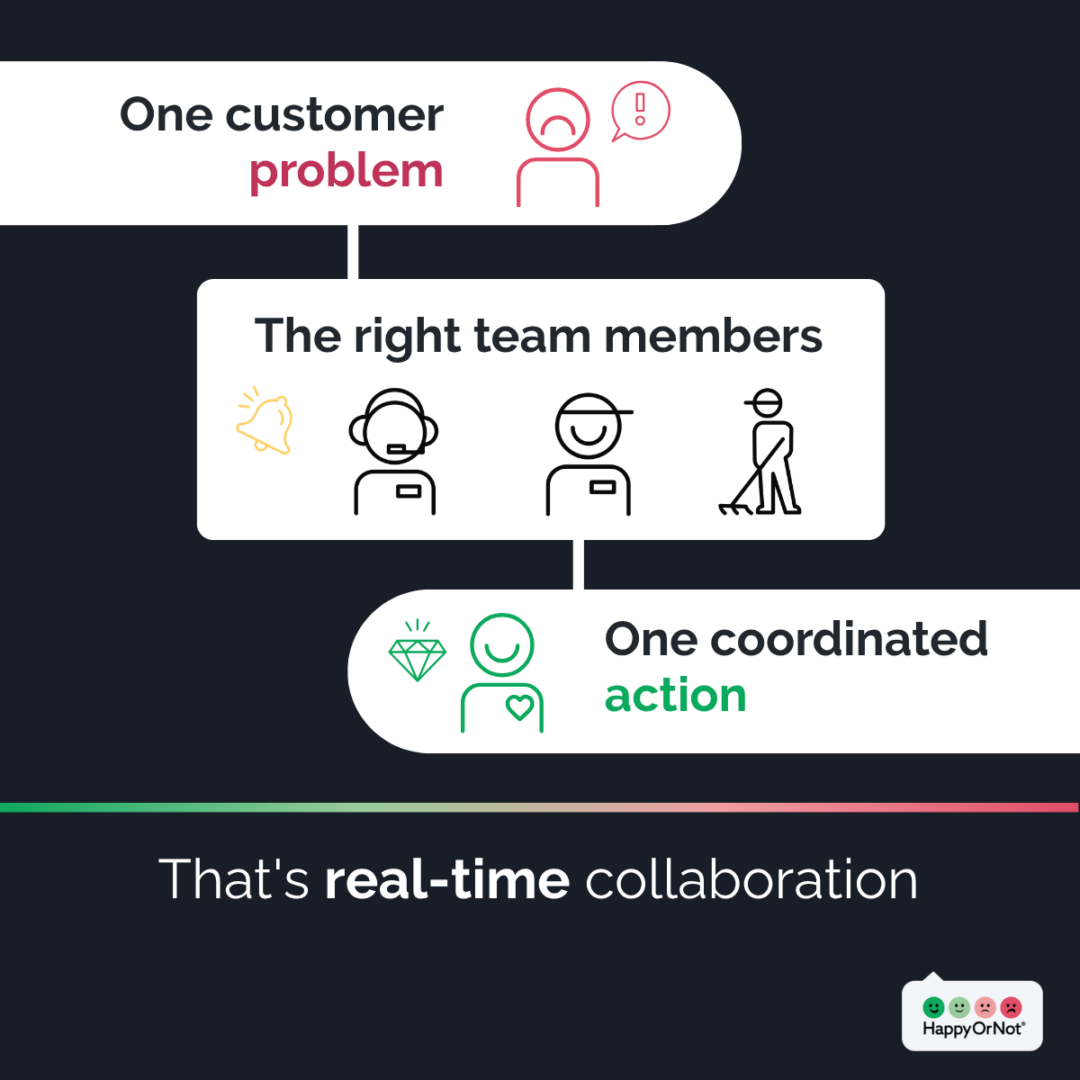
This is why real-time collaboration is just as important as real-time notification.
Once an alert is received, managers and frontline employees can acknowledge the issue, add comments, document actions being taken, and maintain a shared operational record as the situation develops.
Rather than multiple teams working independently – or worse, duplicating effort – everyone has visibility into what is happening and what has already been done.
The result is better coordination across locations, departments, suppliers, and operational teams. Importantly, collaboration is not limited to solving problems: positive feedback can also become an opportunity for recognition.
This emphasis on empowering frontline teams reflects a long-established management principle. As Harvard Business Review has observed, frontline employees have an outsized influence on customer experience because they are closest to the moments that shape customer perceptions.
When teams receive immediate evidence that customers appreciate exceptional service, managers can celebrate success while it is still fresh, reinforcing behaviors that contribute to better customer experiences over time. This facilitates both faster issue resolution and stronger communication between managers and frontline teams through acknowledgements and in-app commenting.
Real Time Alerts across Retail, Healthcare and Service operations
Although every industry measures different operational outcomes, the underlying principle remains consistent. Microfeedback becomes significantly more valuable when it reaches the people who can influence the experience immediately.
A sudden increase in negative feedback around checkout speed can trigger alerts for store managers, allowing additional tills to open before queues continue to grow.
Patient feedback highlighting long waiting times or cleanliness concerns can be routed directly to departmental leaders while patients are still in the facility.
Managers can receive alerts linked specifically to service speed, food quality, or cleanliness, enabling rapid intervention during busy periods rather than after service has ended.
Airports and transport
Operational teams responsible for passenger experience can identify emerging issues in security, restrooms, waiting areas, or customer service before complaints escalate.
Service providers responsible for cleaning, maintenance, or security can receive immediate notifications when customer sentiment indicates service levels may be falling below agreed expectations.
Across every example, the objective remains the same: reduce the time between customer experience and operational improvement.
How smarter alerts reduce alert fatigue
One of the biggest challenges facing modern operations isn’t a lack of data—it’s too much of it, and too little context.
Managers are already balancing notifications from workforce management systems, maintenance platforms, messaging applications, security tools, and customer service software. If every piece of customer feedback generates an alert, important issues quickly become lost among routine notifications.
This is why relevance matters as much as speed.
The latest enhancements to Real Time Alerts allow organizations to create much more targeted trigger conditions. Instead of relying solely on overall sentiment, alerts can be configured around specific follow-up responses and categorized open feedback, ensuring notifications reflect issues that require action rather than simply recording dissatisfaction.
For example, an operations manager might receive an alert only when:
- Negative feedback reaches a defined threshold.
- Customers identify cleanliness as the reason.
- Open feedback has been categorized as Urgent.
The alert email also includes the context that triggered it, allowing recipients to understand what happened before they begin investigating. Rather than asking managers to search through dashboards to understand the problem, the alert provides a clearer starting point for action.
This seemingly small change has an important operational implication: Fewer alerts. More meaningful conversations. Faster decisions.

Real Time Alerts within an operational feedback strategy
While Real Time Alerts play an important role, they are most effective when viewed as one part of a wider operational feedback strategy.
Not every insight requires immediate intervention. Some trends become meaningful over days or weeks rather than minutes, while others contribute to longer-term decisions around staffing, training, facilities investment, or service design. That is why microfeedback supports multiple ways of delivering insight.
Real Time Alerts help frontline teams respond immediately to emerging operational issues, Analytics help site managers identify recurring patterns, and APIs for business intelligence platforms support regional and enterprise-level performance reviews allowing organizations to combine feedback with wider operational data.
All together, these capabilities create a continuous feedback loop rather than a collection of disconnected reports. Different stakeholders consume different types of information, but all are working from the same source of real-time microfeedback.
This reflects an important shift in how customer feedback supports operations. Instead of simply measuring experiences, organizations create a continuous process of listening, acting, learning, and improving.
Building a culture of continuous improvement
Technology alone does not improve customer experience – people do. Research from Gallup shows that employees often feel a strong personal responsibility for customer experience, even when they lack confidence that their organization consistently delivers on customer promises. Equipping frontline teams with timely, actionable feedback helps close that gap by giving people the information they need to respond while the experience is still unfolding.
The most successful organizations use customer feedback to strengthen communication, coaching, recognition, and operational ownership across their teams. Real Time Alerts support this by making customer feedback visible while it is still relevant.
Managers no longer need to wait for weekly reports before discussing service issues with their teams. Instead, feedback becomes part of everyday operational conversations:
- An alert can trigger an immediate discussion.
- A positive comment can become recognition during the same shift.
- An operational issue can be documented, acknowledged, and resolved collaboratively before it develops into a recurring problem.
This creates something more valuable than faster reporting. It creates a culture where feedback becomes part of continuous operational improvement rather than an occasional management exercise.
Importantly, this is not about monitoring employees. It is about helping teams understand what customers are experiencing and giving them the information they need to respond effectively.
How Real Time Alerts improve operational performance
The value of Real Time Alerts is best understood through operational outcomes. At high-footfall venues such as sports stadiums, transport hubs, retail environments, and shopping centres, customer sentiment can change quickly.
When operational teams receive timely, contextual alerts, they can intervene before a localized issue becomes a widespread customer experience problem.
While every organization measures success differently, the underlying principle remains consistent: customer feedback delivers its greatest value when it enables timely operational decisions.
From notifications to operational intelligence
Real Time Alerts continue to evolve alongside the broader evolution of microfeedback. As organizations capture richer feedback through follow-up questions and open comments, alerts become more selective, more contextual, and more relevant to individual roles.
Rather than simply notifying teams that customer sentiment has changed, alerts increasingly help explain why. This evolution mirrors a wider shift in customer feedback management where organizations are moving beyond collecting feedback for reporting purposes.
That shift is becoming increasingly important as broader customer satisfaction levels remain relatively stable across many industries. The American Customer Satisfaction Index (ACSI) continues to show that sustained improvements in customer experience require consistent operational execution rather than one-off initiatives.
Instead, organizations are building operational systems that deliver the right signals to the right people at the right time:
- For frontline teams, that means fewer distractions and clearer priorities.
- For managers, it means faster decision-making.
- For leadership, it creates stronger alignment between customer experience and operational performance.
Ultimately, Real Time Alerts are not just about responding faster. They help organizations build a more responsive way of operating—one where customer feedback becomes part of everyday decision-making rather than an afterthought.
Key takeaway
Organizations do not improve customer experience simply by collecting more feedback. They improve by shortening the distance between customer experience and operational action.
Real Time Alerts help achieve this by transforming microfeedback into timely, relevant operational signals that frontline teams can act on immediately. Combined with real-time collaboration, contextual alerting, and continuous learning, they enable organizations to resolve issues faster, recognize great performance sooner, and create a culture of continuous improvement.
As customer expectations continue to rise, the organizations that succeed will be those that listen continuously, and act while the moment still matters.