What real-time member feedback reveals about branch performance
Discover how credit unions and community banks can use real-time microfeedback to spot branch friction, protect teams, and turn member signals into same-week action.
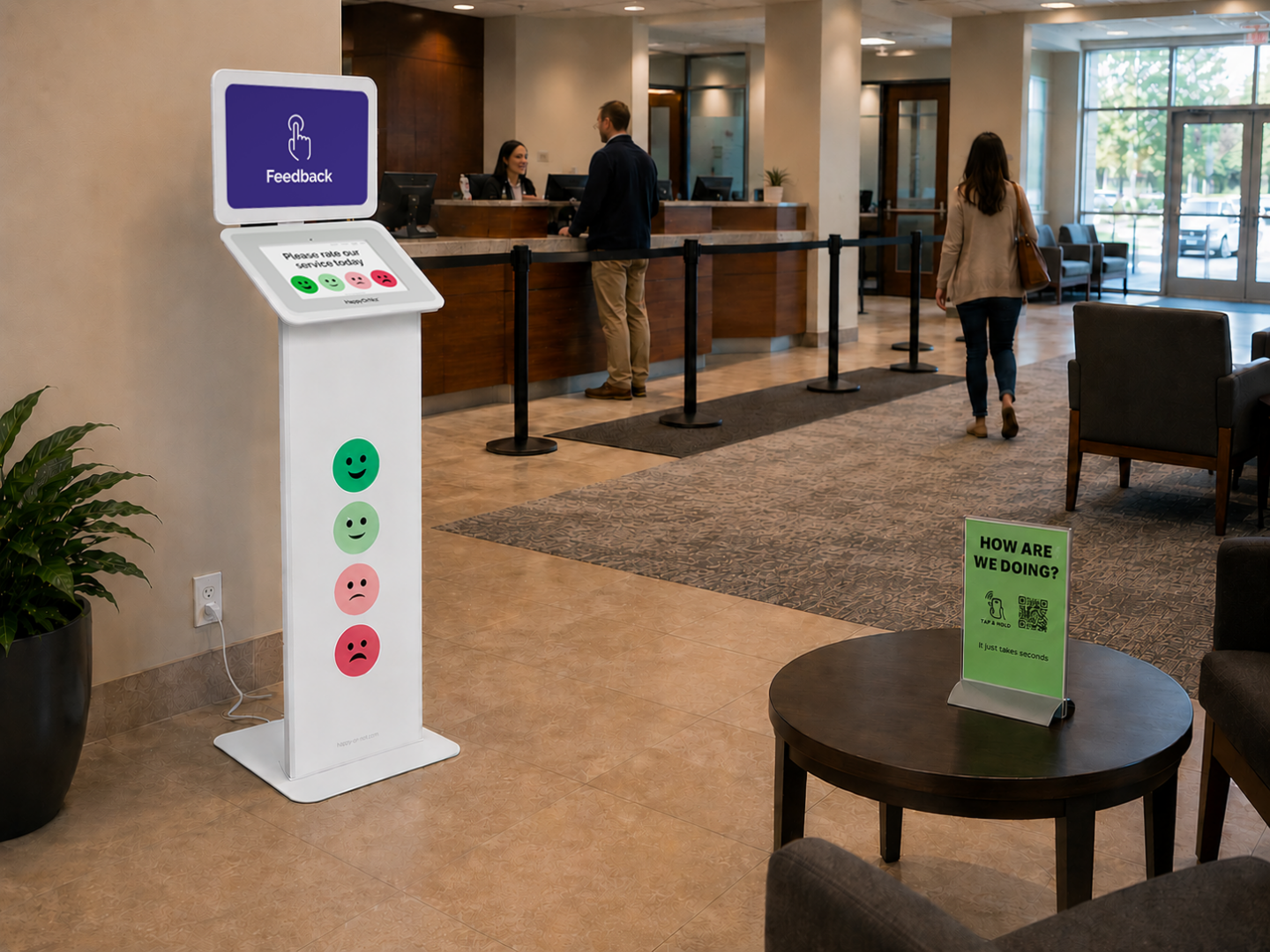
Where branch service breaks down and what Credit Unions and Community Banks can do about it
Credit unions and community banks do not usually have a service intent problem. Most branch teams care deeply about members: Tellers, universal bankers, service representatives, branch managers, and contact center teams are often doing their best with the staffing, systems, traffic patterns, and policy constraints they have. The harder problem is visibility.
By the time feedback shows up in a survey report, NPS dashboard, review, complaint log, or board packet, the moment has already passed. The member has left, and the branch team has moved on. The manager may not know which part of the interaction created friction, and so the opportunity to recover, coach, or recognize the team while the experience is still fresh is often gone.
That is the operational gap real-time microfeedback can close.
For credit unions and community banks, the value is not simply collecting more feedback. Most institutions already have some mix of surveys, NPS, reviews, complaints, informal branch feedback, and board-level reporting. The real opportunity is to make feedback more useful for the teams closest to the member experience.
That means capturing member signals while the moment still matters, connecting them to a specific branch, time, and touchpoint, and giving local teams a simple way to act. Used well, real-time microfeedback becomes an operational heartbeat for the branch network. It helps leaders see where service is holding up, where friction is starting to appear, and what needs attention this week.
Why branch feedback needs to become more operational
Branch and retail operations leaders are not short on reports – they are short on signals they can act on quickly.
Across credit union and community bank conversations, the same pressures come up repeatedly: low participation with long surveys, delayed feedback, limited branch-to-branch comparability, weak visibility into peak-hour issues, and difficulty turning feedback into coaching or service recovery. Filene Research Institute also highlights the role of member experience data and operational transparency in helping credit unions improve performance, reinforcing the need to make feedback usable beyond high-level reporting.
That matters because branch experience is not one thing. It is a series of small operational moments:
- A member waits longer than expected.
- A teller interaction feels rushed.
- A branch is clean but feels impersonal.
- A rate conversation creates frustration.
- A strong team gets blamed for a staffing gap.
- A member has a poor experience but never files a complaint.
Traditional feedback methods can identify some of these issues eventually. Real-time microfeedback helps teams spot them while they still have a chance to act.
What branch feedback reveals when it is viewed through an operational lens
We analyzed over 100,000 real member feedback responses, and the data tells a useful story when it is viewed through the lens of branch operations. It does not suggest that credit unions and community banks have a broad service problem. In fact, much of the feedback points in the opposite direction. Members are often positive about staff, service quality, and the branch experience overall.
But the data does reveal where friction can quietly build: service slips that are easy to miss, coverage gaps that make strong teams look stretched, wait times that shift the tone of the interaction, branch environment issues that affect trust, and price or rate conversations that create value perception challenges.
Those are the signals branch and retail operations leaders need most. Not because every issue requires a major initiative, but because small points of friction become easier to manage when teams can see them early.
Service interaction quality: strong service still needs a recovery loop
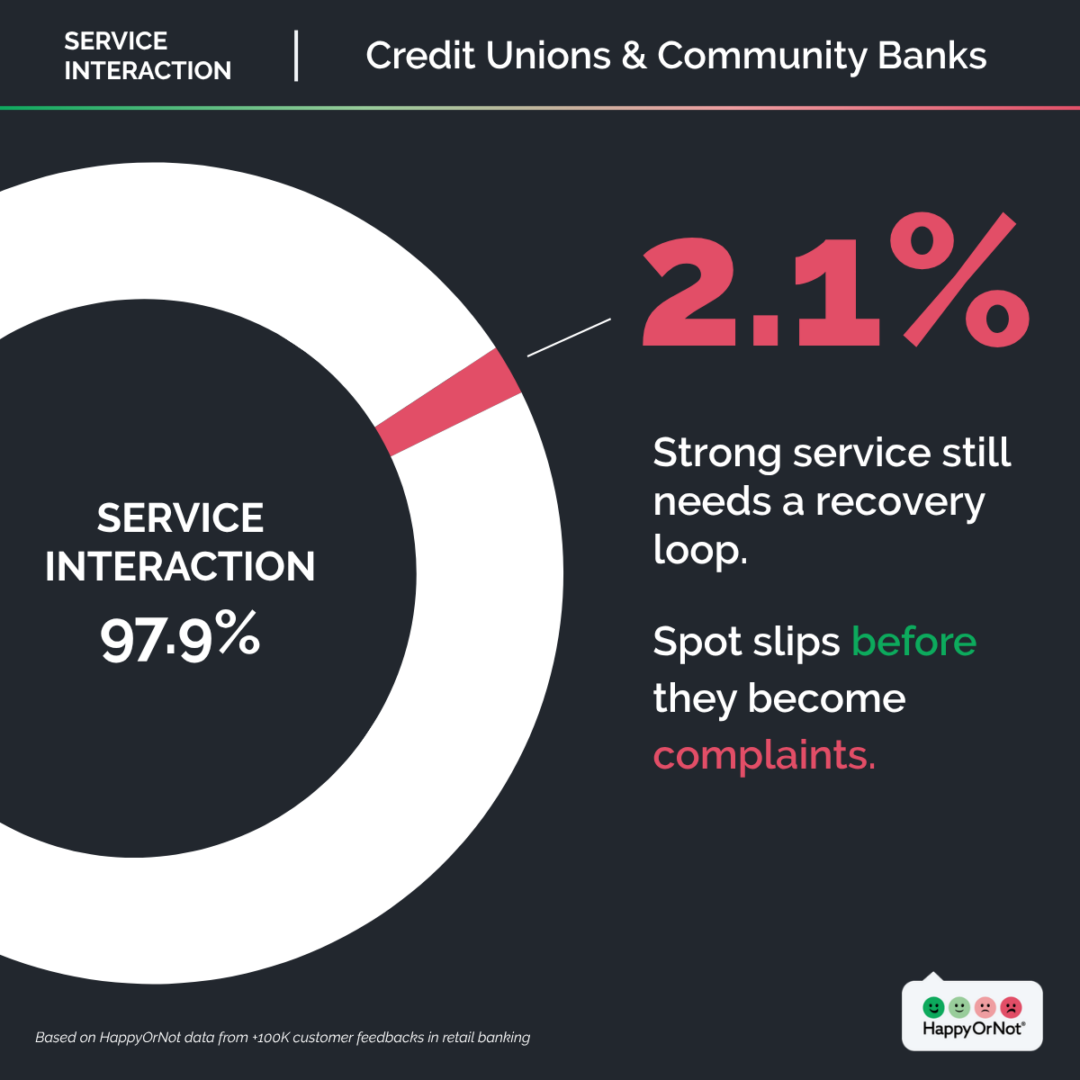
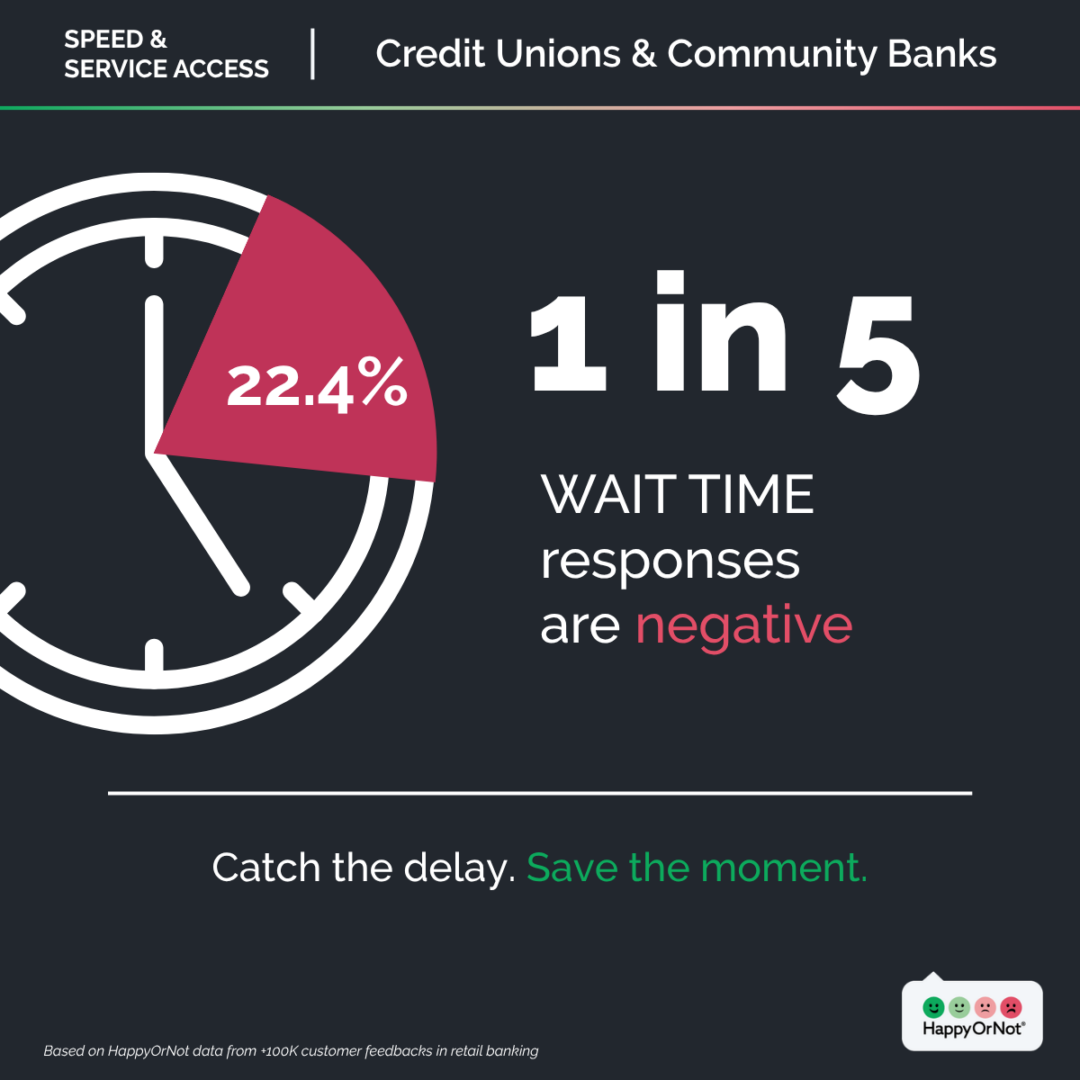
The service interaction data shows that most member interactions are positive. That is good news for branch teams. But high satisfaction does not remove the need for a recovery process.
Even a small share of negative service interactions can represent moments where a member felt rushed, misunderstood, unsupported, or frustrated enough to leave negative feedback. If those moments only appear later in a report, the opportunity to understand and respond is usually gone.
For operations leaders, the question is not, “Are we doing well overall?” The better question is, “Can we see the moments where service slips before they become complaints?”
Real-time microfeedback gives branch leaders a faster way to identify these moments, understand whether they are isolated or recurring, and close the loop while the experience is still fresh.
Staff behavior and capability: protect the team by finding the real issue
The staff behavior data is important because it helps prevent the wrong conclusion. When members report friction, it is easy for teams to assume the issue is frontline performance, but the data suggests something more nuanced. Members are often highly positive about staff friendliness, professionalism, and service quality. The weaker signal appears around availability. That changes the operational response.
If the issue is availability, the answer is not simply “coach the staff harder.” It may be better coverage, clearer handoffs, better lobby support, sharper scheduling, or more visibility into when certain branches are stretched.
This is where real-time branch feedback can protect frontline teams. It helps leaders separate people performance from operational constraints, so coaching becomes more accurate and less punitive.
Wait time: catch the delay before it changes the experience
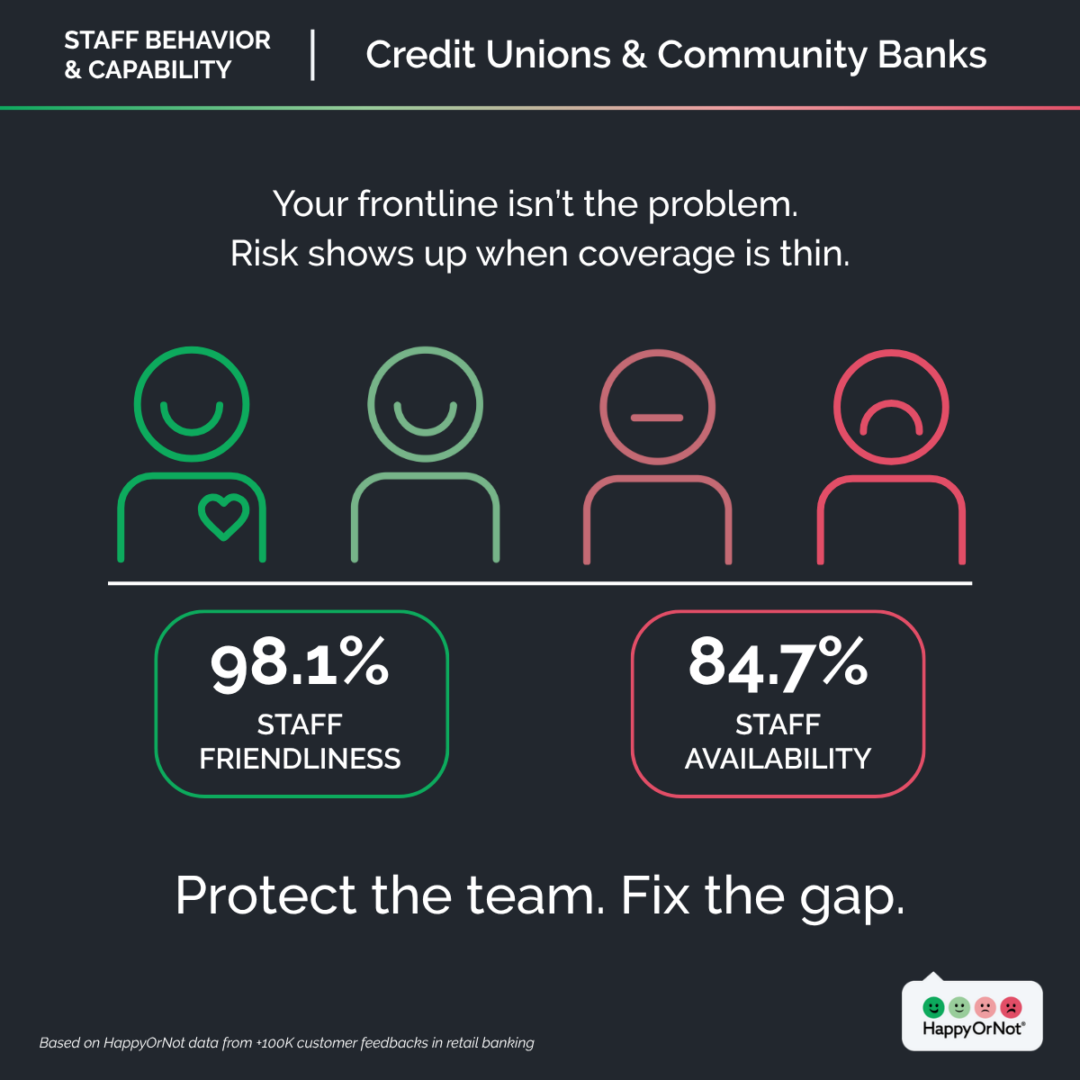
Wait time is one of the clearest operational friction points because it can change how a member feels about the entire visit.
This does not necessarily mean branches are crowded all day. In many credit unions and community banks, the issue is more specific. A certain hour, day, transaction type, appointment pattern, or staffing gap can create delays that members remember more than the actual service that follows.
That is why wait time feedback is so useful for branch operations – it points to moments where the experience starts to bend under pressure.
Real-time microfeedback helps leaders see where delay is showing up, whether it is concentrated in certain locations or time periods, and whether small operational changes could reduce frustration before it escalates.
Branch environment: consistency is part of the trust signal
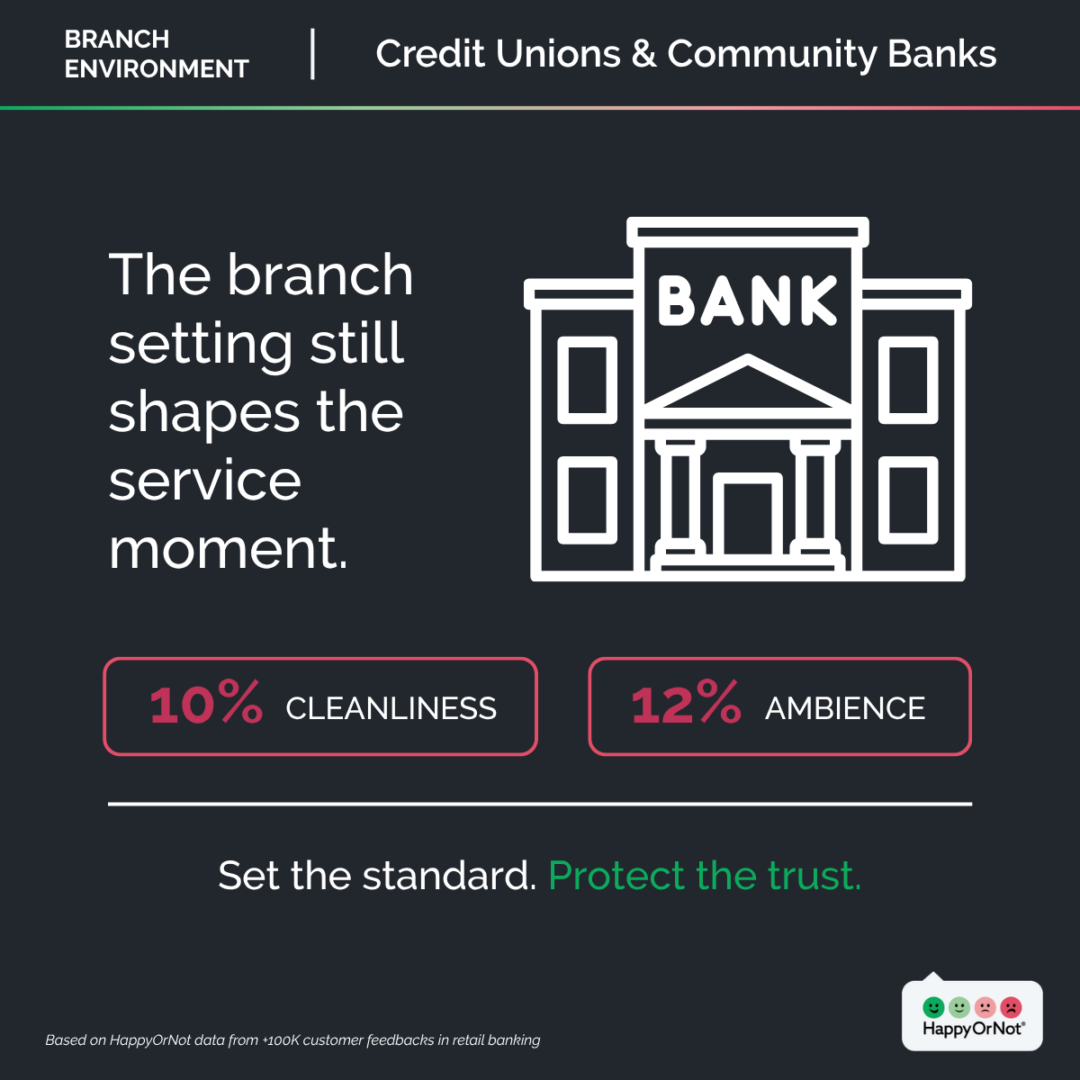
Branch environment can sound like a facilities issue, but members experience it as part of service. Cleanliness, ambience, comfort, privacy, and the overall feel of the branch all contribute to whether the institution feels organized, trustworthy, and member-focused. These details may not always trigger a formal complaint, but they still shape the service moment.
For branch operations, the key issue is consistency. One location may feel polished and welcoming while another feels dated, cluttered, or less cared for. One branch may meet expectations in the morning and slip later in the day.
Real-time microfeedback gives teams a practical way to spot these issues branch by branch, rather than waiting for periodic checks, mystery shopping, or member complaints.
Prices and rates: reduce friction through clearer value conversations
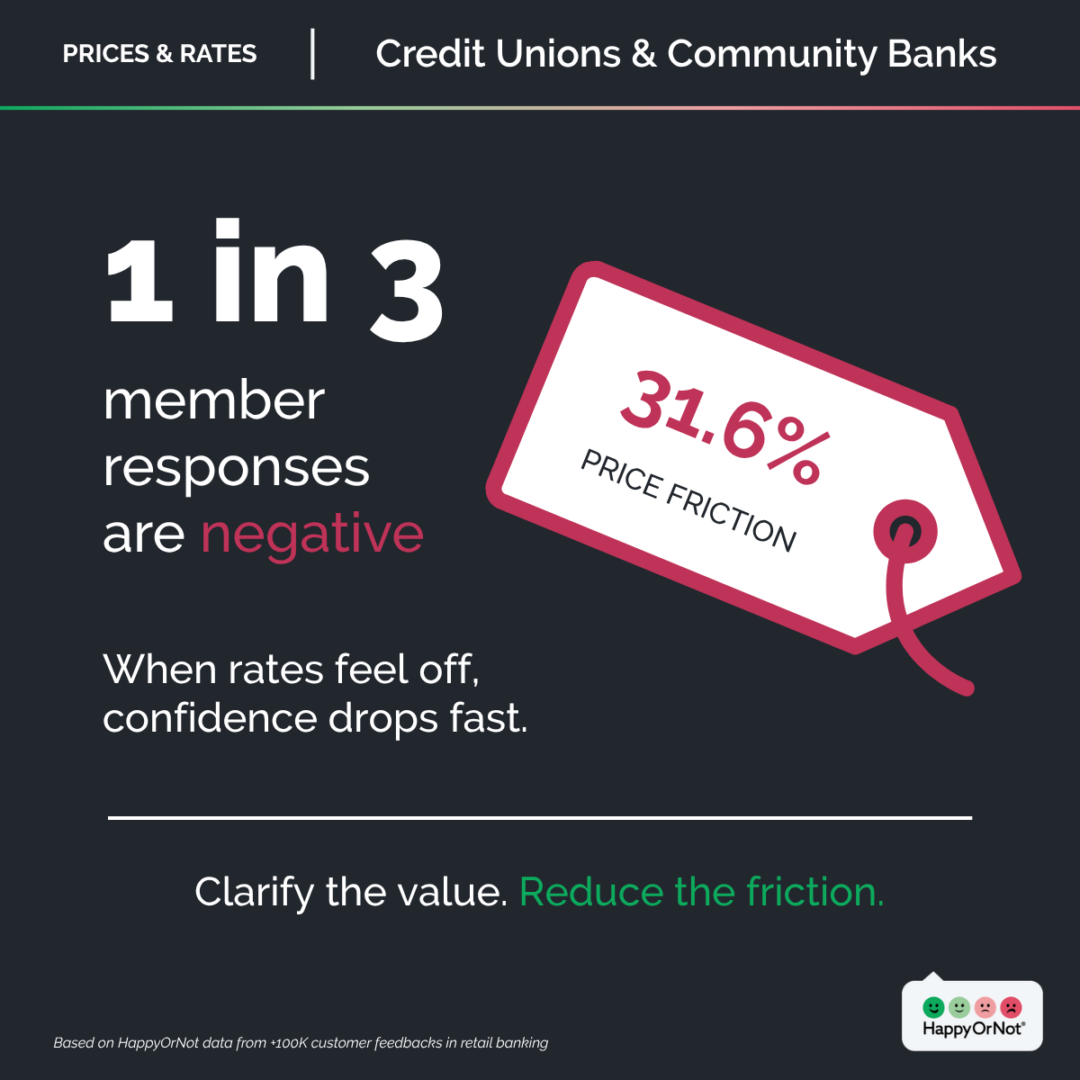
Prices and rates are different from other operational themes because branch teams usually cannot change them directly, however, they can influence how members experience those conversations.
When members react negatively to rates, fees, or pricing, the issue may not only be the number itself. It may also be how clearly the value was explained, whether alternatives were offered, whether the member felt heard, or whether the conversation created confusion.
That makes price and rate feedback useful for coaching and support. Leaders can identify where value conversations are creating friction and equip teams with clearer explanations, better options, and more consistent language.
The goal is not to make branch teams responsible for pricing strategy. The goal is to help them handle value perception moments with more confidence.
Why delayed feedback slows branch improvement
Delayed feedback creates a practical problem for branch teams: by the time the signal arrives, the moment has usually passed.
A branch manager may see a survey result days or weeks after the interaction. The member has already left, the employee may not remember the detail, and the pattern may be unclear. The opportunity to recover the experience, coach around the moment, or recognize what went well is harder to act on. That delay creates operational drag.
Not only does it make coaching less specific, it makes branch comparisons harder, and forces leaders to work from anecdotes, lagging reports, or isolated complaints. Small issues become easier to miss until they have already affected more members.
Real-time feedback matters because it shortens the distance between the member experience and the branch response. Research from Harvard Business School on closing the customer feedback loop also points to the value of using feedback to support follow-up, learning, and process refinement rather than leaving it as a passive measurement exercise.
Not every signal needs an immediate escalation, but branch and retail operations leaders need feedback that fits the rhythm of how branches actually run: daily huddles, weekly manager check-ins, staffing reviews, service recovery, frontline coaching, and recognition.
A stronger branch feedback loop helps leaders answer practical questions:
- Which branches need attention first?
- What issue is driving the friction?
- Is the problem service, staffing, wait time, environment, or value perception?
- Is this a one-off issue or a pattern?
- Can the manager coach while the interaction is still fresh?
- Can the team recognize what is working, not just fix what is broken?
These are not abstract experience questions: they are operating questions that require feedback that is timely, specific, and easy for teams to use.
Where real-time microfeedback fits alongside NPS, surveys, and reviews
Credit unions and community banks do not need to replace their existing feedback programs to make branch feedback more useful. NPS, surveys, reviews, complaints, and informal feedback all have a role. NPS can help track relationship-level sentiment, reviews can support reputation management, complaints can identify issues that require formal follow-up, and longer surveys can capture deeper detail. However, the gap is timing.
Most traditional feedback channels are better at explaining what happened after the fact. Real-time microfeedback is designed to capture a quick signal closer to the moment itself.
That makes it especially useful for branch operations. It gives teams a lightweight way to collect member feedback at key touchpoints such as teller interactions, lobby visits, service desks, appointments, drive-thrus, exits, digital journeys, and contact center experiences where relevant. The result is not another disconnected survey. It is a faster operating signal that complements the tools already in place.
NPS may tell leaders how members feel about the relationship overall, yet real-time microfeedback helps show where the day-to-day experience is holding up or starting to slip. For example, Harborstone Credit Union uses real-time microfeedback across its branch network to complement NPS with a more immediate view of member experience. The approach gives teams a clearer signal from everyday branch interactions, helping them recognize strong service, spot friction earlier, and turn feedback into practical improvement.
How HappyOrNot turns branch feedback into action
HappyOrNot helps credit unions and community banks capture feedback at the point of experience and turn it into practical branch-level action.
Members can share quick feedback while the interaction is still fresh. Branch and operations leaders can then see patterns by location, time, touchpoint, and theme. That makes feedback easier to use in the routines that already matter: manager check-ins, coaching conversations, service recovery, staffing discussions, recognition, and weekly improvement planning.
- For branch and retail operations leaders, this means better visibility into where service starts to slip and which branches need attention first. It also creates a clearer way to separate staff performance issues from process, coverage, wait time, or environment issues.
- For operations executives, it provides a simple branch-level pulse that supports consistency across the network without adding unnecessary complexity.
- For member experience leaders, it connects experience measurement to operational action. Instead of relying only on delayed surveys or high-level reporting, teams get a clearer view of the moments that shape member trust.
The value is not just in knowing how members feel. It is in helping teams do something with that signal while it can still improve the experience. APS Bank shows what this can look like in practice. By using HappyOrNot’s real-time feedback solution across its branch network, the bank gained a clearer view of customer experience and improved its customer satisfaction score by three points. The lesson is simple: when feedback is captured early enough and reviewed consistently, it becomes a tool for improving branch performance, not just measuring it.
The real goal: a weekly branch action loop
The strongest use case for real-time branch feedback is not another dashboard – it is a better operating rhythm. When feedback is captured consistently and reviewed regularly, it can become part of how branch teams manage service quality week to week. The goal is to help leaders move from delayed reporting to a simple action loop.
A practical weekly branch action loop might look like this:
- Capture: Collect feedback at the point of service.
- Spot: Identify patterns by branch, time, touchpoint, and theme.
- Act: Choose one or two practical actions for the week.
- Coach: Use fresh feedback in branch team conversations.
- Recognize: Share what strong branches are doing well.
- Track: See whether the issue improves over time.
This rhythm matters because feedback initiatives often stall when ownership is unclear. Operations, member experience, analytics, marketing, and executives may all care about the results, but branch improvement only happens when someone owns the action loop.
Real-time microfeedback is most effective when it is built into everyday branch routines. It gives managers a signal they can actually use, not just a report they have to interpret later.
What this means for credit unions and community banks
The data points to a practical conclusion. Credit unions and community banks are often delivering strong service, and members are generally positive about the people behind the experience. But specific points of friction can still weaken trust: delays, coverage gaps, inconsistent branch environments, unclear value conversations, and service slips that are not visible soon enough.
Those issues do not always show up as formal complaints. They often appear first as small signals in the branch experience. That is where real-time microfeedback can help. It gives branch teams a faster way to see what members are experiencing, understand where friction is forming, and act before small issues become larger patterns.
For branch and retail operations leaders, the opportunity is not to collect more feedback for the sake of it. It is to make feedback more operational, because the moments that shape member trust usually happen before a survey ever arrives.