NPS vs. microfeedback: How to turn customer loyalty into operational action
Customer loyalty isn't built by scores alone. Learn how combining NPS with microfeedback gives leadership strategic insight and frontline teams the operational context to continuously improve customer experiences. Select 72 more words to run Humanizer.

Net Promoter Score (NPS) and microfeedback exist to answer two different questions: NPS measures whether customers stay loyal to your brand over time while microfeedback captures in-the-moment customer sentiment, creating operational signals that help frontline teams improve experiences as they happen.
NPS tells leadership where the customer relationship is heading. It rarely tells a branch manager, site lead or frontline team what to fix during today’s shift. That is not a flaw in NPS; it is simply a different job. The question this article explores is the one that remains after loyalty has been measured: Once a score moves, how do teams understand the specific experiences, locations, times and operational factors behind it—and turn those insights into action?
In a recent HappyOrNot LinkedIn Live session, If NPS® Tracks Loyalty, What Helps Teams Act in the Moment?, Scott Erickson and Sam Kirkpatrick worked through exactly this gap. Erickson, who works with customers across the sales cycle, hears one question constantly in early conversations: “Why do we need real-time feedback on top of NPS?” Kirkpatrick, who leads customer success in the United States, sees what happens after teams adopt it.
Their conclusion was consistent, and it frames everything below: The gap is not another score. The gap is giving frontline teams the operational context they need to improve customer experiences while they still have the opportunity to act.
NPS measures loyalty. Operations need answers they can act on.
NPS is deliberately a zoomed-out metric. It captures how customers feel about the overall relationship, tracks long-term loyalty and gives leadership, strategy and marketing a way to see how the business compares within its vertical over quarters and years. If you want the mechanics of the framework itself, see our guide to calculating NPS.
But a map of the whole territory does not tell a team which street needs attention today. NPS is a lagging indicator, often collected days, weeks or months after an experience, and usually only from known customers who respond to an email or receipt survey later. By the time the score arrives, the moment has already passed. As Kirkpatrick described it: “It might be three months later that you’re getting that score, and you have no idea: Was it the person at the checkout line who was helpful or not? And then even the person giving the score may not even remember at that point.”
This is the operational gap. A change in NPS can tell leadership the relationship is strengthening or weakening, but it rarely explains whether the underlying cause was checkout speed, cleanliness, a staff interaction, waiting time or product availability.
Knowing loyalty is slipping is valuable. But knowing where to act, when to act and who should act is what helps organizations improve it.
What is microfeedback? The operational view NPS can’t provide
What is microfeedback? Microfeedback is short, in-the-moment feedback captured at a specific touchpoint, designed to create operational signals that teams can immediately use to improve customer experiences. Where NPS is the zoomed-out relationship metric, microfeedback provides the operational visibility needed to improve individual moments across the customer journey.
A customer taps a Smiley Terminal after a specific interaction, and that operational signal is captured tied to a defined location and touchpoint. That immediacy is what makes microfeedback so valuable. Because signals are captured where and when experiences happen, they help teams understand five things a lagging score cannot:
- Where the experience occurred
- When customer sentiment changed
- Which part of the customer journey was affected
- Why customers felt positively or negatively through optional comments
- Who is best positioned to improve the experience.
The objective is not another score. While HappyOrNot measures experiences using the Happy Index, the score itself is simply a way of summarizing operational signals. The real value lies in helping frontline teams identify opportunities, recognize success, coach employees and continuously improve customer experiences.
As Kirkpatrick put it, NPS is “that strategic visionary sort of metric,” while microfeedback provides “that kind of in-the-weeds dirty metric of here’s how things are going”. In practice, that means giving operational teams the visibility they need to improve customer experiences every day.
To be clear: this is not a replacement argument. Both speakers were emphatic on that point. As Erickson explained: “Real-time feedback is definitely not meant to replace NPS in full. It’s really meant to enhance the NPS program.”
The two approaches answer different questions, and together they create a more complete view of the customer experience. NPS helps organizations understand how customer relationships evolve over time. Microfeedback provides the operational signals that help frontline teams improve the moments shaping those relationships every day.
That distinction—not another score—is what creates a true 360-degree view of customer experience.
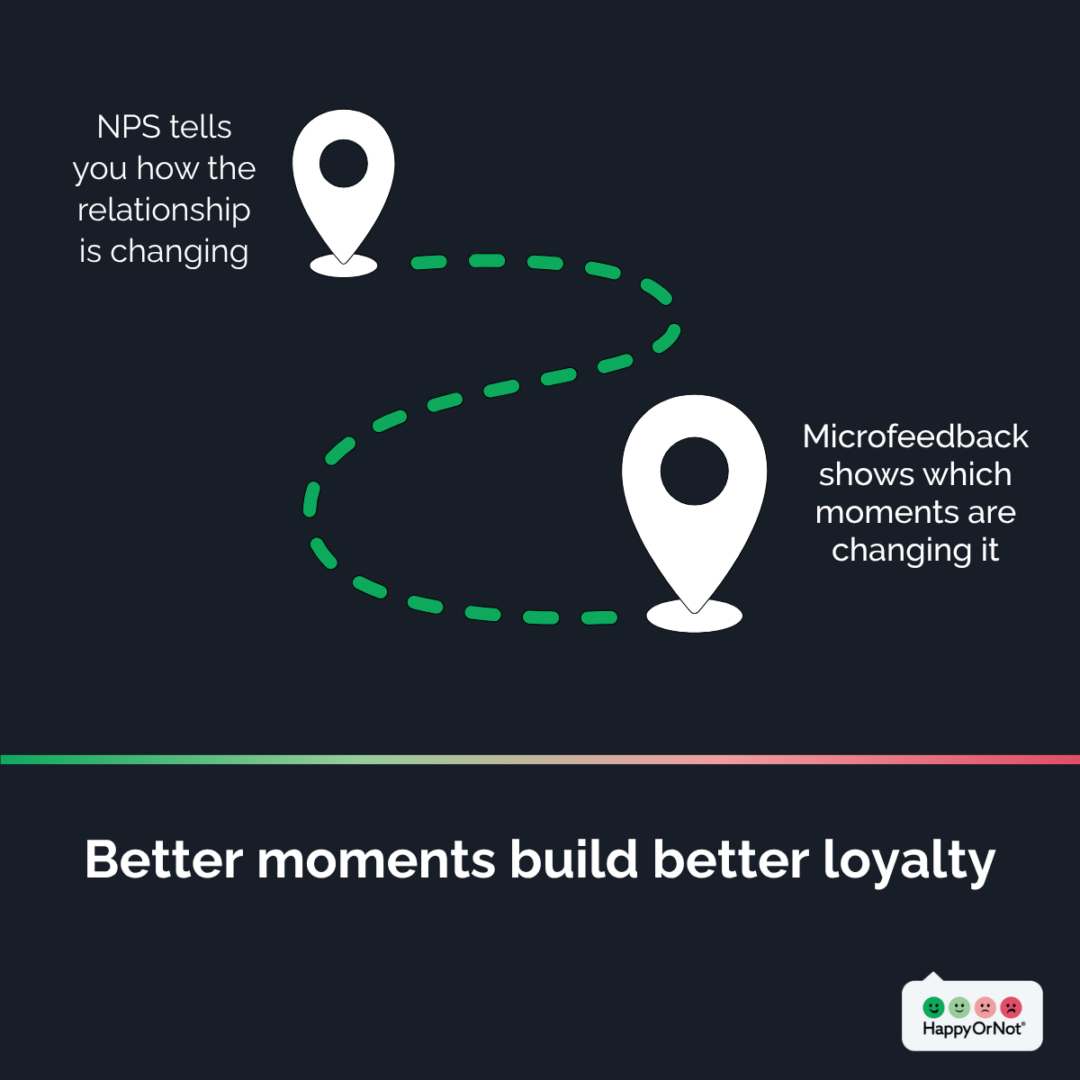
NPS vs. microfeedback: Why they work better together
| NPS | Microfeedback | |
| Primary job | Track long-term loyalty and relationship | Improve the experience at the point of service |
| View | Zoomed-out, strategic | Zoomed-in, operational |
| Timing | Collected later, often days to months | Captured in the moment |
| Who responds | Known customers who reply to a survey | Anyone present, including nonbuyers and walkaways |
| Best used by | Leadership, strategy, marketing | Site and branch managers, regional leaders, frontline teams |
| Cadence | Quarterly, monthly | Continuous, all day |
One difference deserves emphasis. NPS relies on reaching a known contact, so it misses visitors, nonbuyers and walkaways naturally. Microfeedback captures a much broader cross-section of customers in the moment, creating richer operational signals across every stage of the customer journey.
How microfeedback improves operations in the real world
The session grounded the idea in three practical examples, each showing the same pattern: An in-the-moment signal, delivered to the right operational owner, converted into action.
Banking: Consistency across branches
Consider a community bank running 50 branches that wants consistent service quality across all of them. Real-time microfeedback collected at every branch, all day, turns into operational lessons: Compare the high performers against the low performers, understand what the strong branches are doing well (staff friendliness, staff competence, speed of service) and pull the lagging branches up toward the standard. NPS might tell the bank its overall loyalty is soft; microfeedback shows which branches and which factors to work on. (HappyOrNot is widely used across credit unions and community banks for exactly this.)
Airports and transit: Cleanliness before it becomes a complaint
In airports and train stations, cleanliness is priority number one, and you have probably seen a Smiley Terminal in a restroom in the wild. The value is receiving an operational signal while there is still time to improve the experience. When responses spike between, say, 1 p.m. and 2 p.m., that is not a complaint to read next quarter; it is an alert to bolster the cleaning schedule at that location, at that hour, today. The team knows precisely where and when to act to hold guest satisfaction, rather than discovering the problem after it has already shaped a traveler’s impression.
Retail: Measuring the impact of self-checkout
Self-checkout is a decision customers feel strongly about. Retailers that have rolled it out use real-time microfeedback to study how it affects satisfaction each day and whether they need to open manual lanes.
That is an operational change measured at the point of experience, across stores, in a way an annual loyalty score never could. It also feeds a strategic question leadership cares about: Was the self-checkout rollout the right call across all our locations? This is where microfeedback becomes more than a measurement tool.
Operational signals are routed directly to the people closest to the experience, enabling coaching, recognition and continuous improvement while customer moments are still unfolding.
As Erickson summarized: “Producing signals, which can then be delivered in real time to the proper operational owner and converted to action.”
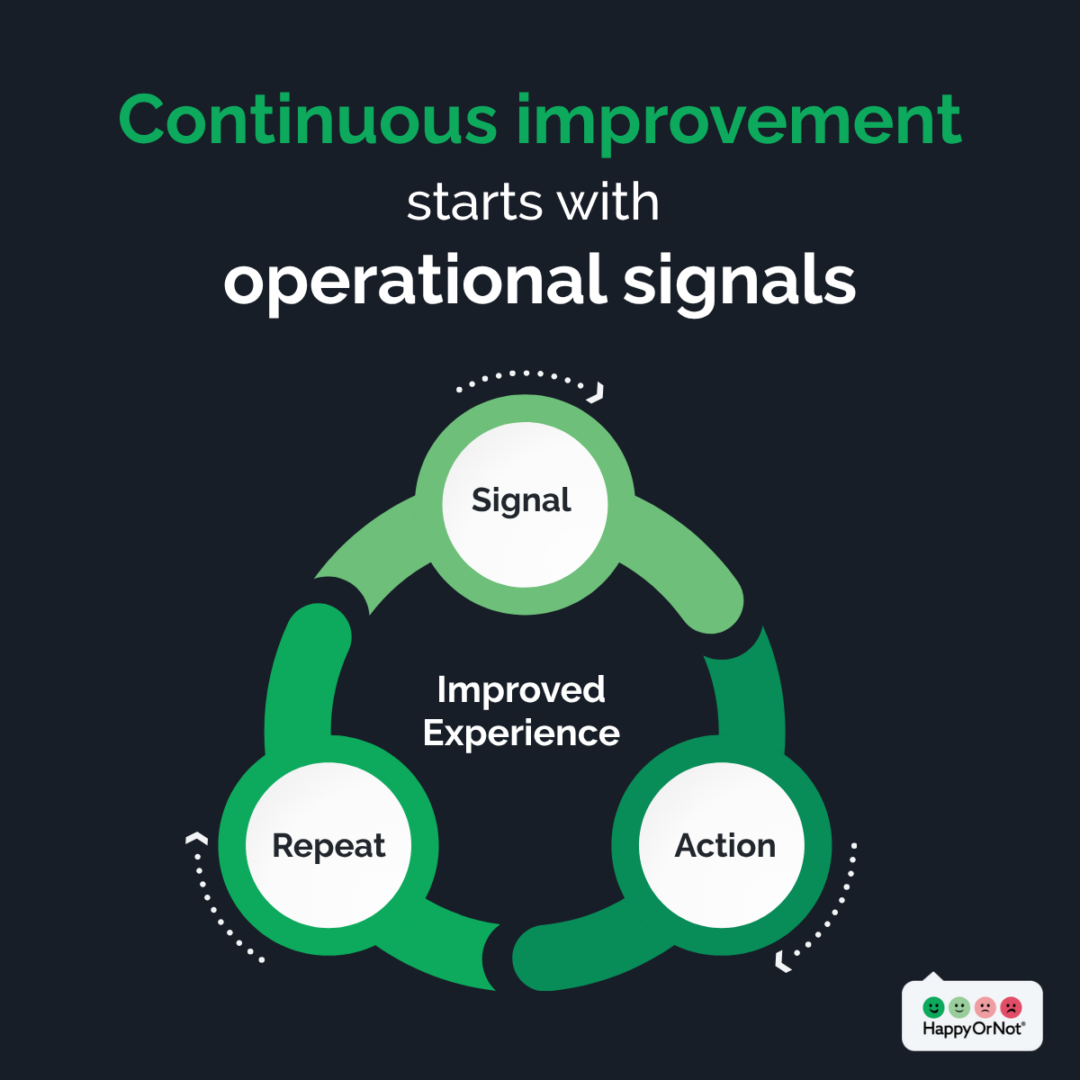
Why the best teams use feedback to recognize success—not just fix problems
One misperception worth retiring is that operational feedback exists only to catch failures. It is equally powerful for spotting what is working. Because microfeedback captures the positive as well as the negative, managers can use strong signals to recognize and reward staff and to coach teams on what the best performers do well.
As Erickson noted, many customers “use positive feedback to reward their staff members, train staff members on what’s working best, which always leads to delivering a better service experience.” Recognition, coaching and continuous improvement—not simply correcting problems—are what transform feedback into a lasting operational culture.
Different jobs, different owners without the data overload
If your team already lives in dashboards, the instinct at the mention of another metric is understandable dread. The answer is not to hand everyone another screen. It is to give each metric a clear job and route role-relevant signals to the right people:
- NPS flows to leadership, strategy and marketing: The people responsible for the long-term relationship and competitive position.
- Microfeedback flows to the people who can influence the experience directly: Site managers, branch managers, regional leaders and frontline staff.
Operational signals should reach the people who can act without creating another dashboard to monitor.
Alerts notify the right operational owner when attention is needed. AI can summarize millions of comments into meaningful themes, surface emerging patterns and increasingly help teams understand what deserves attention first rather than simply reporting what happened.
Rather than creating another reporting system, operational insights become part of existing workflows through business intelligence integrations, notifications and operational guidance.
The objective isn’t another place to view data. It’s helping the right people make better operational decisions, faster.
How operational improvements strengthen long-term customer loyalty
This is where the two approaches come together. Microfeedback helps teams identify and improve the specific moments that shape the customer relationship. NPS measures how that relationship evolves over time.
As organizations continuously improve everyday experiences—a faster checkout, a cleaner restroom, a better-coached branch team—they create the conditions that support stronger customer loyalty over the long term. Rather than asking whether one metric drives the other, it’s more useful to recognize that operational excellence is built one interaction at a time, while loyalty reflects the cumulative effect of those experiences.
Improving microfeedback results will not automatically or directly move NPS by a set amount; too many factors shape loyalty for such a neat equation. The honest framing is the one both speakers used: Microfeedback gives teams a way to know whether they are improving day to day, and those improvements are the raw material that longer-term loyalty is built from. As Erickson put it, “if a company is truly using real-time feedback to improve something, that should parlay into improving the NPS framework down the line.”
NPS or microfeedback? A practical framework for choosing the right metric
Sam closed the session with a simple decision framework. Rather than starting with a measurement tool, start with the operational decision you’re trying to make. Then work backwards to determine which feedback approach best supports that decision.
- What decision are we trying to support? Start from the outcome you want (faster checkout times, better staff tenure, a smoother journey) not from the tool.
- Is it a strategic or an operational decision? Competing for market share in your vertical points toward NPS. Moving people through the checkout line faster points toward microfeedback.
- Who needs the information? Board and strategy teams or frontline operators? The owner determines the metric and how it is delivered.
- How quickly must they be able to act? A quarterly cadence suits strategy; continuous operational improvement requires in-the-moment operational signals
- Which customer moments need visibility? Map the journey and decide which touchpoints you most need to see clearly.
Start with the one, two or three customer moments that matter most to your business today and measure them consistently. Give the resulting operational signals directly to the people who can improve those experiences and then expand from there.
Organizations rarely struggle because they measure too little. They struggle because they collect more information than teams can realistically act upon. Focused operational signals that consistently lead to action will always outperform comprehensive reporting that nobody owns.
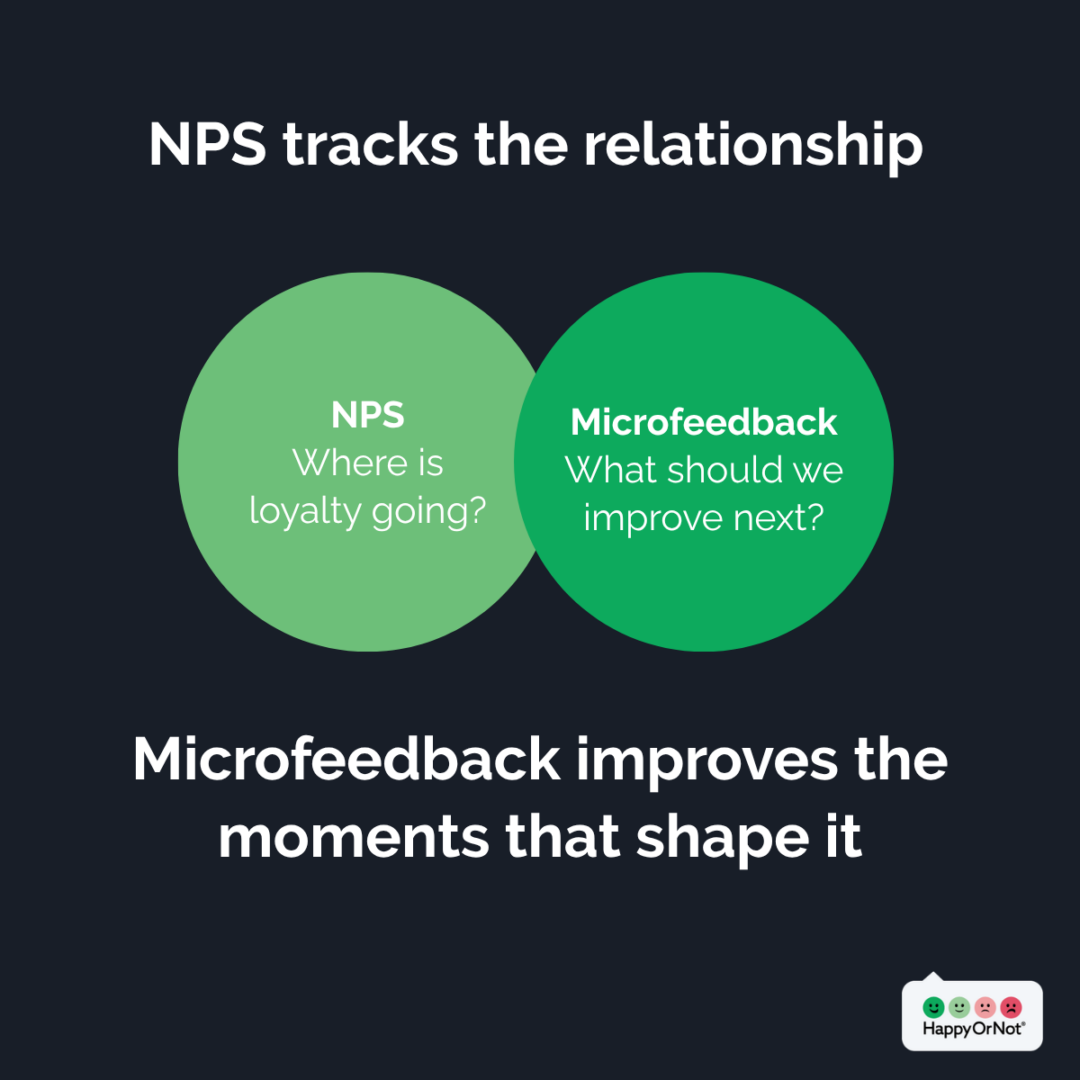
The takeaway: Strategy measures loyalty. Operations improve it.
NPS and microfeedback are not competing approaches. They answer different questions—and together they connect strategy with execution.
NPS tracks the relationship. Microfeedback improves the moments that shape it.
NPS gives leadership a long-term view of customer loyalty. Microfeedback gives frontline teams the operational signals to improve experiences while they still matter.
Together, they help organizations move beyond measuring customer experience to continuously improving it. As Scott Erickson summarized, that combination “ultimately leads to faster operational action.”
Give your frontline teams the operational context to improve customer experiences
If your organization already measures customer loyalty, the next question isn’t whether you need another score. It’s whether the people closest to the customer have the operational context they need to improve today’s experience. That’s where microfeedback complements NPS.
By turning customer moments into operational signals, HappyOrNot acts as an operational ally, helping organizations identify opportunities, recognize great performance and continuously improve customer experiences—one interaction at a time.
Explore how HappyOrNot helps organizations turn microfeedback into operational improvement.