Voice of the Customer program: 7 steps to turn signals into frontline action
Most Voice of the Customer programs collect feedback. Few turn it into action fast enough to improve the experience in the moment. Learn practical steps to build a VoC program that captures real-time signals, empowers local teams and drives continuous improvement.

Operations teams do not lose customers because they lack data. They lose customers because the signal arrives too late, reaches the wrong people, or never turns into a decision.
A modern Voice of the Customer program fixes that by treating customer input as an operational system, not a quarterly initiative. The goal is simple: Capture real-time customer feedback at the point of experience, route it to an owner, take action fast and validate the impact.
That is the difference between a customer feedback program that “measures” and one that produces customer experience improvement.
Why many Voice of the Customer programs fail in practice
Most VoC strategy decks look strong on paper, but breakdown on the floor. Common failure modes include:
- Feedback shows up after the moment has passed, so teams cannot recover the experience.
- Collection relies on email or SMS lists, so walkaways and non-buyers stay invisible.
- Insights get over-aggregated, so local problems blend into “average” performance.
- Frontline teams cannot access the data easily, so they disengage.
- No operating rhythm exists, so nothing gets assigned, tracked or closed.
Response rates are also a structural constraint. Many survey channels face declining participation over time, and low response rates make it harder to trust what is “representative” without extra rigor. For example, Pew Research Center reported telephone survey response rates falling to 6% in 2018 after decades of decline.
A VoC process that depends on delayed recall also introduces distortion. Research on retrospective evaluations shows people often judge experiences based on peaks and endings, while neglecting duration and nuance.
What a modern VoC process looks like for operations teams
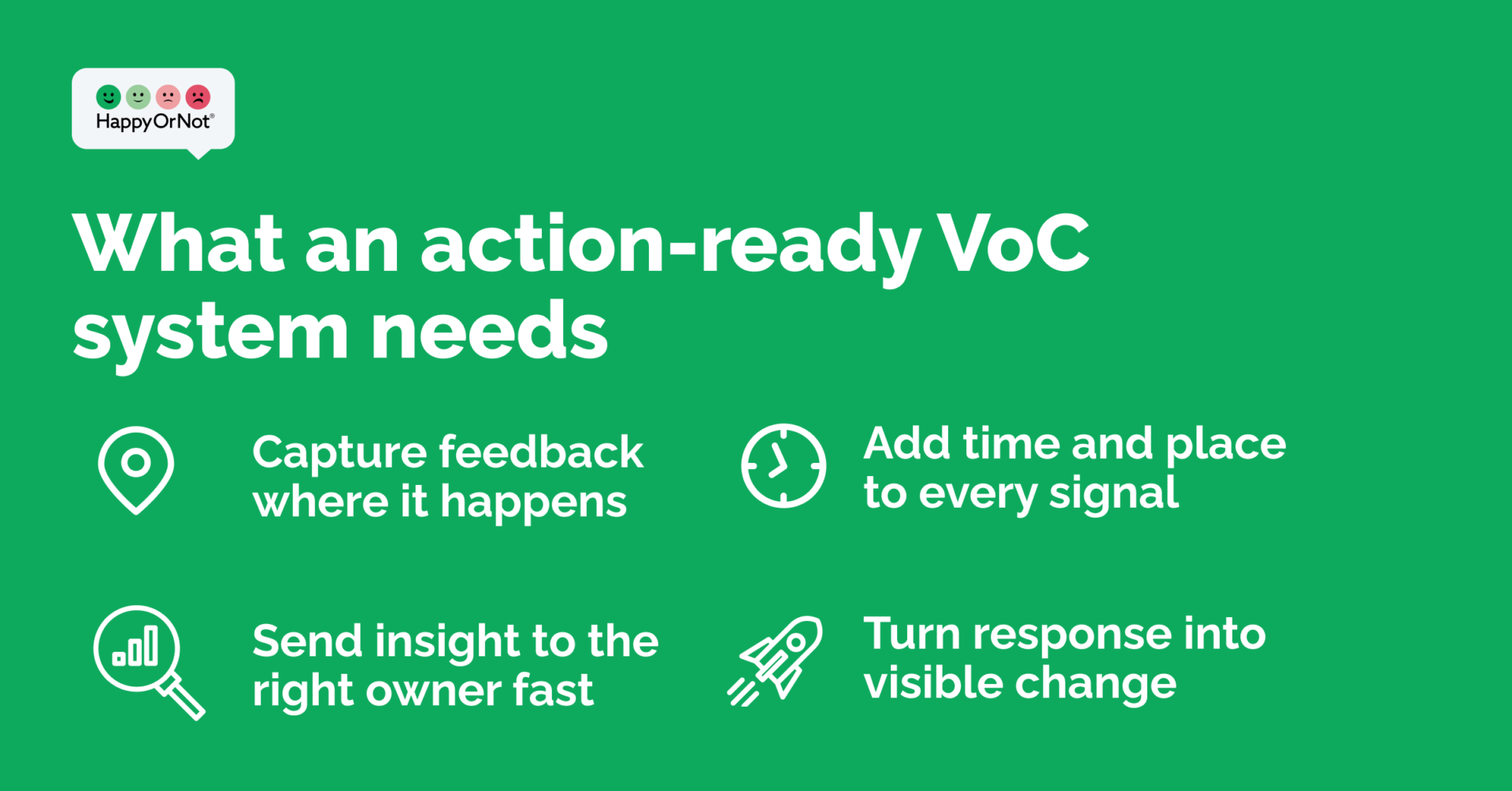
A voice of customer strategy that drives action has four moving parts:
- A collection fabric that captures signals where customers actually are.
- Context that tells teams when and where the signal happened.
- Routing and ownership that puts the signal in the right hands fast.
- A closed-loop cadence that turns signals into visible improvements.
Traditional post-visit surveys still have a role in deeper analysis and periodic benchmarking. But for day-to-day operations, VoC also needs real-time feedback captured at the point of experience. These short, in-the-moment signals – often referred to as microfeedback – help teams see what is happening now, understand where it happened, and take action while the issue is still relevant.
The 7 steps to building your Voice of the Customer program
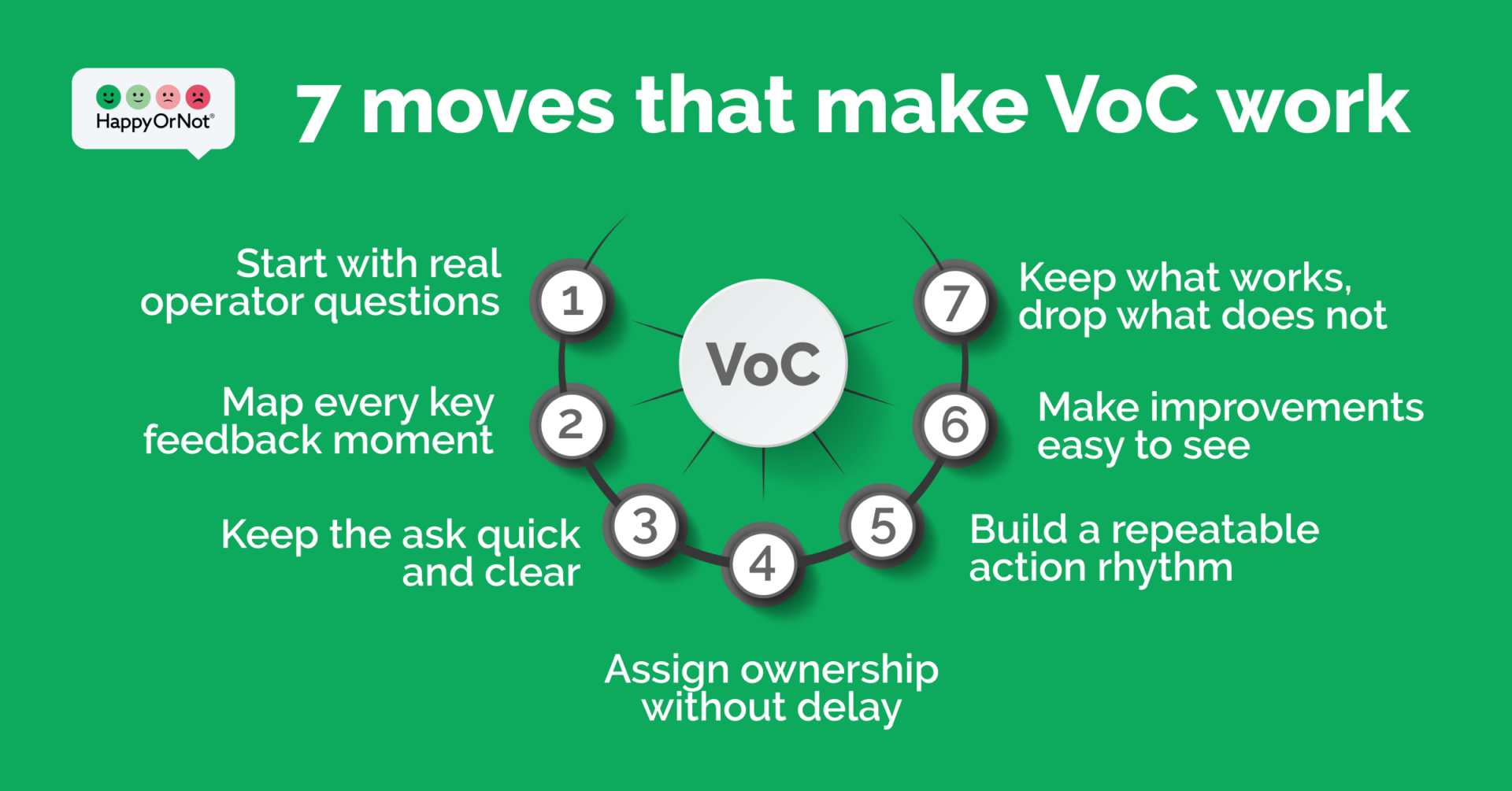
1) Start with the decisions you need to make this week
Before choosing tools, define what the business needs to decide on a daily or weekly cadence.
Examples:
- Which locations are slipping right now?
- Which touchpoint is creating avoidable friction?
- Where do we need to adjust staffing, coaching, or maintenance?
Output to produce:
- A short list of “operator questions” your VoC program must answer every week
2) Design your collection fabric to include buyers and walkaways
A feedback collection fabric is the mix of touchpoints and channels used to capture customer feedback across the journey. If feedback only starts after purchase, the program misses in-moment experiences and the people who gave up.
Build coverage across the entire journey:
- Entry and exit moments
- Service counters and queues
- Post-service points like receipts, confirmation pages or follow-up signage
Make it easy for both groups:
- One-tap sentiment first
- Optional detail second for those who want to explain
Output to produce:
- A simple map of collection points by location and touchpoint, including where walkaways can respond
3) Keep the ask tiny and capture context automatically
Microfeedback works well here because it keeps the ask short: a quick, in-the-moment signal with optional follow-up detail and automatic context like time, location or touchpoint. Operational feedback should be easy to give and easy to interpret.
Design rules that protect signal quality:
- Ask one core question at the moment of experience
- Use optional follow-ups only when you need the “why”
- Capture time and place automatically so analysis does not depend on memory
Output to produce:
- A short question set by touchpoint, with a clear rule for when follow-ups appear
4) Route customer feedback to an owner on the same day
A VoC program fails when everyone sees the data, but no one owns the fix.
Set ownership at the level action happens:
- Each location has a named owner
- Each touchpoint has an accountable role
- Exceptions trigger escalation rules
Output to produce:
- A routing map: Signal type → owner → escalation path → response expectation
5) Turn insight into action with a weekly operating rhythm
Customer feedback only becomes valuable when it changes today’s work.
A simple operating cadence:
- Daily glance at the signal for anomalies
- Weekly review of themes and top drivers
- Two actions chosen, assigned and tracked
Keep actions small and testable:
- Adjust staffing windows
- Fix signage or wayfinding
- Reinforce a service behavior with coaching
- Repair a recurring facility issue
Output to produce:
- A weekly “Top 3 drivers” view plus an action tracker with owners and due dates
6) Close the loop where customers and teams can see it
Closing the loop is not a report. It is proof.
Make the improvement visible:
- “You said, we did” posted near the point of service
- Posts on your social channels
- Wins shared in team huddles
- Customer comments used as recognition, not ammunition
This step is also how you sustain participation. When customers and staff see changes, they keep contributing.
Output to produce:
- A simple close-the-loop template and a rhythm for publishing it
7) Scale what works and retire what does not
VoC is a system, and systems improve through iteration.
Each month:
- Review which signals led to fixes
- Standardize playbooks that repeatedly lift performance
- Remove steps that add friction without value
Output to produce:
- A “keep, change, stop” review tied to operational outcomes
Key takeaway
A Voice of the Customer program earns trust when it produces action at the frontline. Build for speed, coverage and ownership, then run it on a repeatable cadence that turns signals into visible improvements.
Traditional enterprise CX platforms still play an important role in organization-wide reporting, segmentation and long-range insight. But operational teams also need fast, local signals they can act on during the week, not after the quarter. That is where microfeedback adds value: complementing broader CX programs with real-time visibility into frontline experience.
Want a VoC system that matches operational cadence? Start with one or two high-impact touchpoints, capture microfeedback in the moment and build a weekly rhythm that closes the loop.