Why Real-Time Microfeedback Accelerates Frontline Action
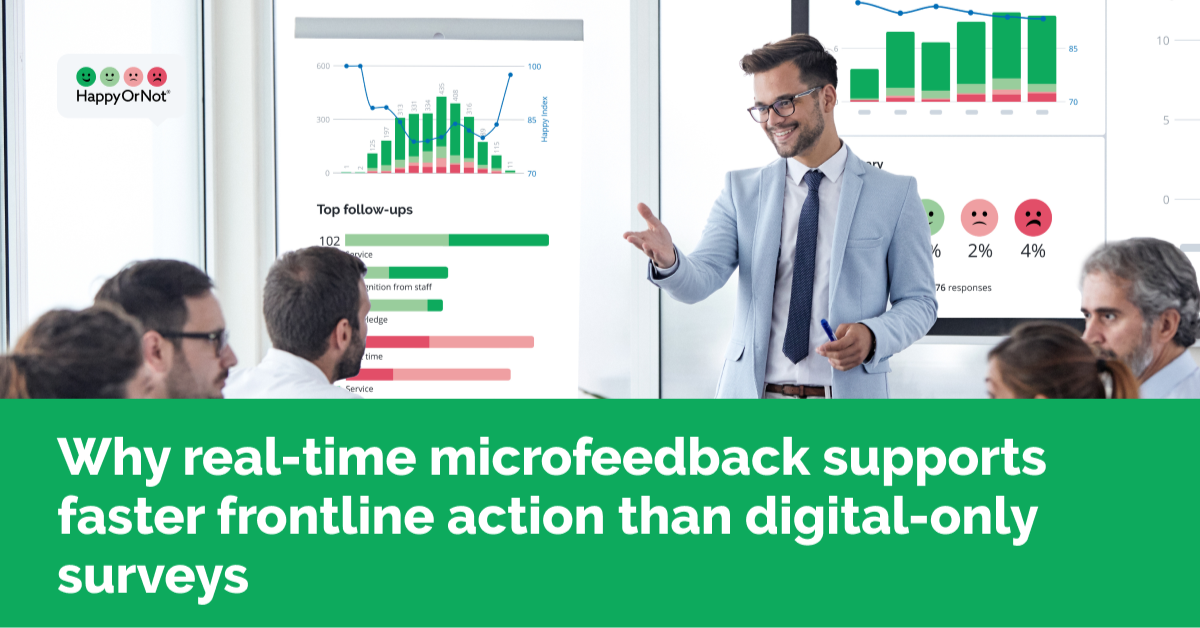
Frontline operations run on speed. Queue times change by the hour, staffing shifts midday, and small service breakdowns spread fast across a network of experience points. When feedback arrives after the moment has passed, relevance drops and action slows.
Digital-only surveys can still be valuable, but they often produce delayed dashboards and post-event opinions—not the in-the-moment signal that helps managers fix problems while customers are still on-site. Real-time feedback, captured at the point of experience, closes that gap. Microfeedback is built for the operational cadence of experience points, teams, and shifts, so frontline feedback turns into same-day decisions instead of next month’s insights.
This article compares digital-only surveys with real-time microfeedback, explains the cadence gap that slows speed to action, and clarifies where enterprise customer experience (CX) platforms fit in a complete feedback ecosystem.
The Limitations of Digital-Only Surveys for Operational Feedback
Digital-only surveys depend heavily on first-party data collection, usually email or short message service (SMS). That introduces a coverage problem straight away. Not every visitor becomes a buyer. Walkouts rarely volunteer feedback. Guests who had the worst experience often disappear without leaving any usable trail. Operational blind spots grow, especially in high-traffic environments where the experience is short and the decision to leave is quick.
Survey timing also creates memory and recall issues. A later email survey asks customers to reconstruct an experience that might already be blurred by the rest of their day. Recall bias is a known issue in self-reported, retrospective questioning, especially as time passes between the event and the response.
Then there is the friction problem. Response rates drop when surveys feel long, repetitive, or poorly matched to the moment. Tim Waterton, Chief Revenue Officer at HappyOrNot®, put it simply: “A large proportion of brand and customer experience happens face to face.” That is exactly where microfeedback earns its keep because it captures high-volume signals at the point of service across physical and digital channels.
Digital-only surveys often drift toward that pattern. Teams try to capture everything at once, but operational feedback needs speed and focus. Survey fatigue is real, and well-intended programs can reduce participation by over-surveying.
For operations leaders, the core issue is not whether digital surveys can produce insights. The issue is whether those insights arrive in time to change what happens on today’s shift.
Understanding the Cadence Gap Between Operations and Traditional CX Reporting
Operations teams live in an hourly and daily rhythm. Experience points open, peak, and close. Staffing levels flex. Service recovery needs to happen now, not after a quarterly business review. That cadence shapes what actionable customer feedback really means in practice.
Traditional CX reporting often follows a different rhythm. Data collection can be continuous, but analysis, distribution, and decision-making commonly land in weekly summaries, monthly dashboards, or quarterly executive reviews. That cadence works for strategic planning, but it can fail frontline managers who need real-time customer insights to make immediate adjustments on the floor.
The result is a cadence gap. The gap is not about data quality. The gap is about speed to action. When insight arrives too late, teams either ignore it or file it into long-term initiatives. Meanwhile, the same friction repeats throughout the day because local teams did not get a timely signal they could use.
Real-time microfeedback closes the cadence gap by matching the way operations actually run. When feedback is captured in the moment and tied to time and place, teams can connect cause and effect quickly, then act with confidence.
Where Enterprise CX Platforms Fit in the Feedback Ecosystem
Enterprise CX platforms are powerful. They excel at aggregating data across channels, supporting enterprise reporting, mapping journeys, and helping organizations measure experience trends over time. Those capabilities matter, especially for large networks where executives and analysts need consistent metrics, governance, and long-term visibility.
Enterprise CX platforms are also often designed for specialist users. Dashboards, taxonomies, and workflows typically assume an analyst-led operating model. That is not a flaw. It has a different purpose. Enterprise tools are built for enterprise insight, program management, and strategic change.
Real-time microfeedback is complementary, not competitive. Microfeedback is the operational layer that makes real-time CX practical at the point of experience. It supports frontline action while enterprise platforms support enterprise visibility. In a mature stack, the two reinforce each other: Microfeedback drives daily execution, and enterprise CX platforms provide the strategic lens and long-term reporting.
For teams exploring the operational layer, an overview of how HappyOrNot Analytics connects feedback to time, place, and action is here: HappyOrNot Analytics.
Real-Time Microfeedback Changes Who Can Take Action
Microfeedback changes the most important part of the feedback equation: who can act.
Instead of feedback being captured later and routed upward for analysis, real-time microfeedback is captured in the moment and in location. Managers do not need to wait for a weekly report to spot a service dip. They can see it during the shift, in the same place it happened, and respond locally.
That is why microfeedback is fundamentally feedback for operations teams. The system is built to deliver a fast signal with minimal friction, then translate that signal into visibility that a frontline manager can use.
Waterton describes the foundation as a “collection fabric” rather than a single channel: “A good solution from this point forward is a combination of physical and digital touchpoints. In many locations, you are going to want the one-tap feedback as well as deeper feedback with follow-ups and verbatims. That is what we call collection fabric.”
That collection fabric is designed to work where customers and employees actually are. For example, in-location feedback devices like Smiley Terminal™ and Smiley Touch™ capture quick sentiment at exit points, service points, and key moments. Digital touchpoints like Smiley Digital™ extend real-time feedback into online journeys when needed. Physical environments can also use quick response (QR) and near-field communications (NFC)–based “tap to tell” moments through the Smiley Sign™, adding flexibility without slowing the experience.
The outcome is immediate visibility for the people closest to the work. Frontline feedback stops being a corporate reporting exercise and becomes an operational signal that supports quick, local action.
From Feedback to Action: How Operational ROI Is Created
Feedback does not create return on investment (ROI). Action creates ROI.
That point matters because many organizations invest in measurement, then stall at analysis. Real-time customer insights only turn into value when teams change something on the frontline. That is where operational ROI is created: shorter queues, cleaner spaces, better handoffs, stronger service behaviors, and fewer repeated failures.
Microfeedback supports that chain because it is designed to trigger action in weeks or months, not years. The loop is short: capture the signal, spot the pattern, fix the cause, and verify improvement through the next wave of real-time feedback.
Waterton put it plainly when comparing technology to outcomes: “I think it’s useful to separate out those things. It’s not enough to just buy a software product. You have to actually implement it. You have to have an operating model. So you can go and buy Salesforce, you can go and buy an ERP [enterprise resource planning] system. But if you don’t implement it properly, it’s worthless. It’s the same with experience management. The software is good, but the work has to happen as well.”
Operational ROI depends on an operating model that fits the frontline. That means clear ownership at the experience point level, simple routines that match daily cadence, and visible follow-through. It also means giving local leaders actionable customer feedback they can act on without waiting for a central team.
For organizations focused on frontline environments, related context on designing feedback programs for shift-based teams is here: Employee Experience in Manufacturing.
Turning Customer Signals Into Same-Day Improvements
Speed enables relevance. When real-time feedback is captured at the point of experience, teams see what is happening now, not what happened weeks ago.
Action enables ROI. Microfeedback delivers the signal, but operational routines turn that signal into fixes. That is why microfeedback supports operational execution inside a broader CX stack rather than trying to replace enterprise CX platforms.
Digital-only surveys can still play a role, especially for deeper, post-event exploration. But for operations leaders and frontline managers who need real-time CX to drive same-day improvements, microfeedback is the faster path from raw signals to clear next steps.
If improving speed to action is a priority, book a demo and see how the operational layer fits your environment: Request a demo.