Using guest feedback to prepare for contract renewals and QBRs
At a contract renewal or QBR, clients increasingly want evidence of dining quality, not just assurances. This guide looks at how operators turn continuous guest feedback into a clear, trend-based record they can bring to those conversations.

For contract catering operators, the renewal is the point at which the whole relationship is reviewed – and the bar has been rising. Research on supplier relationships suggests client expectations of QBRs have grown in recent years, with clients scrutinizing delivered value more closely than before (ClientShare). Increasingly, assurances alone carry less weight than evidence. This guide looks at how to build that evidence from guest feedback, and how to bring it to every QBR and renewal.
Why guest feedback helps at renewal
A host organization renewing a catering contract is really asking three things: are our people happy with the dining, do you catch and fix problems when they arise, and is the service improving rather than slipping? Guest feedback, captured continuously and tied to time and place, speaks to all three in the client’s own terms. Operational metrics like cost per cover and covers served matter internally, but they do not answer the question the client tends to care about most: how did our people feel and will they come back? Guest experience data speaks to that directly.
What is a QBR in contract catering?
A QBR is a structured meeting between operator and client to review performance against the contract, surface issues and align priorities for the period ahead. In contract catering, it typically covers performance against service-level agreements (SLAs), guest satisfaction, issues and how they were resolved, initiatives and innovation, and plans for the coming quarter. Handled well, QBRs are where operators demonstrate delivered value and strengthen the partnership, and where the groundwork for renewal is laid, quarter after quarter.
The operators who run strong QBRs tend not to scramble for data the week before. They arrive with a current, ongoing view of the guest experience, because they have been capturing it all along.
What evidence do clients look for at renewal?
Clients increasingly look for evidence across four areas:
- Guest satisfaction over time. A consistent, trend-based satisfaction score, rather than a one-off survey, showing how the experience has held up across the contract term.
- Issue detection and resolution. Signs that problems were caught quickly and addressed, which points to an active, responsive operation.
- SLA discussions. Evidence that agreed service levels for quality and experience were met consistently, site by site.
- Continuous improvement. A record of specific changes made in response to feedback, the “you said, we did” story that shows the operator acts rather than reacts.
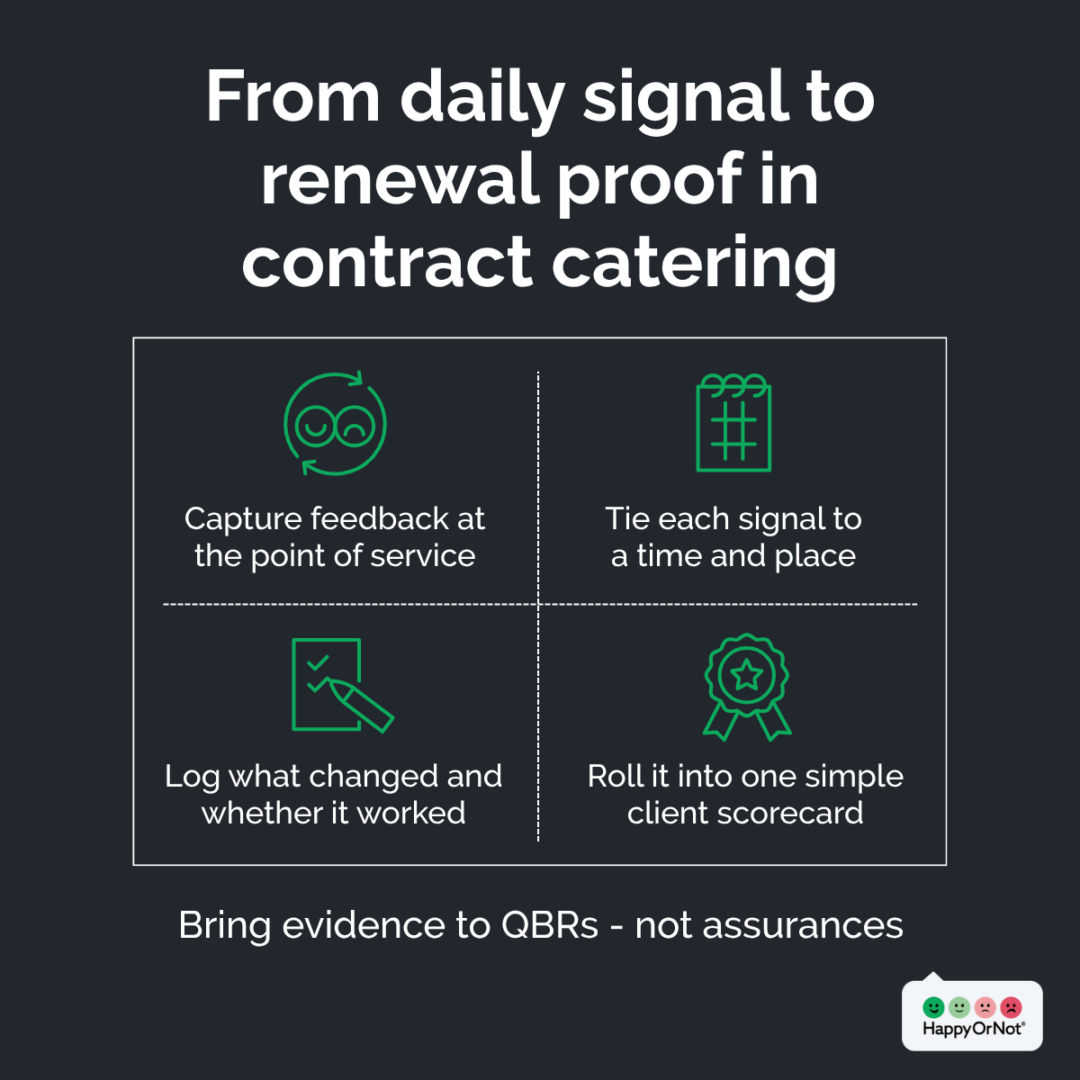
How to build a renewal-ready record from guest feedback
The strongest renewal evidence tends to be a by-product of running the operation well, using a simple loop of signal, hotspot, fix and proof. Here is how to turn it into a QBR-ready narrative:
- Capture continuously. Collect real-time microfeedback at the point of service across every site, so the record is current rather than reconstructed at quarter-end.
- Tie signals to time and place. Show performance by site, meal and period, and speak to SLA performance location by location.
- Log the fixes. Record what changed in response to feedback, and whether the score moved, the heart of the “you said, we did” story.
- Build a simple scorecard. Combine overall satisfaction, response volume, participation and closed-loop actions into a repeatable summary the client can trust.
- Use AI to summarize the themes. AI-powered open feedback can group written comments into themes, which gives useful input for client meetings and staff recognition.
Real-time feedback in renewal and governance: examples
The City of Järvenpää and its food provider Palmia show the loop in practice. Continuous student feedback, reviewed weekly between client and operator, gives both sides a shared, objective view of dining quality. Palmia has described the feedback as helping the team stay on top of service quality and meet SLA expectations across service locations, which is the kind of evidence a renewal conversation calls for.
The pattern is consistent: the feedback that informs day-to-day operations is also the feedback that helps demonstrate value at renewal. HappyOrNot’s facilities and managed services work is built around this kind of continuous visibility, which supports SLA discussions and renewal conversations.
Turn every quarter into a renewal advantage
The operators who approach renewal with confidence tend not to be the ones with the best last-minute slide deck. They are the ones who have been capturing the guest experience continuously, acting on it visibly and logging the proof along the way. By the time the QBR or renewal arrives, much of the case is already made. To put the underlying system in place, see our guide for catering operators on capturing real-time dining feedback.
Bring evidence to every renewal, not just assurances
HappyOrNot gives food service operators continuous, current evidence of dining quality across every site. Explore Managed Service or see how operators capture real-time feedback.