Catering operators: How to capture real-time dining feedback
Food service operators need feedback that is fast enough to act on, specific enough to pinpoint the site and meal, and credible enough to bring to a client review. This page looks at what a real-time cafeteria feedback system should do and how HappyOrNot supports it.
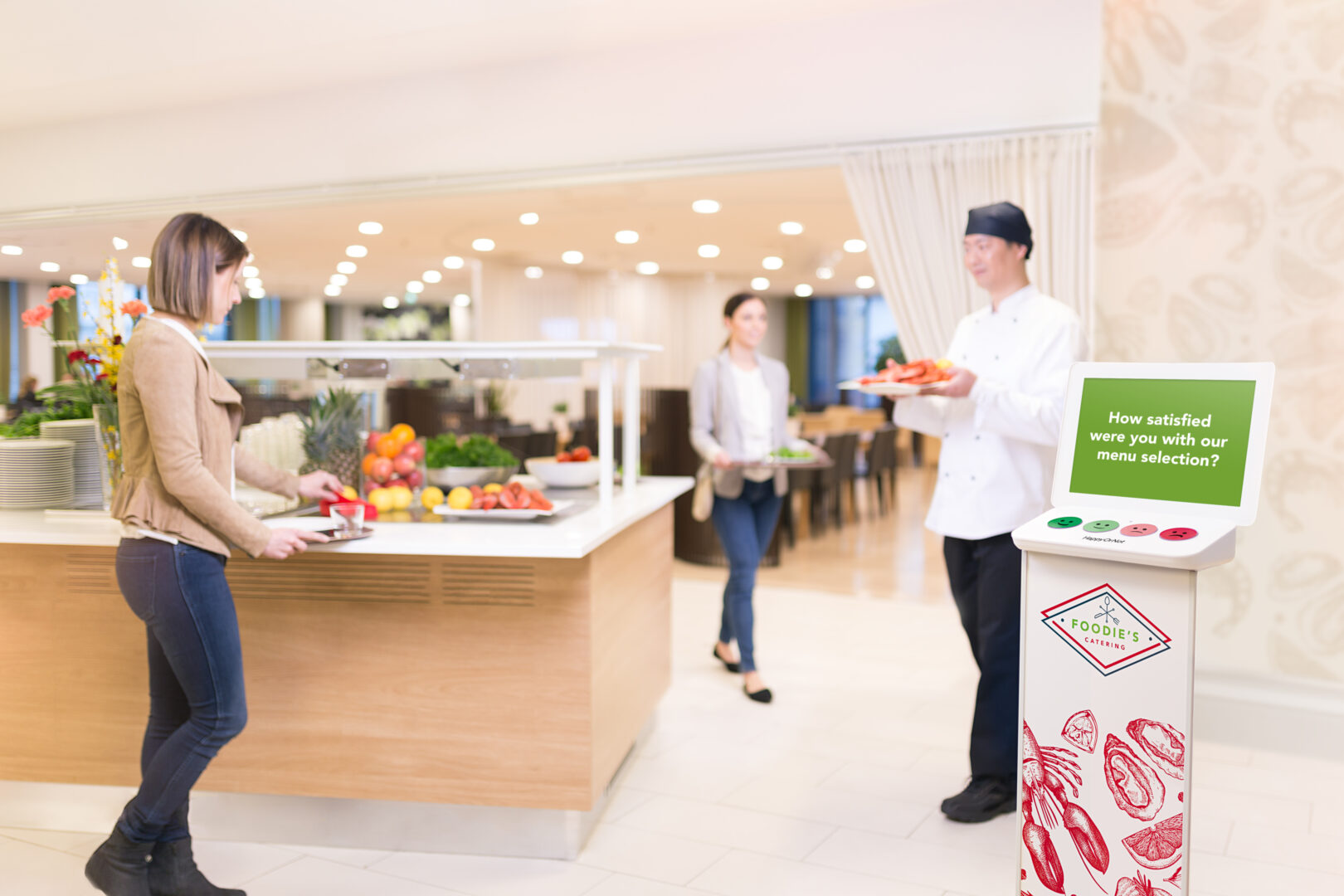
If you run contract catering, across workplace restaurants, campus dining halls, senior living communities or a mixed portfolio, you know the limits of traditional feedback. Surveys tend to arrive late and infrequently. Mystery shopping is a periodic snapshot. Complaints usually surface only when a diner is frustrated enough to raise one. Meanwhile, many guests simply stop coming, and participation can slip before the warning shows up. This page looks at how real-time dining feedback helps, and why it fits the way operators work.
The feedback challenge for food service operators
Operators sit in a demanding position: you deliver the experience, and you also have to demonstrate it, to a host organization, on a contract, at a review. There are three gaps make that hard with legacy methods:
- Feedback arrives too late. A survey analyzed weeks after service describes meals that can no longer be changed. Email survey response rates have fallen to around 10 to 15 percent (User Intuition), so even that late signal is thin.
- Visibility is fragmented. When each site measures differently, or not at all, there is no consistent, portfolio-wide view of how the dining experience is really performing.
- Evidence is hard to produce. At a quarterly business review (QBR) or renewal, assurances alone rarely satisfy. Clients increasingly look for evidence, and legacy tools do not always provide it in a form that holds up.
What a cafeteria feedback system should do
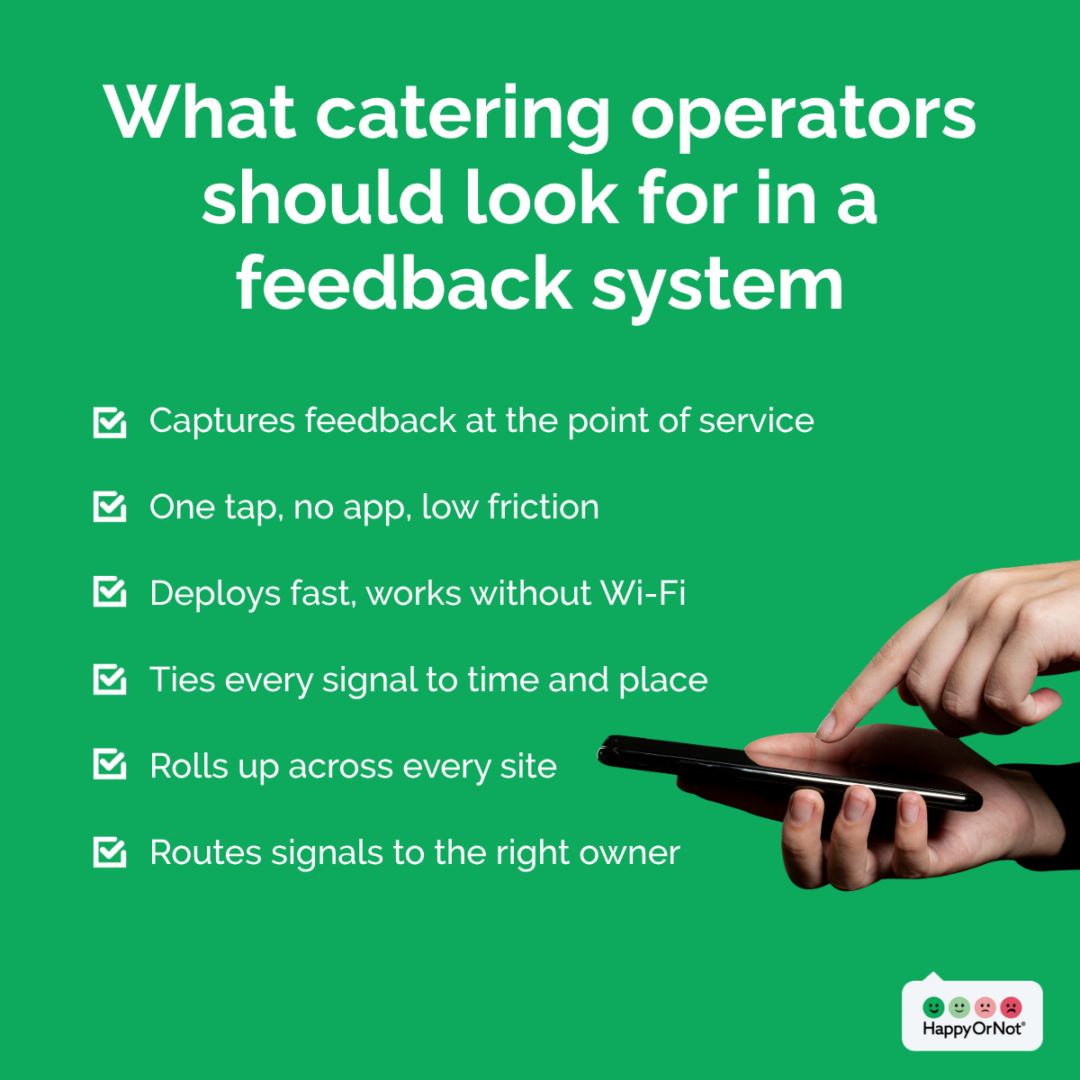
A capable system helps close all three gaps. It is worth looking for a system that offers, amongst other things, capabilities such as:
- Captures at the point of service. Collect feedback where and when the meal happens, such as the exit from the service area, the tray return or the seating area, rather than hours later by email.
- Keeps it low-friction. One tap, anonymous, no app required, so a broad cross-section of diners takes part.
- Deploys without fuss. Plug-and-go hardware that works even without on-site Wi-Fi, plus digital options for pre-order and online channels.
- Ties every signal to time and place. Service dips point toward the site, meal and hour that need a closer look.
- Rolls up across the portfolio. One consistent measure and one view across every location, for fair comparison and governance.
- Helps turn signals into action. Role-based insights, alerts and integrations that route the right signal to the right owner, so feedback leads to a fix rather than a report.
How HappyOrNot works for food service operators
HappyOrNot is a real-time feedback platform built around this need: capture in-the-moment sentiment as microfeedback at the point of service, and turn it into action teams can take the same day.
Capture
Collect feedback across touchpoints: a Smiley Terminal or Smiley Touch feedback kiosk at busy serveries and exits, a Smiley Sign with QR or NFC to boost coverage and capture in areas where signage works best (e.g. walls, tables, counters), and Smiley Digital for apps and online ordering. One quick question, answered in seconds.
Analyze
Every response flows into HappyOrNot Analytics, tied to time and location, with AI-powered open feedback to group written comments by category and theme, as well as demographics to segment by guest group. See patterns by site, meal and hour, and explore the data in Analytics, Power BI or via API.
Improve
Route the right signal to the right owner with alerts and integrations, act on a daily and weekly cadence, and close the loop. Choose a self-managed or fully managed service model depending on how much support your team wants. It is a continuous loop of signal, hotspot, fix and proof.
Why operators add real-time feedback alongside surveys
Real-time feedback and periodic surveys do different jobs, and many operators use both. The contrast is clearest side by side.
| Periodic surveys | Real-time dining feedback | |
| When you find out | Weeks after the meal | Close to the moment, often same day |
| Volume | Lower, a sample of guests | Higher, continuous responses over time |
| Granularity | Aggregate averages | By site, meal and hour |
| Frontline action | Harder; the signal is slow | Easier; built for day-to-day use |
| Renewal evidence | A periodic snapshot | Continuous, trend-based |
Used across managed dining
Operators use HappyOrNot to run and demonstrate their dining programs:
- ISS reports a meaningful rise in customer satisfaction after introducing real-time feedback, used across its global food service locations and benchmarked across countries and accounts.
- Chartwells Higher Education compares and improves satisfaction across university dining locations.
- Unison Retail Management captures feedback across concessions at Chicago O’Hare, using it to act by location, brand and shift.
Built for the operator’s whole job
Real-time feedback is not only about today’s service. It is the same data that helps you prepare for contract renewals and QBRs and benchmark dining experience across multiple sites, turning day-to-day signals into portfolio governance and renewal evidence. It is designed around how catering operators work: capture, act and show.
See real-time dining feedback in action
Give your teams a live view of the dining experience at every site, and the evidence to back it up. Explore HappyOrNot’s food service solutions, or talk to us about a rollout across your portfolio.
Frequently Asked Questions
What feedback tools work best for food service operators?
Tools that capture feedback at the point of service in real time – feedback terminals and touchscreens at serveries and exits, QR or NFC signage to cover additional touchpoints (walls, tables, counters), and digital feedback for online ordering – all feeding a single analytics view. This tends to suit daily action and multi-site visibility better than periodic surveys alone.
What is a good way to collect cafeteria feedback?
Capture it in the moment, at the point of experience, with a single low-friction question a guest can answer in seconds as they leave. Tie every response to time and location, review it regularly and act with named owners.
How quickly can a feedback system be deployed?
A real-time system like HappyOrNot uses plug-and-go hardware that works even without on-site Wi-Fi, so sites can go live quickly with minimal IT effort. Digital options can be added for pre-order and online channels.
How does dining feedback help at contract renewal?
Continuous feedback gives operators trend-based, credible evidence of dining quality to bring to QBRs and renewals, which tends to be stronger than a periodic snapshot. See our guide on using guest feedback to prepare for contract renewals and QBRs.
Can the HappyOrNot feedback system scale across multiple sites?
Yes. A single consistent measure and one analytics view let operators compare and benchmark performance across a portfolio. See our guide on how to benchmark dining experience across multiple sites.