5 benefits of omnichannel customer feedback for retailers

The modern customer journey rarely happens in one place. A shopper might discover a product on their phone, check availability online, visit a store to see it and return an item at the service desk a week later. Each of those moments shapes how they feel about the brand, and each one is a chance to win or lose them.
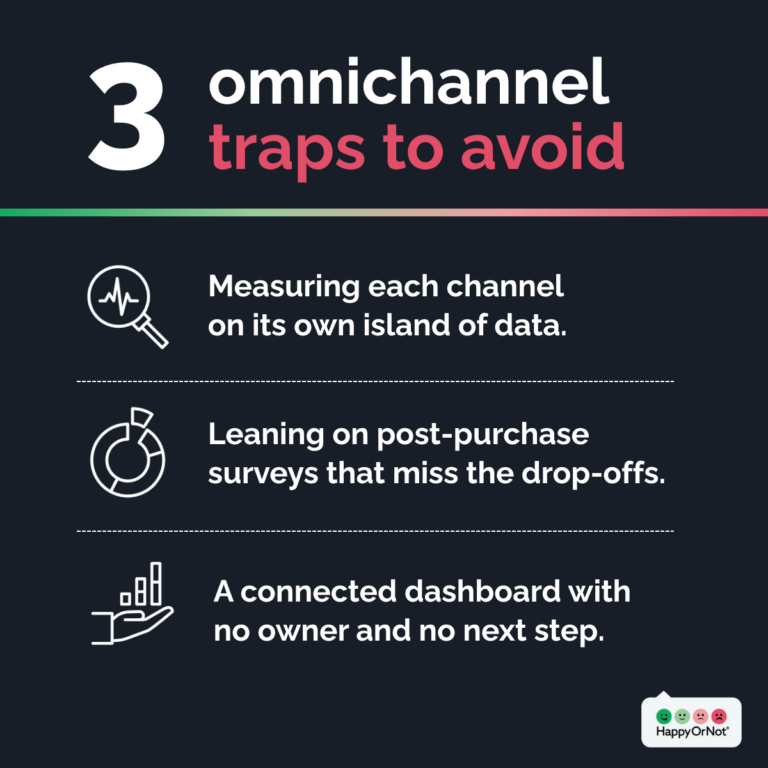
The problem is that most retailers measure these moments in isolation, if at all. The website team sees web survey data, the store team sees something else and nobody sees the whole journey. That disconnected view makes it impossible to manage the experience as customers live it as one continuous journey across channels.
Omnichannel customer feedback solves this by connecting every touchpoint, physical and digital, into a single, unified signal, a connected “collection fabric” stretched across the entire customer journey. The fastest way to weave that fabric is real-time feedback, captured as microfeedback: Short, in-the-moment signals gathered when and where each moment happens, online and in-store alike. Connected this way, feedback insights become the raw material for steady CX improvement and higher customer satisfaction across the journey. Here are five benefits that deliver for retailers, and how to put each one into practice.
What is omnichannel customer feedback?
Omnichannel customer feedback is the practice of capturing customer sentiment consistently across every channel a customer uses and bringing it together into one connected view. Rather than treating the website, the app, the store floor, the checkout and the service desk as separate islands of data, it stitches them into a single picture of the journey.
That means capturing feedback both physically and digitally: Smiley Terminal™ and Smiley Touch™ points in-store, Smiley Sign™ wherever a kiosk is not practical and Smiley Digital™ across web and app, all flowing into one analytics view.
Retailers need this unified view because a customer does not experience channels separately; they experience a brand. According to NielsenIQ research, omnichannel shoppers can be worth significantly more than single-channel ones, with omnichannel shopping growing by around 50%.NielsenIQ research has found that omnichannel shoppers can be worth significantly more than single-channel ones, with omnichannel shopping growing by around 50%. Managing those high-value journeys requires seeing them whole.
5 benefits of omnichannel customer feedback
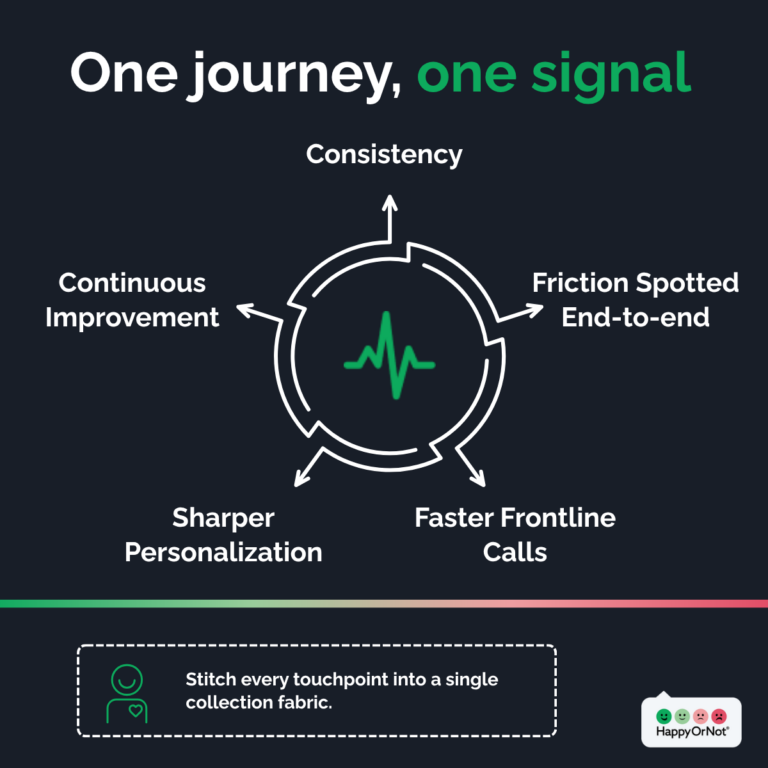
1. Create a consistent customer experience across channels
Why it matters: Customers expect the same quality of experience whether they are on your site or in your store. Inconsistency between channels erodes trust and loyalty.
Practical implementation: Measure the same experience signals across every channel so you can see where the journey is strong and where one channel is letting the others down.
How real-time customer feedback supports it: A connected signal reveals consistency gaps as they emerge, for example, when in-store satisfaction outpaces the online checkout, so you can close the gap before it costs you customers.
Business outcome: Consistency builds trust, and trust drives repeat business and higher customer lifetime value.
2. Identify friction throughout the customer journey
Why it matters: Friction can appear anywhere, a confusing online checkout, an out-of-stock item in-store, a slow returns process and it is invisible if you only measure one channel.
Practical implementation: Place feedback points at the key moments in every channel, then look at the journey end to end to find where customers drop off or grow frustrated.
How real-time customer feedback supports it: Because each signal is tied to a specific touchpoint and moment, microfeedback pinpoints exactly where friction lives, rather than leaving you with a single blended score.
Business outcome: Removing friction at the right points lifts conversion and reduces lost sales across the journey.
3. Improve frontline decision-making
Why it matters: The teams closest to customers, in stores and service centers, make better decisions when they can see how customers feel in the moment.
Practical implementation: Give each location and channel team visibility of their own feedback and the authority to act on it.
How real-time customer feedback supports it: Live, location-level signals let frontline teams respond the same day rather than waiting for a head-office report, turning feedback into action where it matters.
Business outcome: Faster frontline decisions mean problems are fixed before they spread, protecting satisfaction and revenue.
4. Personalize customer experiences using real-time insights
Why it matters: A unified view of the journey is also the foundation for relevant personalization, because you understand the customer across channels, not just in one.
Practical implementation: Use connected feedback to understand what different customer groups value and tailor the experience accordingly.Use connected feedback, including demographic patterns, to understand what different customer groups value and tailor the experience accordingly.
How real-time customer feedback supports it: Current, in-the-moment insight keeps personalization relevant, reflecting what customers want now rather than what a survey said last quarter. Because demographic patterns are captured as part of the real-time feedback itself, teams can see how different customer groups experience each channel and personalize on evidence, not assumption.
Business outcome: Relevant personalization drives loyalty and spend, McKinsey links it to revenue lifts of 10 to 15%.
5. Drive continuous operational improvement
Why it matters: A connected feedback signal is not just a measurement tool; it is the engine of an ongoing improvement process across the whole business.
Practical implementation: Review signals on an operational cadence, daily for quick fixes, weekly for recurring patterns, monthly to confirm improvements hold and standardize what works across channels and locations.
How real-time customer feedback supports it: A continuous, always-on signal lets you test a change, confirm its impact and replicate it, the basis of real continuous improvement.
Business outcome: Compounding small improvements across the journey is what drives sustained retail business growth.
From omnichannel feedback to frontline action
A connected signal is only valuable if it reaches the people who can act on it. Turning omnichannel feedback into action rests on three things:
- Connecting customer signals across channels. Bring physical and digital feedback into one view so the journey can be seen and managed as a whole, supported by integrations with the tools your teams already use.
- Store-level ownership. Give each location and channel team their own data and the authority to act on it, so decisions happen close to the customer.
- A continuous improvement loop. Capture, review on a cadence, act with named owners and close the loop, then repeat.
XXL shows what this looks like at scale. The sporting goods retailer captured around 1.5 million online feedbacks and improved online customer satisfaction by 30%, reaching a 97% digital satisfaction score across more than 800,000 respondents, while using a single Happy Index as one consistent key performance indicator (KPI) across markets. As XXL’s Kenneth G. Sørensen put it, HappyOrNot gives the retailer “the unique ability to consistently measure customer satisfaction at a completely elevated and statistically significant level than ever before.” See the XXL in-store and XXL digital stories for the full picture.
Key takeaway
Customers experience your brand as one continuous journey, so the feedback that improves it has to be connected too. Omnichannel customer feedback weaves every touchpoint, physical and digital, into a single collection fabric and real-time microfeedback is the fastest way to capture each moment as it happens. The benefits are concrete: A more consistent experience, friction identified across the journey, faster frontline decisions, sharper personalization and continuous operational improvement, each tied to retention, revenue and growth. Managed as one connected journey, every channel contributes to a stronger overall customer experience. Connect the signal, route it to the people who can act and improve the whole journey, not just one channel at a time.
See how HappyOrNot helps retailers capture real-time microfeedback in-store and online and bring it into one view frontline teams can act on. Explore our retail solutions or learn about Smiley Digital for digital touchpoints.