Retail CX trends Q1 26: performance improving; consistency a challenge
Learn where retail CX improves, and where it breaks down. Discover how performance shifts during peak trading periods and what retail operators should focus on to maintain consistency.
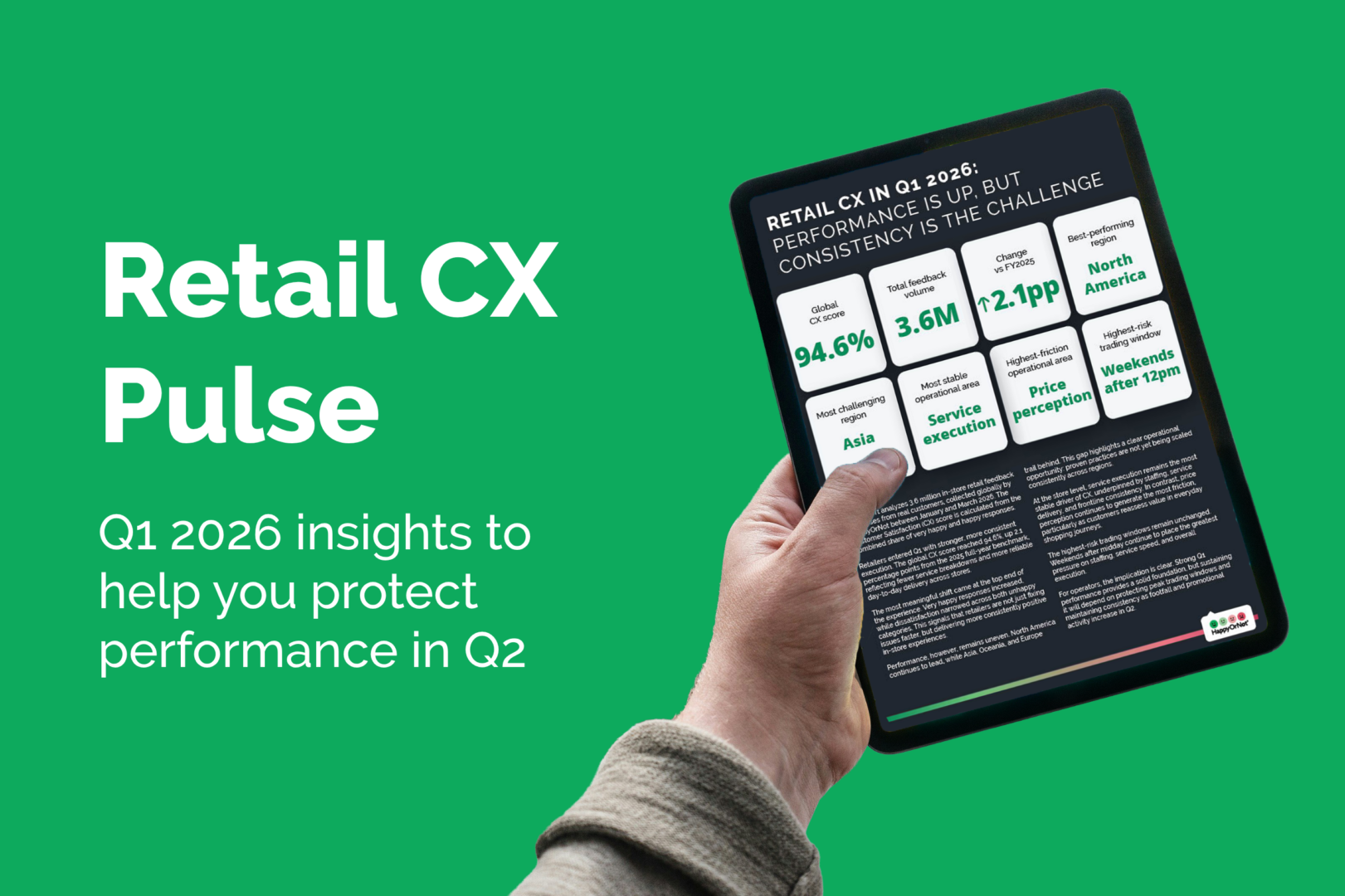
Based on 3.6 million real customer feedback signals collected globally in Q1 2026, retail customer experience is off to a strong start.
The customer satisfaction score reached 94.6%, continuing an upward trend from 2025. But a 5.8 percentage point gap between the best and worst trading hours reveals a more important truth: performance is improving, but execution is still inconsistent.
The highest-risk window remains familiar. Weekends after 12pm continue to place the greatest pressure on staffing, service speed, and overall store operations.
This is where experience starts to slip.
Stronger performance is not the same as stronger execution
At a high level, retailers are delivering better day-to-day experiences.
More customers are leaving stores satisfied, and fewer are encountering severe breakdowns. That points to stronger control over the fundamentals:
- Staffing
- Service delivery
- In-store execution
This is exactly where real-time, in-moment feedback plays a critical role in helping teams not only resolve issues faster, but reinforce what works across stores and shifts.
The gap between performance and consistency
Despite this progress, performance is not evenly distributed. Across regions, stores, and trading periods, there is still a clear gap between where CX performs well and where it starts to slip.
That gap is where operational pressure shows up, and where most retailers still have work to do.
Where CX starts to break down
Two recurring patterns continue to define retail CX:
 |
Pressure builds during peak trading windowsCustomer experience remains most vulnerable when stores are busiest and operational demands increase. |
 |
Execution gaps persist across key touchpointsEven with strong overall performance, certain parts of the journey still create friction, especially when consistency drops under pressure. |
These challenges are not new, but they remain the most important to solve.
The real opportunity: protect performance when it matters
The biggest opportunity for retail operators isn’t lifting already strong CX scores. It’s maintaining them.
Because the real risk – and the real impact – sits in the moments where execution breaks down:
- Peak hours
- Busy weekends
- High-pressure trading periods
This is where staffing, service flow, and operational discipline are most tested, and where consistency matters most.
What this means for retail teams
As the year progresses, the focus shifts from improving performance to sustaining it. That means:
- Strengthening execution during high-pressure periods
- Aligning staffing more closely with demand
- Ensuring consistency across stores and teams
Retailers that can maintain performance under pressure will be best positioned to protect both customer experience and commercial outcomes.
Access the full Q1 Retail CX Pulse
This blog highlights the key themes, but the full picture goes deeper.
In the full report, you’ll find:
- Global and regional CX benchmarks
- Operational performance across key CX drivers
- The highest-risk trading windows
- Clear priorities for the next quarter
Want the bigger picture?
For a deeper look at retail CX trends and performance drivers across the industry, get our 2025 full annual report
Final takeaway
Retail CX is improving, and that progress is meaningful. The next step is making it consistent.
The retailers who succeed are not just improving the average. They’re ensuring that strong performance holds steady, even when operational pressure is at its highest.
To see how this is being applied in practice, explore how retail operators are using real-time micro-feedback to improve execution, maintain consistency across stores, and respond more effectively during peak trading periods.
Explore our retail customer stories