10 great customer service examples and what businesses can learn from them
Great customer experience stories are easy to admire and surprisingly hard to copy. The famous examples – the airline that flies a forgotten teddy bear home, the hotel that remembers a guest’s coffee order three years later – feel like magic. The teams who created them know the truth: those moments are not luck. They come from systems, training, and a steady feed of real-time signals that tell the frontline what to do next.
This article collects ten customer service examples that have stood the test of time, then unpacks the operational ingredients behind each one. For every story, you will find what happened, why it worked, what businesses should learn, and how real-time customer feedback and microfeedback can support – or even spark – service moments like these in your own organization.
What Makes Customer Service Excellent?
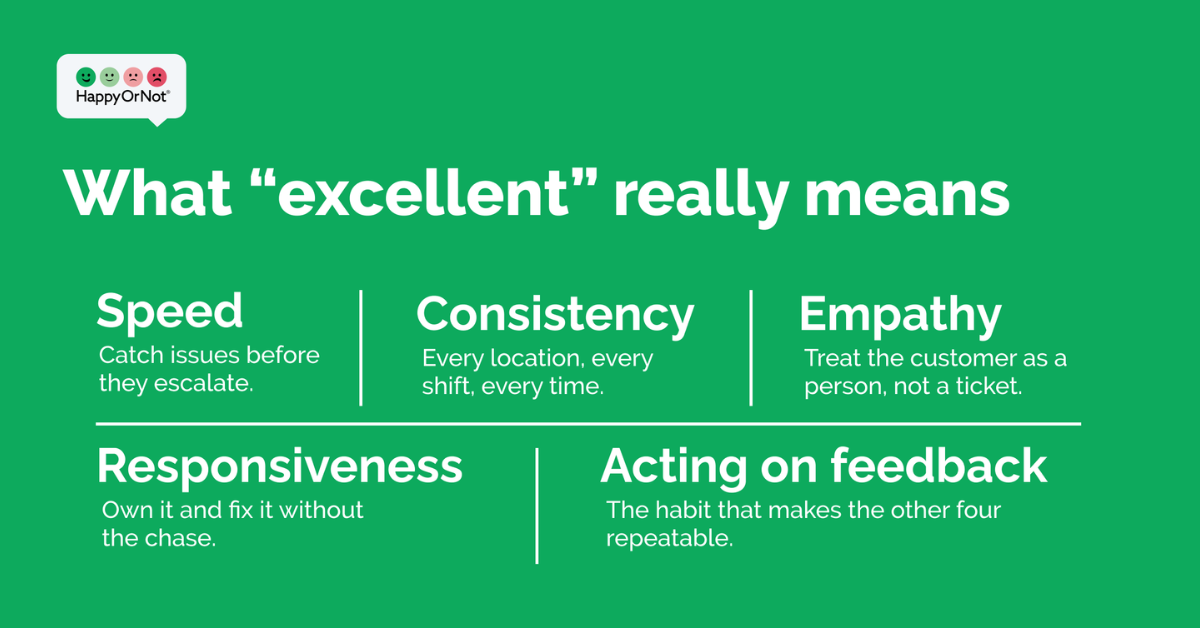
Before the examples, it helps to be precise about what we mean by “excellent.” Across industries and channels, five qualities show up in nearly every great customer service story:
- Speed. Issues are spotted and addressed quickly – often before the customer escalates.
- Consistency. The experience is repeatable across locations, shifts, and channels. One amazing visit and three forgettable ones is not great service.
- Empathy. Frontline staff treat the customer as a person, not a ticket. Tone, language, and body language all signal care.
- Responsiveness. When something goes wrong, the team acknowledges, owns, and resolves it without making the customer chase.
- Ability to act on feedback. The best teams listen to what customers tell them – directly, indirectly, and through real-time signals – and adjust on the fly.
Speed, consistency, and empathy are usually the qualities celebrated in the story. The ability to act on feedback is what makes them repeatable. According to PwC’s 2025 Customer Experience Survey, 52% of consumers have stopped buying from a brand after a bad experience – yet 89% of executives believe customer loyalty has grown in recent years while only 39% of consumers agree. That perception gap is exactly what real-time feedback is designed to close.
10 Great Customer Service Examples
1. Ritz-Carlton: every employee can spend up to $2,000 to solve a guest problem
What happened. Ritz-Carlton famously empowers every employee – from front desk to housekeeping – to spend up to $2,000 per guest, per incident, to resolve a complaint or create a memorable moment. Stories include guests receiving lost stuffed animals returned with photo albums of the toy’s “extended vacation” at the hotel.
Why it worked. Speed and ownership. The customer did not have to chase a manager. The person closest to the problem was trusted to fix it.
What businesses should learn. Empowerment without a budget is just slogans. Give frontline staff a clear authority to resolve issues, and the resolution will be faster and the customer happier.
How feedback supports this. Real-time microfeedback at checkout, reception, and key moments helps identify where those empowered actions are needed most. When a manager can see a dip in satisfaction at the breakfast service every Thursday, the next service-recovery decision is informed, not reactive.
2. Zappos: the 10-hour customer service call
What happened. A Zappos customer service representative famously stayed on the phone with a single customer for more than ten hours, helping with everything from shoe questions to a friendly chat. Zappos celebrated the call internally rather than penalizing the agent for low call-handling efficiency.
Why it worked. The company chose connection over efficiency metrics. Customers feel the difference between an agent racing to end the call and one who is fully present.
What businesses should learn. The metrics you reward shape the service you get. If average handle time is the only KPI, expect rushed conversations. Balance efficiency with quality signals.
How feedback supports this. A lightweight post-call feedback prompt – a quick rating sent by SMS, IVR, email, or a follow-up link the moment the call wraps – gives operations a richer view than any internal KPI. It adds a layer of experience quality on top of metrics like call duration: a short call with a happy customer beats a fast call with an unhappy one, and the data should show that.
3. Trader Joe’s: emergency grocery delivery to an elderly customer in a snowstorm
What happened. During a heavy snowstorm in Pennsylvania, an elderly man’s daughter called several stores to arrange grocery delivery for her father. Trader Joe’s – which does not normally deliver – agreed on the spot, suggested items that fit his low-sodium diet, and delivered them free of charge within thirty minutes.
Why it worked. A frontline employee read the situation and made a judgment call. The company did not block the action with policy.
What businesses should learn. Policies set the floor. Culture sets the ceiling. Train staff to recognize moments that justify breaking the script, and they will reward you with stories customers tell for years.
How feedback supports this. Microfeedback gathered across locations helps identify which stores already have a culture of going above and beyond – and which ones could learn from them. Real-time location-level data turns isolated wins into something coachable.
4. Lidl Sweden: real-time feedback across 210+ stores
What happened. Lidl Sweden rolled out real-time customer feedback across more than 210 stores, giving store managers a live view of customer satisfaction by location and time. Issues that previously surfaced weeks later through quarterly surveys are now visible the same day.
Why it worked. Frontline visibility. Store managers no longer wait for a report from headquarters; they see their own data and act on it.
What businesses should learn. Multi-location operations cannot rely on enterprise averages. Each store is a local business, and managers need local signals.
How feedback supports this. This is the feedback model. Real-time microfeedback at the point of service, role-based dashboards for each store manager, and alerts when an issue is emerging – not after the customer has already left a one-star review online.
5. Apple Store:theGenius Bar walk-in experience
What happened. When a customer walks into an Apple Store with a problem, the Genius Bar process is built around acknowledgment, diagnosis, and resolution in a single visit. Even when a device cannot be fixed on the spot, the customer leaves with a clear next step.
Why it worked. Predictability. Customers know what to expect every time, in every store, in every country. That consistency builds trust.
What businesses should learn. Service excellence at scale requires process design. The “magic” of an Apple Store visit is actually choreography rehearsed thousands of times.
How feedback supports this. When the process is standardized, microfeedback at the end of the visit shows where the choreography is breaking down. A spike in “not happy” taps at one store on Saturday mornings is a coaching opportunity, not a mystery.
6. daa(Dublin and Cork airports): turning wait-time complaints into operational decisions
What happened. daa – the airport authority that operates Dublin and Cork – uses real-time feedback at security, retail, and arrivals to monitor passenger experience minute by minute. When satisfaction dips, supervisors are alerted and can reallocate staff to the affected area.
Why it worked. The feedback is tied to specific moments and locations. A 4-star average across the whole airport is a number; a satisfaction dip at security lane 3 on Tuesday at 6 a.m. is a decision.
What businesses should learn. High-traffic environments need granular signals. Aggregate metrics hide the issues that matter most to the customer in the moment.
How feedback supports this. This is the textbook signals → coaching → improvement loop. Smiley Touch™ kiosks at each touchpoint, alerts to the right manager when satisfaction drops, and a culture of acting on signals quickly.
7. Amazon: proactive refunds before customers complain
What happened. Amazon has repeatedly issued refunds and account credits before customers noticed an issue – for example, when a video stream stuttered or a delivery arrived a day late. The customer often discovers the problem and the resolution in the same email.
Why it worked. Proactive service inverts the usual dynamic. Instead of waiting for the customer to chase, the business gets ahead.
What businesses should learn. You do not have to wait for complaints. If you have the signal that something went wrong, the most loyalty-building thing you can do is act first.
How feedback supports this. Microfeedback is that signal for in-person service. A dip in satisfaction at a particular branch is the equivalent of Amazon’s buffering data – proof that something happened, and a prompt to do something about it before the customer escalates.
8. Nordstrom: the tire return
What happened. A customer in Alaska returned a set of tires to Nordstrom – a retailer that has never sold tires. The store accepted the return and refunded the customer in full. The story has been told for decades as shorthand for service culture.
Why it worked. A simple, no-questions-asked return policy backed by trust in frontline staff. The cost of one pair of tires is a rounding error compared to the marketing value of the story.
What businesses should learn. Policies that make customers prove they deserve good service cost more, long term, than the occasional generous exception.
How feedback supports this. Microfeedback at return desks and exit points tells you whether a generous policy is being delivered with a smile or a sigh. The policy is only half the story; the delivery is the other half.
9. Nature’s Way Foods: lifting colleague satisfaction 34.5% to improve customer outcomes
What happened. A large food manufacturer used real-time feedback from its workforce to boost colleague satisfaction by 34.5%. Engaged colleagues delivered better customer outcomes downstream – fewer errors, better service, more consistent quality.
Why it worked. Customer experience and employee experience are linked. Microsoft research on frontline workers has consistently shown that empowered frontline teams produce better customer outcomes – but they need the right tools and a voice in the system.
What businesses should learn. You cannot deliver excellent customer service through demoralized staff. Start by listening to your own people.
How feedback supports this. The same microfeedback infrastructure that captures customer sentiment can capture employee sentiment – anonymously, at the moments that matter, and frequently enough to spot trends before they become turnover problems.
10. The independent café that remembers your order
What happened. You walk into a small café for the second or third time and the barista starts your usual order before you reach the counter. It is the simplest customer service example in the world – and one of the most powerful.
Why it worked. Recognition. Being known is one of the strongest drivers of repeat business in any category.
What businesses should learn. You do not need a global enterprise to deliver excellent customer service. The fundamentals – speed, empathy, attention – work at any scale.
How feedback supports this. At enterprise scale, you cannot rely on baristas’ memories. You can, however, build systems that mimic the effect: location-level feedback, named regulars in your loyalty data, and dashboards that highlight which moments matter most to your most valuable customers.
How real-time feedback improves customer service
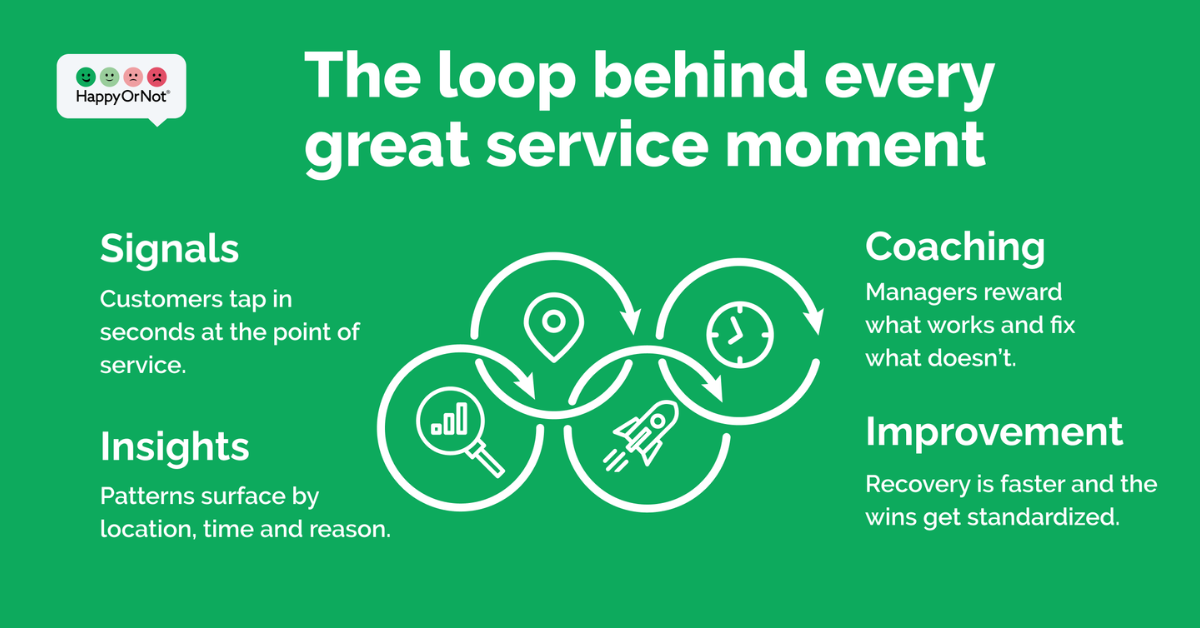
Look at the ten examples above and you will see a pattern. The best stories are not random acts of kindness. They are systems that put the right information in front of the right person at the right moment – and trust that person to act. Microfeedback is the connective tissue. It runs on a simple loop:
- Signals. Customers tap a smiley or leave a short comment at the point of service. Volume is high, friction is low.
- Insights. AI-powered analytics surface patterns by location, time, and reason – so a store manager sees that satisfaction always dips at 4 p.m. on Fridays.
- Coaching. Frontline managers use the data to coach individual team members, reward what is working, and address what is not.
- Improvement. Issues are fixed faster, recovery happens sooner, and the wins are standardized across the business.
That loop is what separates a service culture from service theater. It also turns the “great customer service story” from a once-a-year miracle into a repeatable operational outcome.
 Common customer service mistakes businesses make
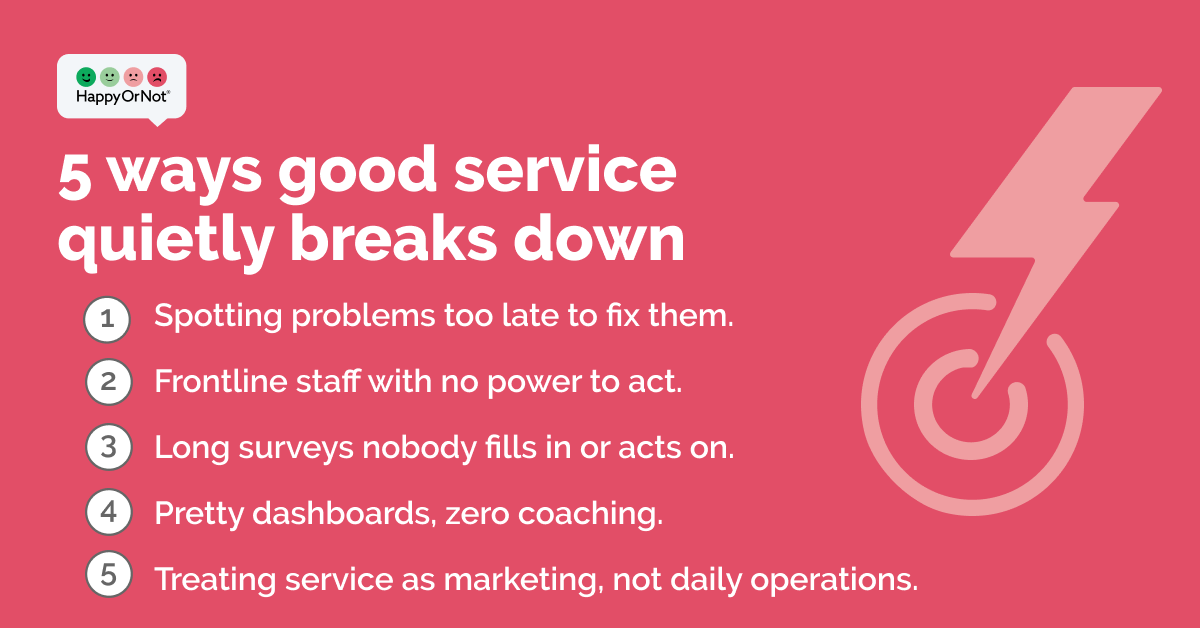
For every story of excellent service, there are dozens of avoidable failures. The most common patterns:
- Waiting too long to identify problems. If your earliest signal that customers are unhappy is a one-star online review, you are already losing them. By the time the survey arrives in their inbox, they have moved on.
- Lack of ownership at the frontline. When frontline staff cannot resolve an issue without escalating, the customer feels passed around. Empowerment without authority is not empowerment.
- Generic surveys with no follow-up action. Long, infrequent surveys generate low response rates and even lower action rates. Customers stop responding when they sense the data is not being used.
- Reporting without coaching. Beautiful dashboards that no manager opens are not insights. Data has to lead to a conversation and a behavior change to count.
- Treating customer experience as marketing. Service is an operational function delivered every day at the frontline. Marketing can communicate the promise, but operations has to deliver on it.
Key takeaway
The best customer service examples all share the same quiet ingredients: clear authority at the frontline, a culture that rewards going beyond the script, and a steady stream of real-time signals that tell teams what to do next. The famous moments are the tip. The system underneath is the iceberg. If you want excellent service to become a habit rather than a story, invest in the system: empower your people, listen continuously, and build a feedback loop tight enough that every great story is just another Tuesday.