Mythbusting real-time microfeedback: What Smiley feedback kiosks really tell you
Customer experience (CX) rarely fails because of one big moment. It slips through repeated everyday friction: a queue that builds, a lack of help at the wrong time, a restroom that falls behind cleaning, or a confusing self-checkout.
Those are operational problems, and they need operational signals.
That’s where microfeedback changes the game. It captures sentiment in the moment, at the point of experience, and turns it into something teams can actually act on.
Yet despite its widespread use, misconceptions still exist. Let’s break down the most common myths – and what’s actually happening behind the Smiley buttons.

Myth 1: ‘Nobody looks at the data’
Real-time feedback only works when it’s owned, visible, and acted on.
Teams ignore feedback when it feels like a report that belongs to “someone else.” The difference is not the button. It is how the signal is used.
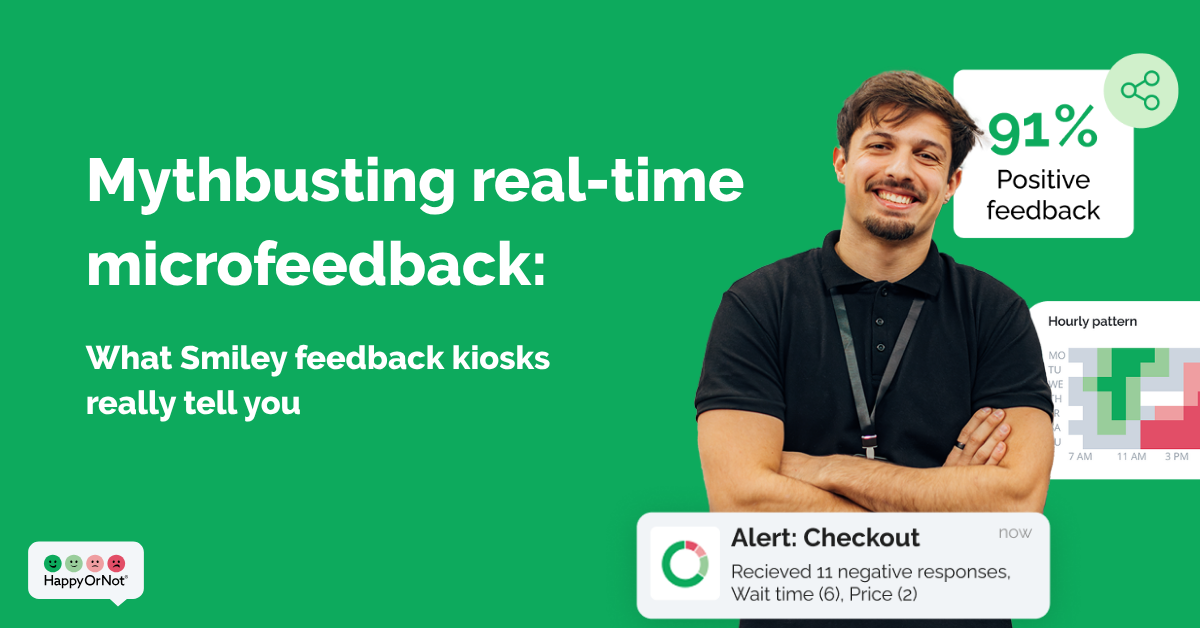
When feedback is visible in the same window where the work happens, it becomes a live input for running the business. The operational version looks like this: managers check trends, supervisors spot dips, and teams act while the shift is still in motion.
Just as importantly, the data has a clear owner. Each location, team, or function knows what they are responsible for and what they can influence. That is what turns feedback from something abstract into something actionable.
This is where microfeedback moves beyond “CX reporting” and becomes an operational tool. When teams can see and act on feedback in real time, they don’t ignore it but instead rely on it.

Myth 2: ‘These buttons only capture complaints’
Microfeedback captures the full reality of the customer experience, not just the extremes.
Unlike reviews and long-form surveys which often skew toward customers who are very unhappy or very delighted, one-tap feedback captures the everyday majority, including the people who would never write a review.
In fact, most feedback is positive. That matters.
There’s a common assumption that people only give feedback when something goes wrong. In reality, when feedback is easy to give, people are just as willing to acknowledge a good experience.
When positive feedback is visible, it becomes a powerful tool for recognition, helping supervisors reinforce what’s working in the moment, rather than only when something breaks down.
That shift matters operationally, because it doesn’t just highlight problems. It shows teams what to repeat, scale, and protect.

Myth 3: ‘It’s not connected to anything meaningful’
The value is not only the smiley itself. It’s the operational insights behind it.
Microfeedback becomes powerful when each response is tied to a specific place and moment, turning feedback into precise, actionable signals.
That is what lets you move from “CX is down” to “departures dipped between 4 p.m. and 6 p.m. near Gate X” or “Saturday afternoons drop at Branch B but not Branch A.” That level of precision makes ownership possible.
It also changes how teams respond. Instead of reacting to general trends, they can fix specific issues, in specific locations, at the right time.
Once you see time and place, you can make better calls on staffing, cleaning cycles, queue management, and coaching. You do not need a massive transformation program to get a return on investment. You need a repeatable loop: spot the pattern, assign the fix, and validate the change.

Myth 4: ‘It’s too simple to be useful’
Simplicity is not a limitation. It’s what makes it work at scale.
Most customers will not spend time filling out a survey, but they will give you a few seconds along their way. That is exactly why short, low-effort feedback outperforms surveys in real environments.
When customers are given a neutral option, many default to it, not because they feel neutral, but because it is the easiest way to move on. Removing that option creates clearer, more decisive data.
Microfeedback is not designed to capture nuance in a single moment. It is designed to capture a reliable signal, quickly, consistently, and at scale.
Microfeedback captures clear signals at scale, allowing patterns to emerge quickly and action to follow.
When deeper insight is needed, the most effective approach is layering. Start with a one-tap signal, then offer a lightweight follow-up for those willing to share more.

Myth 5: ‘We can just survey customers later’
Delayed feedback misses the moment and the people who matter.
First, People don’t recall experiences accurately. They overweight peaks and endings and compress details. The peak-end rule is one well-known pattern in how experiences are evaluated retrospectively, which is a big reason in-the-moment capture is often more actionable than recall-based methods.
Second, surveys miss key audiences like walkaways and non-buyers. This matters because “why someone didn’t buy” is often valuable operational friction lives: Out-of-stocks, confusing navigation, no help during peak, long waits, broken self-service.
If you want to fix issues while they matter, you need feedback in the moment, not after the fact.

Myth 6: ‘The camera makes it creepy’
Designed for insight, not identity, with privacy built in from the start.
It’s a common assumption, but it’s based on how people think cameras work, not how this technology is actually designed, which was privacy-first.
Cameras were introduced to enable demographic categorization, not to record individuals. It does not take photos, record video, or store any identifiable data.
It works by instantly converting a face into a mathematical representation (a 128-dimensional vector) in real time that cannot be reverse-engineered into an image and is never stored or transmitted.
This means:
- No images are captured
- No personal data is collected
- No individual can be identified
The purpose is to improve data quality, such as filtering out non-representative inputs and enabling aggregated insights. Camera-enabled features are optional, controlled by the customer, and governed by local regulations.
The result is richer insight without compromising privacy.
Turning microfeedback into real-time action
Microfeedback delivers value when it’s embedded into daily operations.
Place feedback at moments that define the customer journey. Then build a review cadence that matches your reality.
-
- Daily: Check for spikes and dips. Route urgent issues to an owner.
- Weekly: Review patterns by location and time window. Pick one fix per site and assign it.
- Monthly: Identify repeat issues and decide whether the fix is process, staffing, training, or investment.
- Visible loop closure: Show what changed, where, and why. Make improvements visible to both staff and customers.
This is where microfeedback delivers real value: turning in-the-moment signals into consistent, operational action.
Key takeaways
- Microfeedback is not a gimmick. It is a faster input for frontline decisions.
- The value comes from context, cadence and ownership, not from the button alone.
- Optional depth beats forced questionnaires when customers are in motion.
- Treat demographics as opt-in, aggregated signals and keep governance tight.
- One fix shipped per week beats one annual report nobody acts on.
Want the full conversation that these insights came from? Listen to the full episode on the No Such Thing podcast below.